

One of the most beloved tales from Hindu Mythology that symbolizes friendship and divine compassion is the story of Krishna and Sudama. The story is found in the Bhagavata Purana, and it does not just talk about the deep bond between Lord Krishna and this childhood friend Sudama, but it also highlights the truth that God always values love over wealth.
I read this story when I was very young in a school library, and I was very recently telling this to one of our neighbor’s kids. That is when I thought I need to write about this, just the way I read and remember.
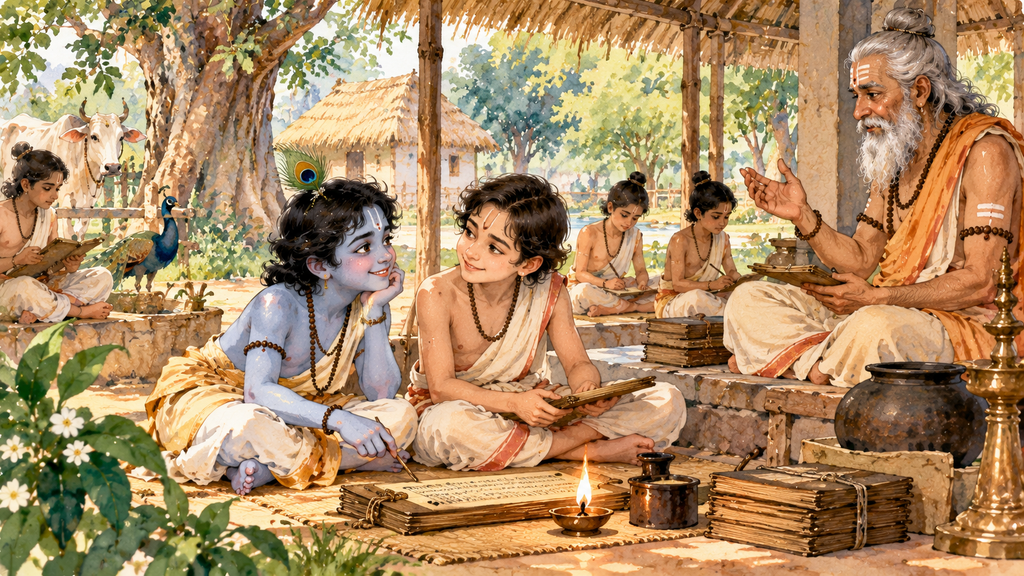
Childhood Days in Guru Sandipani’s Ashram
After Krishna’s childhood adventures in Vrindavan, he was sent to Guru Sandipani’s ashram in Ujjain for education. There, he met Sudama, a poor Brahmin boy. Despite belonging to very different social and economic backgrounds, the two became inseparable companions.
Both Krishna and Sudama learnt scriptures together, and they fetched firewood and served Guru Sandipani with sincerity. One day, both the friends were stranded in the forest. Sudama was terrified, but Krishna reassured him saying, “Do not fear, I am with you.” This moment became symbolic of Krishna’s eternal promise to protect his devotees.
Once they reached the ashram safe and sound after the storm, Guru Sandipani blessed both Krishna and Sudama that their knowledge of the Vedas would never fade.
Sudama’s Life of Poverty
Many years passed, and both Krishna and Sudama left the ashram. Krishna was now the King of Dwarka, and was already married to Rukmini, who is the goddess of prosperity, Lakshmi herself. He thus lived in splendor.
Sudama, however, lived in dire poverty with his wife and children. His family often went without food or proper clothing, but Sudama and his family remained content, immersed in devotion.
His wife, unable to watch their children suffer, finally urged him to visit Krishna, saying, “Your friend will never refuse you help.”
Though hesitant to ask for favours, Sudama agreed for the sake of his family.
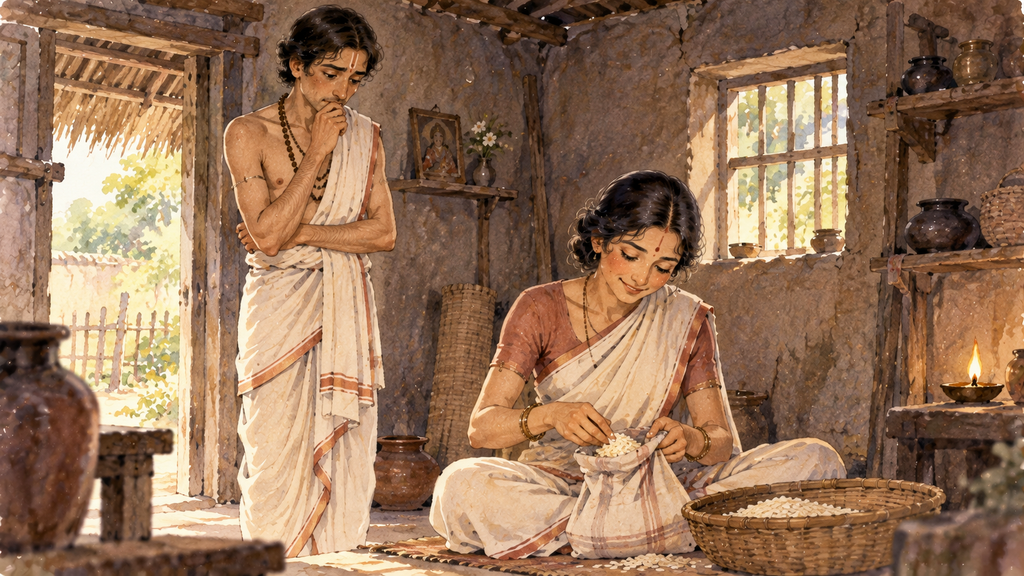
The Humble Gift of Poha
There was a tradition in the olden days that you carry a gift when you visit the house of your family or friends. In keeping with tradition, Sudama’s wife insisted he carry a gift. As they were poor and did not have anything at home, she borrowed a small handful of flattened rice (poha) from a neighbour. She then tied the poha in a piece of clean but torn cloth.
This gift, though materially insignificant, was offered with deep love, making it priceless in the eyes of the Lord.
Sudama Visits Dwarka
When Sudama finally reached Dwarka, he could hardly believe what he was seeing. The city seemed to shine from every direction. Its grand palaces, beautiful gardens, wide streets, and glittering halls were unlike anything he had ever known. As a poor Brahmin who had spent years struggling to make ends meet, Sudama felt almost out of place in such a magnificent city.
But he had not come to see palaces.
He had come to see Krishna.
With the small bundle of poha tucked away carefully in his hands, Sudama made his way toward Krishna’s palace. The humble offering embarrassed him. What could a handful of beaten rice possibly mean to a king who lived surrounded by wealth? Yet it was all he could bring, and somewhere in his heart, he remembered the days when he and Krishna had shared whatever little they had at their gurukul.
When Krishna heard that Sudama had arrived, he did not wait for his friend to be brought into the royal court.
He ran to meet him.
Krishna, the king of Dwarka, came barefoot and embraced Sudama with tears of happiness. For a moment, there was no palace, no throne, and no difference between a wealthy king and a poor Brahmin. There were simply two old friends meeting again after many years.
Krishna personally washed Sudama’s feet and welcomed him with the greatest honour. Queen Rukmini herself attended to their guest. The royal attendants watched in amazement. They could not understand why their king was showing such affection and reverence toward a man who arrived in worn clothes and carried almost nothing with him.
But Krishna saw something they did not.
He saw his childhood friend.
As they talked, memories of their days at the gurukul came rushing back. They remembered their teacher, the lessons they had shared, and the simple days when they had owned very little but had been rich in friendship.
Then Krishna noticed the small bundle Sudama had been trying to hide.
“What have you brought for me?” he asked.
Sudama felt shy. It was only poha, a simple food that poor families often ate. He had been worried that such a humble gift would seem insignificant in Krishna’s palace.
But Krishna did not see it that way.
He eagerly took the bundle, opened it, and ate the poha with genuine delight. To Krishna, the value of the offering was not in its price. It was in the love with which Sudama had brought it.
Tradition tells us that with every handful Krishna ate, blessings quietly began to enter Sudama’s life. Sudama did not ask for wealth. In fact, he could not even bring himself to ask Krishna for anything.
And Krishna did not make him ask.
While Sudama sat beside his old friend, unaware of what was happening, Krishna had already decided to change his life.
Sometimes, the greatest gifts in a friendship are the ones that are given without being asked for.
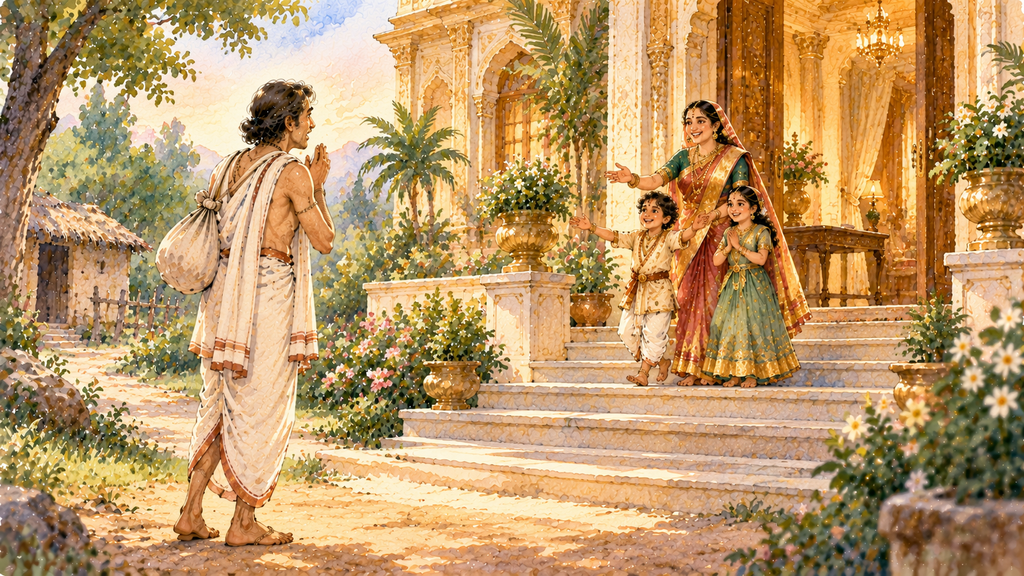
The Silent Blessing
Sudama left Dwarka with a strangely peaceful heart.
He had spent time with Krishna after so many years. Krishna had welcomed him with the same affection he had shown him as a young boy, had listened to him, embraced him, and treated him with the greatest honour. For Sudama, that reunion itself felt like a blessing.
Yet, as he walked home, he could not help thinking about his family.
He had gone to Krishna hoping, perhaps, that his friend might help him. But when the moment came, Sudama could not bring himself to ask.
How could he ask Krishna, the king of Dwarka, for wealth?
He had received something far more precious. He had been reminded that their friendship had survived years, distance, and completely different lives.
So Sudama returned home empty-handed.
Or so he thought.
As he approached the place where his humble hut had stood, Sudama stopped in confusion.
Where was his house?
In its place stood a magnificent home, surrounded by beautiful gardens and filled with light. His wife, dressed in fine clothes, came rushing toward him. Their children were surrounded by comforts they had never known before. The poverty that had once been part of their everyday life had disappeared.
Sudama stood there, overwhelmed.
He had asked Krishna for nothing.
He had not even spoken about his troubles.
And yet Krishna had understood everything.
The story does not present Sudama’s transformation simply as a reward for giving Krishna a handful of poha. The deeper meaning lies in the friendship between the two. Sudama offered what little he had with love, and Krishna received it with joy. Sudama could not ask for anything in return, and Krishna gave without waiting to be asked.
That is why the story of Sudama and Krishna has remained so beloved for generations.
It reminds us that devotion is not always about asking for what we want. Sometimes, it is about offering what we have with a sincere heart and trusting that we are understood.
Sudama went to Krishna carrying a small bundle of poha.
He returned carrying something much greater: the quiet assurance that he had never been forgotten.
Symbolism and Untold Facts
- True Friendship: Their bond proves that love and loyalty transcend status or wealth.
- Sudama’s Humility: Unlike others, Sudama never sought material favours and that humility itself drew divine grace.
- Rukmini’s Role: Some versions suggest Rukmini encouraged Krishna to accept the poha, showing that even Goddess Lakshmi values pure devotion over riches.
- Poha as Symbol: Flattened rice, a simple food of the poor, symbolizes sincerity and humility in offerings.
- Lesson in Bhakti: Sudama represents bhakti yoga, devotion without expectation.
Legacy of Krishna and Sudama’s Story
The Krishna and Sudama friendship story remains a favourite among devotees. It is sung in bhajans, enacted in plays, and remembered in temples across India.
It continues to inspire us with its timeless truths:
- God treasures love over luxury.
- Friendship built on trust never fades.
- Devotion without asking is rewarded abundantly.
This story of Krishna and Sudama in Dwarka is more than just mythology, it is a spiritual guide for all who believe in friendship, humility, and the grace of God.