

This is a quiet little story about two sisters who were also goddesses, Joy and Luck. This is also a story about the difference between being kind to someone and actually changing their life. It sounds like it should be the same thing. This story is about why it isn’t.
✦ ✦ ✦
One day, the deities of Joy and Luck were wandering together over the land, as they sometimes did, looking in on the lives of ordinary people. And their travels brought them into a certain town.
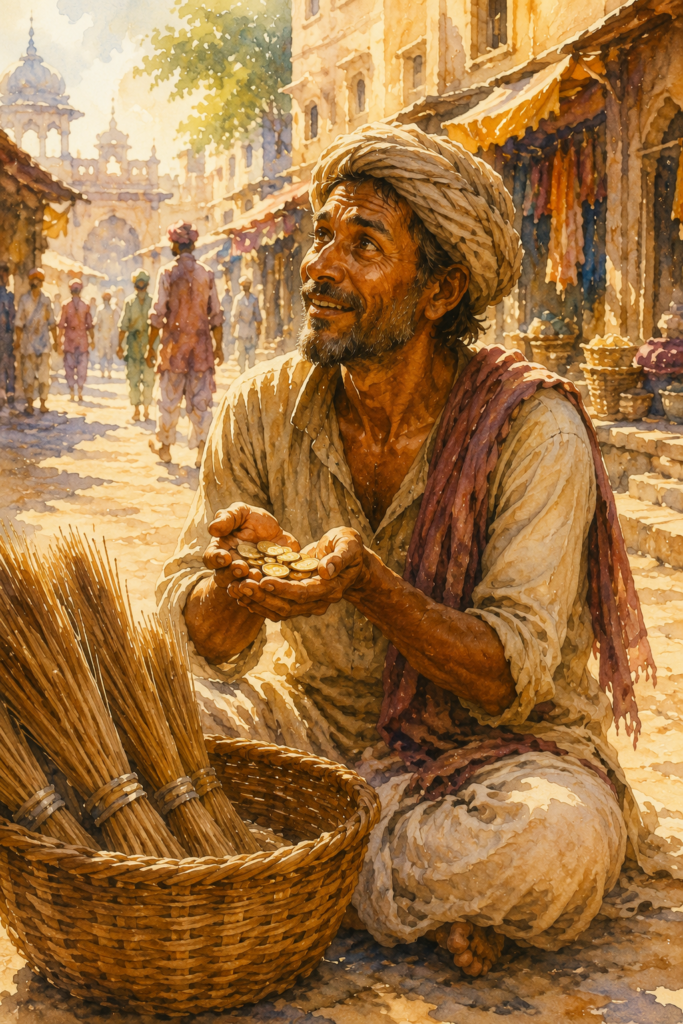
There, in the street, they saw a very poor man selling brooms. He sat on the ground with his small bundle of them, calling out to passers-by, hoping someone would stop. By his clothes and his thin face, it was plain he had very little, and that the brooms were all that stood between him and nothing at all.
Joy, who was tender-hearted, and who could not bear to see suffering pitied the man at once. She wanted to help him. So, she went to him and bought every single broom he had, and she paid him twice what they were worth. The poor man could hardly believe his good fortune. Twice the price, and his whole stock sold in a moment! The two sisters went on their way, and Joy felt warm and pleased with herself for the good she had done.

Sometime later, the sisters happened to pass through that same town again. And Joy looked for the man she had helped, expecting to find his life improved.
He was still there. Still sitting in the same spot in the street. Still selling brooms.
Joy was sorry to see it, she felt she had failed him somehow. So, this time she went to him and bought all his brooms again, and paid him even more. Four times their value, she gave him. Surely that much money would set him on his feet.
More time passed. And once more, the two sisters came to that town. And there he was. Still in the street. Still with his miserable little store of brooms. Still exactly as poor as the first day they had laid eyes on him.
And this time, Joy was not tender. She was annoyed. “What a fool I have been,” she said. “Twice I have helped this man, paid him far more than his brooms were ever worth and here he still sits, no better off than before. He doesn’t deserve any help. I am finished with him.”
Her sister Luck had watched all of this quietly. “Watch me help him,” she said.
What Luck Did
And here is the part of the story worth slowing down for, because what Luck did looked, at first, like the opposite of help.
She went to the broom-seller, and she bought all his brooms, but she paid him only the normal price. Not twice. Not four times. The plain, ordinary, fair value of the goods, and not a coin more. Then the two sisters left the town, and Joy could make no sense of it at all. Her generous gifts had done nothing. What could a simple fair payment possibly do that doubling and quadrupling the price had failed to do?
She would find out on their next visit.
But let us stay a moment with the broom-seller, in the days after Luck’s visit, because that is where the real story lives.
Something was different this time, and it took him a little while to understand what. When Joy had overpaid him, he had felt, each time, a rush of relief and gratitude, followed, soon enough, by the old helplessness returning. Because he had come to think of those coins as a gift. A stroke of good fortune. Something that fell on him from outside, that he had done nothing to earn and could do nothing to repeat.
And so, when the money was spent, he was exactly where he had started, sitting in the street, waiting, hoping that another kind stranger might happen along. The overpayment had eased his hunger for a few days, but it had left him a beggar in his own mind, dependent on the next act of pity to survive.
But the fair price was different. The fair price was not a gift. It was a transaction. It said, quietly but unmistakably: your brooms are worth this. Your work is worth this. You made a thing, and it sold, at its honest value, the way any tradesman’s goods sell.
And for the first time, the poor man did not feel like a beggar who had been pitied. He felt like a seller who had made a sale.
And that small shift changed the way he thought about everything.
If his brooms sold at a fair price, he thought, then perhaps the thing to do was not to sit and wait and hope, but to get more brooms. To sell more of them. To buy the materials, to make them in greater number, to take them where more people passed and more people would buy. The money in his hand was not a rescue that would run out. It was a beginning that he could build upon. It was capital.
He stopped thinking like a man waiting to be saved, and started thinking like a man with a business.
He took the fair payment and he bought more materials, and he made more brooms, and he sold those, at a fair price, and used what he earned to make still more. And slowly — not overnight, but steadily, in the way that real things grow — he began to prosper. He was no longer a poor man hoping for a kind stranger. He was a tradesman, building something of his own, one honest sale at a time.
When the two sisters next came to that town, they went up the main street and saw a cart coming toward them, piled high with sacks of grain. And the man driving the cart, prosperous and upright and busy about his affairs, was none other than the broom-seller.
He had done so well selling brooms that he had branched into trading grain. The thin, hopeless man who had sat in the street for years was now a merchant with a loaded cart and a living of his own.
Joy stared, unable to understand it. She had given him so much, and it had come to nothing. Luck had given him so little, and it had come to this.
And Luck explained it to her, gently, in the two lines that are the whole heart of this old story.
“You only ever showed him joy in selling brooms, sister,” said Luck. “A good day, a full pocket, a moment of relief, and then it was gone, and he was waiting for the next one. But I got him interested in the doing of the thing itself. I made him a tradesman instead of a beggar. And so, he has prospered.”
✦ ✦ ✦
What I love about this little story is that it doesn’t make Joy the villain. Her heart was in exactly the right place, and her gifts fed a hungry man more than once. But the story gently points out something we don’t always want to hear, that the kindest-feeling thing and the most genuinely helpful thing are not always the same.
But it was Luck who actually changed his life, by doing the less dramatic thing, and believing he could do the rest himself. I try to remember that, whenever I want to help someone. Sometimes the best help doesn’t look or feel like help at all. It looks like respect.
MORE FOLK TALES
Bhagya aur Parishram— A Story About Luck and Hard Work
The Rupee Tree — A Story About Honest Wealth
The Frog and the King — A Story About Seeing Worth in the Lowly
Have you ever been helped most by someone who simply believed you could do it yourself? Share this gentle little story with someone who needs it — and explore more folk tales on Fables n Tales.