

Here is a short one, and a sharp one, the kind of story that takes about three minutes to tell and then sits in your head for a good deal longer. It is about a king who did not think before he acted, and the ordinary man who taught him, in front of his whole kingdom, exactly why he should.
✦ ✦ ✦
There was once a king who was rash and hasty by nature. He simply was not built for reflection. He never paused to weigh a thing before he did it, never sat with a decision to let it settle. Whatever occurred to him, he acted on at once and being a king, whatever he acted on, happened.
Now one morning, everything seemed to go wrong for him at once.
It began with the royal barber, who, while shaving the king, slipped and nicked his chin. A small thing, a little cut, a bead of blood but an irritating way to start the day.
A short while later, the royal stables caught fire. And in the blaze, the king’s favourite horse, a magnificent animal he loved above all the others in his stables was burnt to death.
And then, before the king had even recovered from that, a messenger arrived with worse news still. One of the king’s great ships, laden with goods, had sunk at sea. Lost, cargo and all, to the bottom of the ocean.
A cut, a dead horse, a sunken ship — all before the morning was even properly begun.
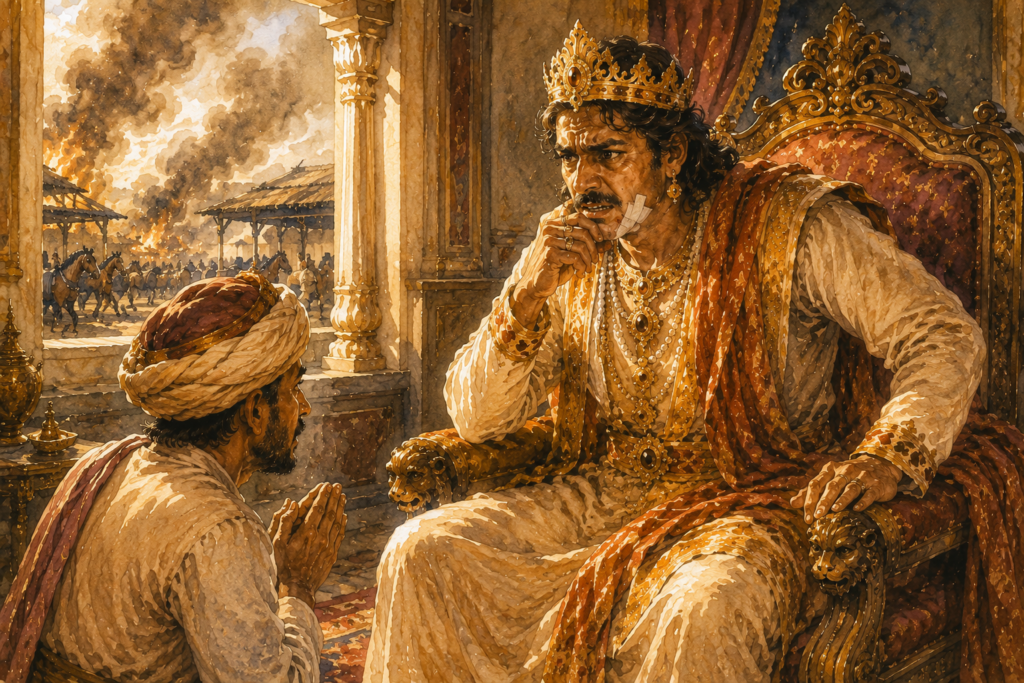
The king sat there, rattled and angry, and instead of asking himself the sensible question — how do I deal with all this? — he asked himself a foolish one.
“Whose evil face,” he wondered, “did I look upon first this morning, that I should be cursed with all these calamities before noon?”
Because that was the sort of thing people believed in those days — that some people carried bad luck in their very faces, and that to see such a face first thing in the morning was to doom your whole day.
And the king thought back. And he remembered that earlier, before dawn, while out walking, he had passed a washerman on the road. The washerman’s had been the first face he saw that day.
Well. That was enough for a hasty king.
“Seize that wretched washerman,” he ordered his men, “and hang him — for all the misfortune he has brought down on me today.”
✦ ✦ ✦
And so the poor washerman, who had done nothing that morning but walk to his work, and had no idea he had even been seen by the king was dragged from his home, tried, and sentenced to hang. Just like that. A man’s life, ended before lunch, because a king had a bad morning and needed someone to blame for it.
The whole town gathered to watch the hanging, the way crowds do.
And at the very last moment, with the noose ready, the washerman asked if he might say one thing to the king before he died. A final appeal. The king, who could afford to be generous now that he had his scapegoat, allowed it.
“Well,” said the king. “What is it you want to say?”
And the washerman looked up at him, and said the thing that would be repeated in that kingdom for a hundred years afterward.
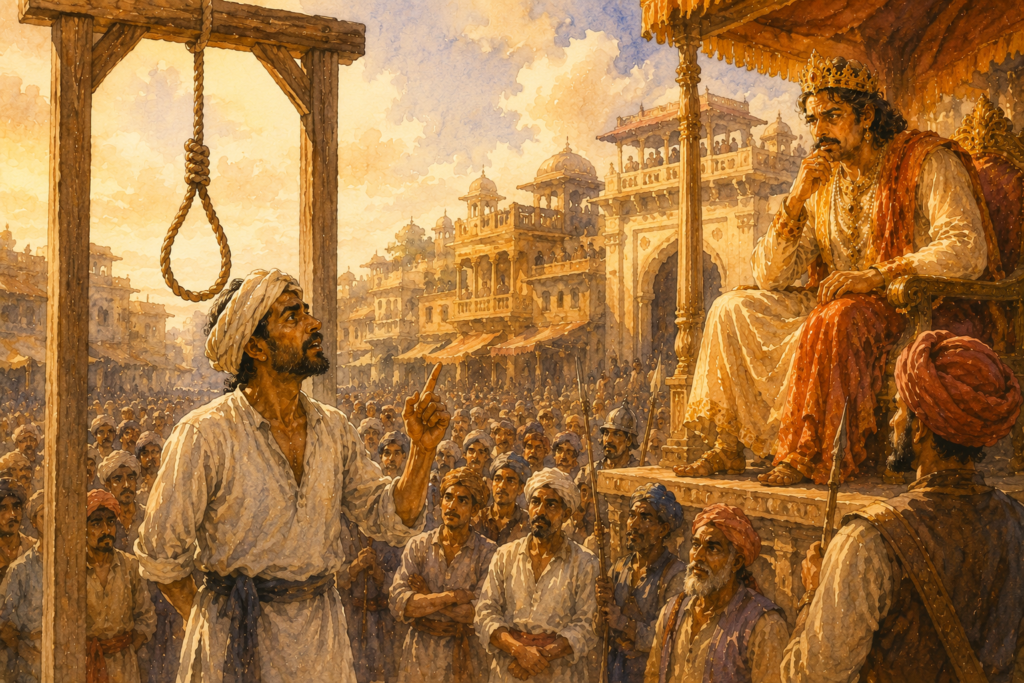
“Sire — this morning, you looked upon my face first, and see what has happened to you. A cut on your chin, your finest horse dead, a ship at the bottom of the sea. But Sire — I looked upon your face first this morning too. And look what I am getting.”
There was a silence in the crowd. And then, I imagine, a ripple of something dangerous close to laughter.
Because the washerman was exactly, unarguably right. If seeing an unlucky face first thing in the morning brought disaster, then whose face had been more disastrous to look upon that day? The king had seen the washerman and lost a horse and a ship. The washerman had seen the king and was about to lose his life. By the king’s own logic, it was the king who had the cursed, unlucky face, not the washerman at all.
The king stood there, put to shame before his entire kingdom, caught out in his own foolishness by a man he had been about to kill for nothing.
He cancelled the punishment on the spot. The washerman went free.
And from that day on, the story says, the king never again rushed to a hasty conclusion. He had learned his lesson in the most public way a king possibly can with the whole town watching, from the mouth of a condemned washerman with nothing left to lose and nothing but the truth to offer.
MORE FOLK TALES
The Eight Dwellers in the Human Body
The Frog and the King — A Story About Seeing Worth in the Lowly
The King and the Mukhiya — A Story About Anger and a Wise Minister
Have you ever watched someone rush to blame the nearest face? Share this quick, clever little story with them — and explore more folk tales on Fables n Tales.