

Have you ever come across someone who finds a sneaky little loophole, technically true, but completely unfair and uses it to take advantage of someone else?
This next story is about exactly that. And it has one of the most satisfying endings of any Akbar-Birbal tale, because the trick gets turned right back around using its own logic.
Let me tell you about the well that belonged to one man, and the water that supposedly belonged to another.
A Fair Deal — Or So It Seemed
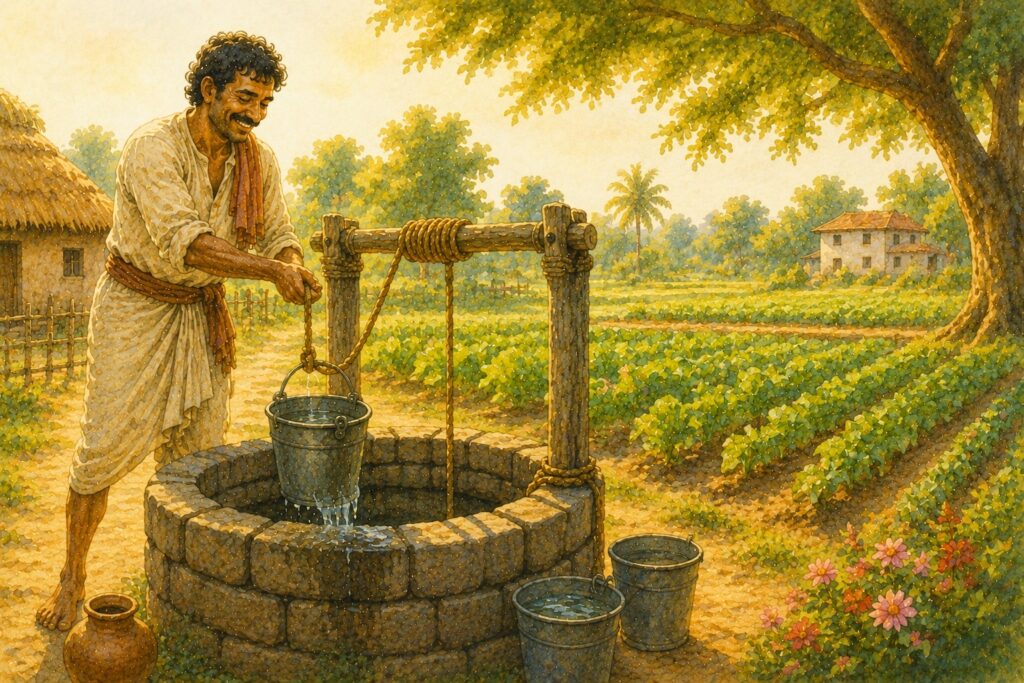
In a small village, there lived a wealthy landowner who owned a well. Nearby lived a poor farmer who desperately needed water for his fields. So the farmer did the sensible thing, he bought the well from the landowner, paid him a fair price, and went home feeling rather pleased with himself.
The very next morning, bright and early, he came to the well with his buckets, ready to start watering his crops.
But just as he lowered his bucket in, the landowner appeared at the edge of the well smiling in a way that should have made the farmer suspicious immediately.
“I Sold You the Well. Not the Water.”
“Stop right there,” said the landowner. “What exactly do you think you’re doing?”
“Drawing water,” said the farmer, confused. “From my well.”
“Your well, yes,” the man said smoothly. “But I only sold you the well, my friend not the water inside it. The water is still mine. If you’d like to use it, you’ll need to pay me. Separately.”
The farmer just stood there. The whole point of buying the well was to get water! But the landowner wouldn’t budge, he’d sold the well, not the water, and as far as he was concerned, that was that.
With nowhere else to turn, the farmer made his way to Akbar’s court.
Birbal Steps Forward
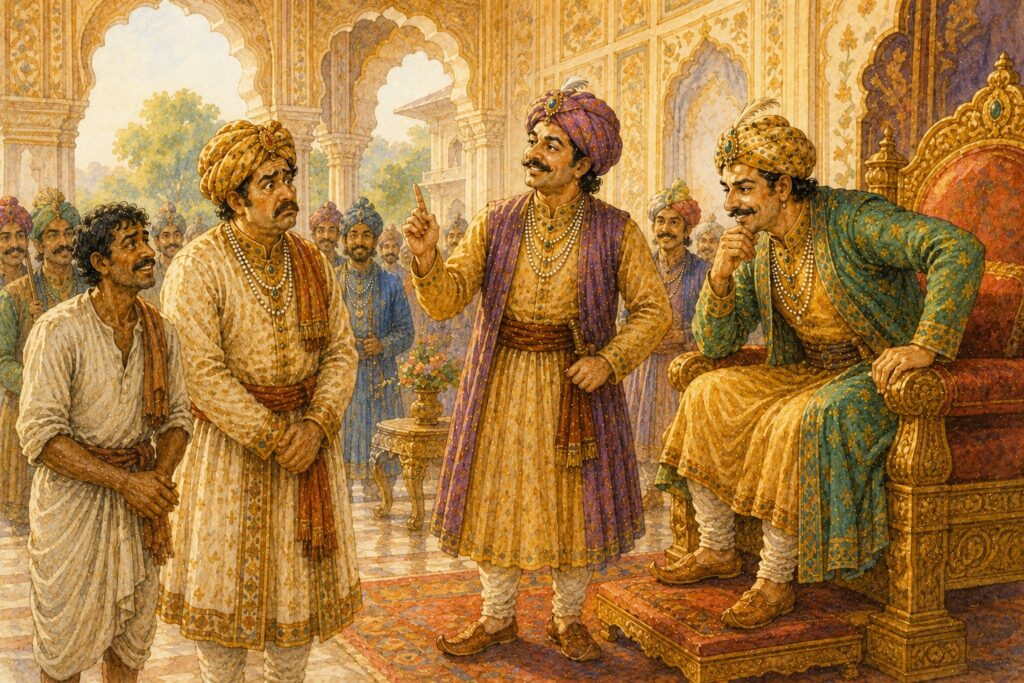
Akbar listened to both sides and, for once, found himself a little stuck. Technically, the landowner’s argument made sense. But it was also clearly, deeply unfair. Was there even a way out of this?
That’s when Birbal stepped forward.
He turned to the landowner. “Just to be clear, you’re saying you sold the well, but the water inside it still belongs to you?”
“That’s correct,” said the man, smiling again.
“Well then,” said Birbal, “that’s actually quite simple. If the water is yours and it’s currently sitting inside someone else’s well, then your water is sitting in the farmer’s property, as the well belongs to him. This is without his permission. So, you have two choices. Either remove every single drop of your water from his well, right now. Or, if you can rather leave it there, you’ll need to pay him rent. For storing your water in his well.”
The Smile Disappears
The whole court burst out laughing. The landowner’s smug little smile vanished completely. He looked left, he looked right, but there was simply no way out. He couldn’t scoop all his “water” out of the well. And he certainly didn’t want to start paying rent for it.
He had no choice but to give in. He admitted that, yes, fine, the sale included the water too. And the farmer walked home with his well, his water, and his buckets — exactly as it should have been from the start.
What I love most about this story is that Birbal doesn’t break any rules to fix things. He doesn’t shout, or accuse, or even argue, really. He just takes the landowner’s own argument and gently walks it forward, one step at a time, until it folds in on itself.
It’s the kind of justice that doesn’t need to raise its voice. It just needs to keep asking, calmly: “So… if that’s true, then surely this must also be true?”
The Psychology of the “Reductio ad Absurdum”
This is such a brilliant verdict and holds well from a legal standpoint as well. Birbal here uses a classical logical technique known as “reductio ad absurdum”. In simple terms, it is reducing an argument to absurdity. He not only accepted the landowner’s malicious loophole as the truth but also forced him to accept the logical consequence of this own rule by asking him to pay the rent for storing the water.
This story teaches a very powerful lesson about legal integrity, which states that rules that are applied without common sense or fairness will eventually fold in on themselves.
Read More Akbar Birbal Stories
Did this verdict satisfy you as much as it did the farmer? Share it with someone who loves a good story about fairness and explore more tales from Akbar’s court.
Sources & Cultural Context
The narratives in our Akbar-Birbal series are adapted from historical court records and regional oral traditions:
Historical Basis: Court accounts of the Mughal Empire, documenting the real-world relationship between Emperor Akbar and his counselor Mahesh Das (popularly known as Raja Birbal).
Literary Traditions: Classical regional folklore compilations and traditional oral retellings passed down through generations across the Indian subcontinent.