

The Mahabharata is remembered for its great confrontations. The dice game. The battlefield of Kurukshetra. The Bhagavad Gita. These are the moments that have been told and retold across centuries.
But the Aranyaka Parva, holds something quieter and in many ways more extraordinary. A conversation between two women, alone in the forest, about love. About what it takes to hold the devotion of a person you love. About the difference between service and sacrifice.
It is one of the most human passages in the entire Mahabharata. And it is almost never discussed.
The Forest of Kamyaka
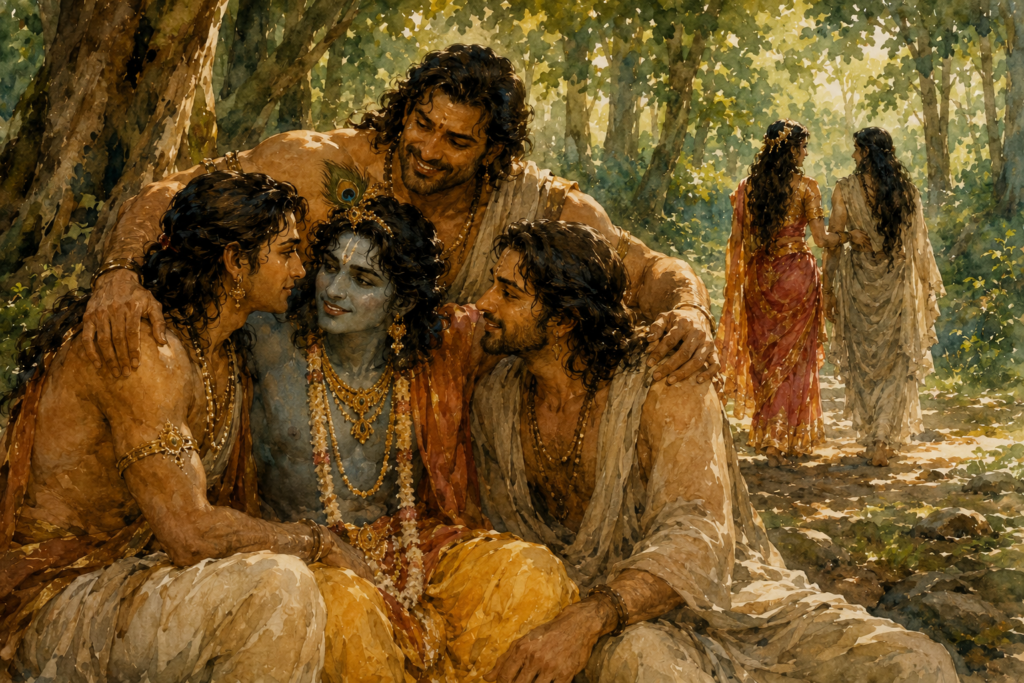
This is the Vana Parva — the twelve long years of the Pandavas’ exile. They were living in the forest of Kamyaka, far from Hastinapura, stripped of everything they had once possessed. Yudhishthira, Bhima, Arjuna, the twins — living simply, in bark garments, waiting.
Krishna and Satyabhama made the journey from Dwarka to visit them.
The significance of that visit deserves a moment of consideration. The Pandavas had lost their kingdom, their wealth and their standing. They were in a forest. And Krishna — the most powerful king among the Yadavas, a man whose presence commanded every room he entered — came to sit with them in that forest. Not to strategise. Not to promise war on their behalf. Simply to be present with people he loved in the lowest period of their lives.
Satyabhama came with him. She who was accustomed to palaces and the Parijata tree in her courtyard, now sitting in the same clearing as a queen in exile.
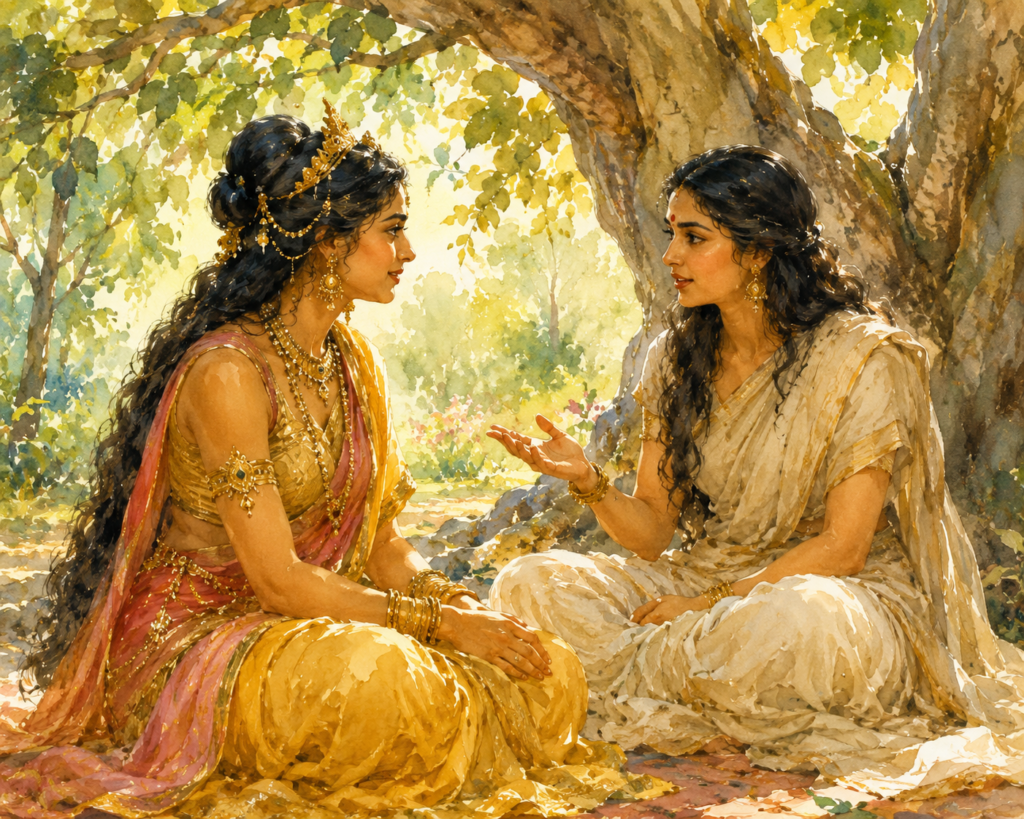
At some point during that visit the two women found themselves alone — Draupadi and Satyabhama — under the trees. And a conversation began that the Mahabharata thought worthy of recording in full.
The Question Satyabhama Asked
It was Satyabhama who spoke first. And what she asked was this:
“Draupadi — what is your secret? How do you hold the love and the respect of your husbands? What do you do and what do you refrain from? Tell me honestly.”
The remarkable thing about this question is not the question itself — it is who is asking it.
This is Satyabhama. A woman of extraordinary pride and self-assurance. The queen who had demanded an entire tree uprooted from heaven because one flower was not enough. The woman whose love for Krishna was fierce and total and entirely unafraid of itself. She was not, by nature, someone who asked for guidance on how to love.
And yet she sat down in a forest across from a woman who had lost everything — her kingdom, her comfort, her dignity in that court — and said: you know something I need to understand. Teach me.
That willingness, from someone whose pride was so much a part of her identity, is itself a kind of wisdom. The recognition that strength in one area does not mean mastery in all areas. The humility to seek understanding from an unexpected source.
What Draupadi Said
Draupadi answered with complete honesty. She was not a woman who softened difficult truths or offered reassurance for its own sake.
She spoke of attending to her husbands’ needs with care and attentiveness — knowing each man’s specific preferences, what he needed at the end of a difficult day, what words helped and what words harmed. She spoke of discipline in her own conduct — not lingering in conversation with other men that could be misread, not competing with her husbands for recognition in public, not allowing anger to make her speak in ways she would regret.
And then she said something that lies at the heart of the entire exchange:
“I do not serve out of compulsion or calculation. I serve because I have chosen to. That choice — made freely, with full understanding of what it requires — is what transforms service into devotion. The action may look the same from the outside. The inner state is entirely different.”
She was drawing a distinction that is both ancient and entirely contemporary. The difference between doing something because you feel you must and doing the same thing because you have consciously chosen to. Between love as obligation and love as commitment. Between duty performed under pressure and duty embraced as an expression of who you are.
The Part About Pride
Draupadi also spoke about a specific quality of pride — the kind that keeps a careful account of every slight, that would rather be right than remain close, that cannot set aside its own sense of injury in service of something larger.
She said she did not carry that kind of pride into her relationships. Not because she lacked self-respect, but because she understood the difference between the pride that protects your dignity and the pride that quietly destroys everything around it.
This was not abstract philosophy. Both women understood that this particular observation was pointed. Satyabhama’s pride was legendary — it was one of the most recognisable things about her. And Draupadi was naming, with the honesty of a real friendship, the specific thing that pride unexamined tends to cost.
Two Women Whose Lives Could Not Have Been More Different
What makes this conversation remarkable is the contrast between the two women having it.
Satyabhama had come from Dwarka — from a palace, from wealth and abundance, from a husband who had literally gone to war in the sky because she asked for a tree. She had never known exile. She had never been publicly humiliated. She had never sat in a courtroom and heard herself discussed as property.
Draupadi had endured all of that. The dice game. The attempted disrobing before the assembled Kuru court. Twelve years in a forest in bark garments. She had held together five very different men through the worst years of their lives, maintaining her dignity through every humiliation with a quality of self-possession that the Mahabharata clearly regards as extraordinary.
And the Mahabharata records their relationship not as formal or distant but as genuine warmth. They visited each other. They confided in each other. They were, in an epic largely concerned with the alliances and conflicts of men, two women who had chosen to be honest with each other across the considerable distance of their very different circumstances.
Why the Mahabharata Preserved This
The Aranyaka Parva records this conversation without comment. It does not frame it as instruction or lesson. It simply sets down what two women said to each other in a forest, and trusts the reader to understand its significance.
What Draupadi describes is ultimately a philosophy of relationship. That love sustained over time requires not just feeling but conscious, repeated choice. That devotion is not a state you arrive at but a practice you undertake. That the quality of attention you bring to the people you love — genuine, consistent, ego-set-aside — is what determines whether love deepens or gradually empties.
And Satyabhama’s willingness to hear this — to sit across from someone she could have dismissed as having nothing to teach her and instead to truly listen — is its own form of grace. One that does not come easily to someone of her nature, which is perhaps why the Mahabharata thought it worth recording.
Two women. A forest. A question asked with unusual humility. An answer given with complete honesty.
It is a small scene in a very large epic. But it is among the most real.
Continue Exploring
- Satyabhama — The Warrior Queen of Krishna
- Before the Battles — How Satyabhama and Krishna Began
- Satyabhama — The Reincarnation of the Goddess of Earth
- Krishnavataram — Everything You Need to Know About the Mythology Behind the Film
Did this conversation from the Mahabharata surprise you? Share it with someone who appreciates the quieter corners of Indian mythology. And explore the full Satyabhama series on Fables n Tales