

This is a story about salt.
That is not a sentence you would expect to find in Indian mythology. But bear with it — because this is also a story about what it means to be truly essential to someone. About the difference between being spectacular and being irreplaceable. And about a very specific kind of love that does not announce itself loudly but is felt the moment it is absent.
It begins with a comparison that did not go well.
He Called Her Salt
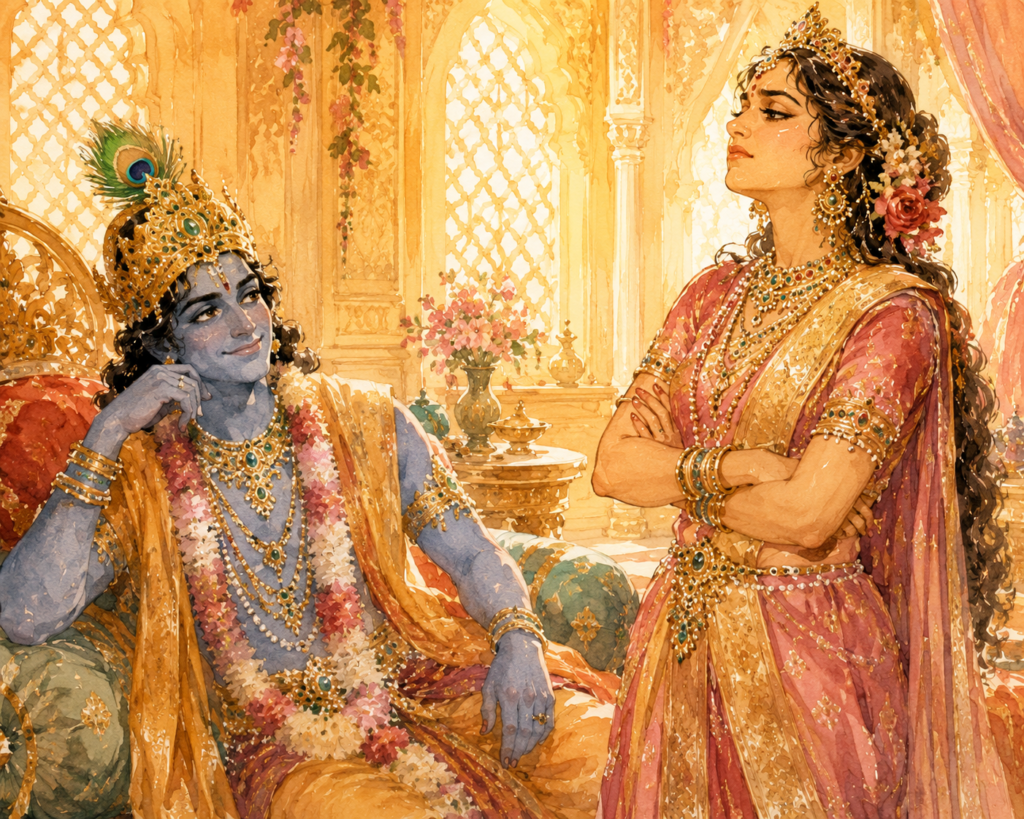
One ordinary day in Dwarka, Krishna said something to Satyabhama that she did not appreciate at all.
He told her she was like salt to him.
Now. To understand why this did not land well, you need to know who Satyabhama was. This was the queen who had been compared to the sun, to jewels, to the most precious things in creation. This was the woman who had once demanded an entire tree from the garden of heaven — not a flower, the whole tree — and gotten it. This was a woman who knew her own worth in considerable detail.
And her husband had just compared her to salt.
An everyday, ordinary, available-in-every-kitchen, nobody-ever-writes-poetry-about-it ingredient.
She was not pleased. She told him so, at some length, with the particular eloquence that Satyabhama could produce when her feelings were strong. If you are going to compare me to something, she said, at least find something worthy. There is nothing in this entire world good enough to compare me to. And salt certainly is not it. Krishna listened. He smiled that particular smile — the one that always meant he was thinking something. And he let it go.
The Grand Banquet
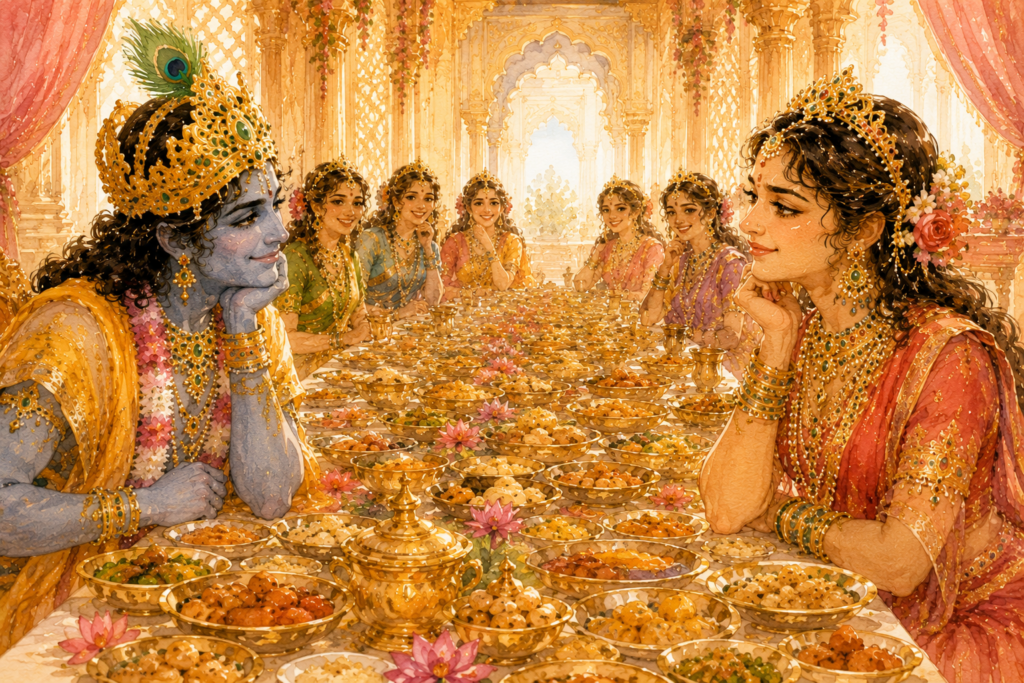
Some days later, Krishna announced that he was organising a great banquet at the palace. Not a small gathering. A full royal celebration — 56 dishes, the Chappan Bhog, arranged with all the care and splendour that the palace kitchens of Dwarka were capable of.
He personally invited all eight of his queens. He seated them in their places. He waited until everyone was settled and the first dishes were served.
And then he watched.
Satyabhama, who prided herself on her knowledge of fine cooking and fine food, reached for the first dish. Put a morsel in her mouth. Chewed.
Something was wrong.
She reached for the second dish. Same thing.
The third. The fourth.
Dish after dish after dish — and not a single one had salt in it. The vegetables were flavourless. The sweets were cloying without the balance of salt to anchor them. The kachoris were crisp and empty. Even the richest, most elaborate preparations tasted like they were missing something so fundamental that no amount of other flavour could compensate for it.
The Chappan Bhog. 56 dishes. Arranged perfectly. Beautifully presented. Entirely inedible.
The Mercury Rises
Satyabhama’s patience, which was not her most celebrated quality at the best of times, did not survive the third dish.
She put down her spoon. She called for Krishna. When he arrived — face arranged in that expression of perfect, guileless concern — she looked at him and said:
“Who told you to organise a banquet? There is no salt in any dish. Not a mouthful can be eaten. What is the point of 56 dishes if not a single one has salt in it?”
Krishna looked at the table. Looked at her. And said, with complete simplicity:
“Then what is the problem? You can eat without salt, can you not?”
Satyabhama stared at him.
“You can eat sugar without sugar,” she said. “But you absolutely cannot eat food without salt. Salt is not optional. Salt is the thing that makes everything else taste like what it is supposed to taste like. Without salt, nothing works. Nothing.”
There was a pause.
And then Krishna smiled. That smile.
What He Had Been Saying All Along
He said — then why were you angry when I told you that you are to me like salt?
Satyabhama went still.
He had not insulted her. He had been trying to tell her something — and she had not heard it. So he had arranged 56 dishes without salt and waited for her to understand from the inside out what he had been saying from the beginning.
Salt is not glamorous. Nobody writes odes to salt. Nobody demands salt from the garden of heaven or places it on a golden altar. Salt sits in a small vessel in the corner of every kitchen and nobody notices it is there.
Until it is not.
Without salt, the most magnificent banquet in the world becomes impossible to eat. The most carefully prepared, the most beautifully presented, the most lovingly cooked — all of it fails. Not because something dramatic went wrong. Because something quiet and essential and completely irreplaceable was missing.
That, he was saying, is what you are to me.
The Specific Thing About This Story
What I find extraordinary about this story is not just the comparison itself — though the comparison is beautiful. It is the care that went into showing it.
He could have explained. He could have said: when I called you salt I meant you are essential, I meant the feast of my life would be inedible without you, I meant that the things that get noticed and praised and celebrated are not always the things that hold everything together.
He could have said all of that.
Instead, he arranged 56 dishes without salt and waited.
Because he knew her. He knew that Satyabhama does not receive explanations — she receives experiences. She is not a woman who hears something and immediately understands it in the abstract. She is a woman who needs to feel it, taste it, live it. And so he gave her something she could taste.
He gave her 56 dishes that did not work. And in the not-working of them, he gave her the understanding he had been trying to offer since the beginning.
From Me to You
What stays with me in this story is that Krishna did not try to explain himself when Satyabhama was offended. He could have argued. He could have told her what he meant. Instead, he created an experience that would allow her to discover it for herself. There is something incredibly gentle about that kind of wisdom.
I also keep thinking about the comparison itself. A Tulsi leaf is sacred and immediately recognised as precious. Salt is ordinary. It sits unnoticed on the table every day. And yet the moment it is missing, everything changes. Perhaps some of the most important people in our lives are like that — so woven into our happiness that we only realise their value when they are absent.
And maybe that is why Satyabhama’s reaction feels so human. She hears “salt” and thinks it is an insult. Only later does she understand that Krishna was describing something indispensable. Something so essential that an entire feast loses its joy without it. What first sounded ordinary turns out to be the highest compliment of all.
| Sources and References Sources: Krishna folk tradition — the salt and banquet story is from the oral storytelling tradition around Krishna’s life in Dwarka, preserved in devotional literature and regional retellings. The Chappan Bhog (56 dishes) is a well-documented devotional offering tradition. The Tulabharam parallel is from Bhagavata Purana tradition. All reflections are the author’s own. |
Continue Exploring — Satyabhama Series
- Satyabhama — The Warrior Queen of Krishna
- The Tulabhaaram — The Tulsi Leaf That Outweighed All of Satyabhama’s Gold
- Before the Battles — How Satyabhama and Krishna Began
- Satyabhama — The Reincarnation of the Goddess of Earth
- Krishnavataram — Everything You Need to Know About the Mythology Behind the Film
Does this change how you think about what it means to be called salt? Share this story with someone who deserves to know what they mean. And explore the full Satyabhama series right here on Fables n Tales.