

There is something I find extraordinary about the love story of Mata Rukmini that tends to get lost in the telling.
She had never met Krishna.
She had never been in the same room as him. She had never heard his voice. She had never seen his face except perhaps in paintings or sculptures in temple shrines. And yet by the time the wedding preparations with Shishupala were underway, she had already decided — completely, irrevocably — that she would marry Krishna or she would not live.
That kind of certainty, built entirely out of stories heard from a distance, is one of the most remarkable things about her.
The Kingdom She Came From
Rukmini was born in Vidarbha — a prosperous, well-established kingdom in the region that is present-day Maharashtra and eastern central India. Its capital was Kundinapura — identified today as Kaundinyapur in eastern Maharashtra.
Her father was Bhishmaka — a good king, by the accounts we have. Respected. Just. Privately fond of Krishna and aware of his greatness, though publicly unable to act against the tide of his own court. He had five sons before Rukmini was born — Rukmi, Rukmaratha, Rukmabahu, Rukmakesa and Rukmanetra. And then one daughter.
Her birth name was Ruchiranana — the one with a face like an open lotus. Beautiful from birth. A name given by a father who clearly looked at his daughter and saw something extraordinary.
She would later be called Rukmini — the radiant one, the one decorated with gold. Also Vaidarbhi — the princess of Vidarbha. Also Bhaishmi — Bhishmaka’s daughter. Also, after her marriage, Chirayauvana — the forever young — a name she earned through her perfect hospitality to the fearsome sage Durvasa.
But all of that came later. First she was just a princess in a prosperous kingdom, growing up in a palace, the only daughter among five brothers.
Her Brother Rukmi
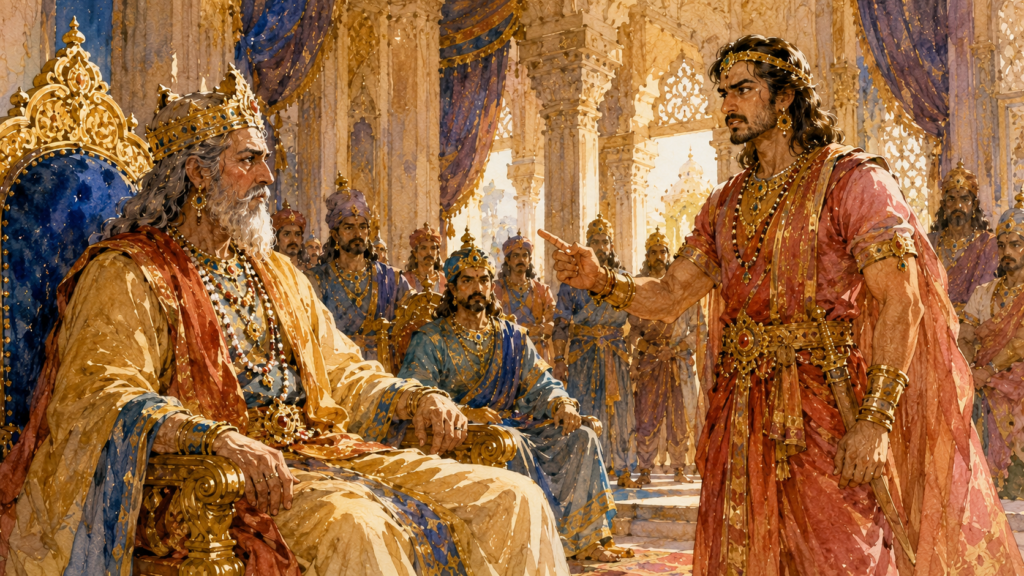
I need to tell you about Rukmi before I tell you anything else, because Rukmi is the shadow that falls across the whole of Rukmini’s early life.
Rukmi was the eldest and the most powerful of Bhishmaka’s sons. He was a formidable warrior — he had received the Brahmastra from the sage Parashurama himself and the Devastra from the sage Druma. He was ambitious, politically calculating and had one serious problem with his character: he was cold. The texts describe him as arrogant in a way that even his father could not manage.
Rukmi had made his political alliances carefully. He was aligned with Jarasandha — the powerful king of Magadha who was one of Krishna’s most persistent enemies and had attacked Dwarka multiple times. And Rukmi was close friends with Shishupala, the king of Chedi.
When Rukmini came of age, Rukmi had already decided who she would marry. His friend Shishupala. A Kshatriya king of appropriate status and with the right political connections. The fact that Shishupala was also — in the cosmic karmic framework — the latest incarnation of an ancient enemy of Vishnu, carrying lifetimes of enmity toward the divine, apparently did not factor into Rukmi’s calculation.
Bhishmaka knew this was wrong. He loved Rukmini. He privately approved of Krishna. But he was a father who could not override his most powerful son, and he lived with the weight of that.
How Stories About Krishna Reached Vidarbha
Rukmini was growing up in a world where stories about Krishna were everywhere.
Think about what had already happened by the time Rukmini was coming of age. Krishna had been born in a prison cell, switched at birth, raised by cowherds in Gokul and Vrindavan, killed the tyrant Kamsa in Mathura, freed the imprisoned Yadavas, led his people to build the magnificent city of Dwarka on the sea. He had defeated Jarasandha’s attacks multiple times. He was known as the most extraordinary person in the world — a king, a warrior, a philosopher, and according to many sages and travellers who passed through royal courts, something more than human entirely.
These stories reached Vidarbha through the channels that all stories travel — traders, travelling sages, Brahmin priests visiting from other courts, wandering musicians and poets who carried news across kingdoms in their songs.
Rukmini listened to all of them.
The Bhagavata Purana says that her heart recognised its eternal companion through these stories. That is the theological framing — Lakshmi recognising Vishnu across incarnations. But at the human level, what was happening was perhaps simpler and more recognisable: a young woman was hearing about someone who seemed completely unlike anyone else in the world, and something in her was responding to that with unusual intensity.
What She Heard About Him
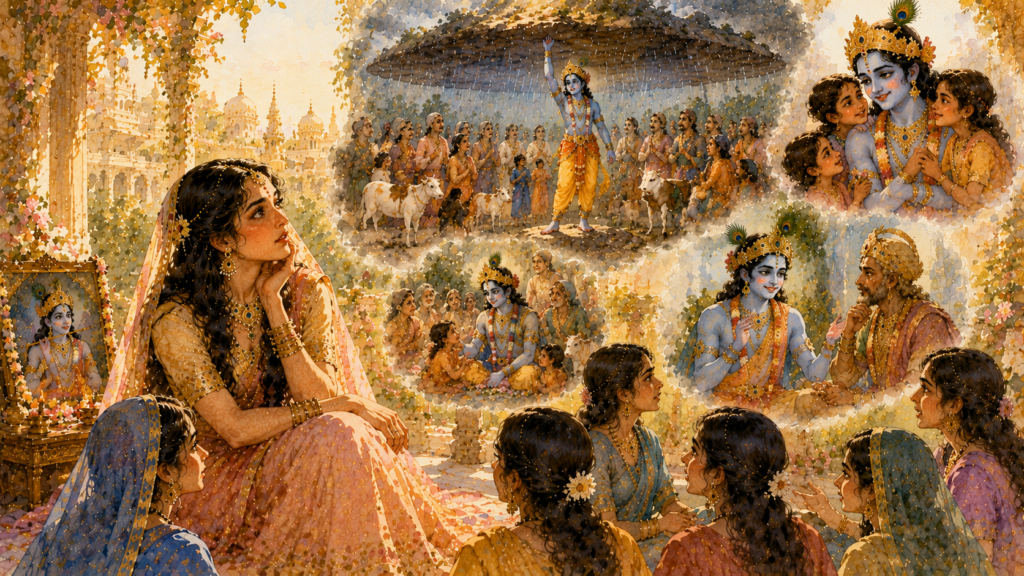
The stories that reached Rukmini were not just stories of victories and battles — though there were plenty of those. What the Bhagavatam describes is that she heard about his character.
His compassion. The way he treated the people around him — not just the powerful but the ordinary, the overlooked, the frightened. The way he had protected his people through the rain sent by Indra’s wounded pride by simply lifting a mountain and holding it above their heads like an umbrella. The way he had stayed — at enormous personal and political cost — loyal to everyone who loved him.
She also heard about his beauty. The dark complexion, the peacock feather in his crown, the smile that the Puranas have spent centuries trying and failing to fully describe.
And she heard about his wisdom. The depth of understanding that came through every story about him — the sense that here was a person who saw things as they actually were, not as convention or self-interest might want them to appear.
All of this built up in her slowly. And at some point it stopped being admiration and became something else entirely.
The Decision She Made Alone
Here is the thing about Rukmini that I think is essential to understand before you read the letter.
She made her decision alone. Nobody helped her make it. Nobody encouraged her. In fact, the most powerful person in her immediate world — her brother Rukmi — was actively working against it. Her father was sympathetic but silent. Her other brothers were not factors.
She looked at everything she knew — the stories, the character, the man who had built Dwarka and protected his people and carried himself with that particular grace that all the accounts agreed upon — and she decided. With the completeness and clarity that would define her entire life.
Not: I would like to marry Krishna.
Not: I hope I might marry Krishna.
Simply: I will marry Krishna, or I will not marry anyone.
That is not a teenage crush. That is a resolution. A complete settling of an interior question that most people spend their whole lives wrestling with.
When She Found Out About Shishupala
And then came the news that her marriage had been arranged to Shishupala.
She was horrified. The texts use this word — horror. Not disappointment. Not sadness. Horror at the idea of this specific man, who she knew was cruel and who every story she had ever heard had cast as something diametrically opposed to everything she valued, becoming her husband.
She went to her father. He was sympathetic and helpless. She went to her brothers. None of them would speak against Rukmi.
She was alone with the weight of a decision that was being made for her and that she found completely unacceptable.
So, she found a trusted Brahmin priest. And she told him to go to Dwarka. And she wrote a letter.
From Me to You
What I keep coming back to in Rukmini’s story is the way she fell in love with Krishna without ever seeing him. Not through beauty. Not through closeness. But through stories — through hearing about the kind of person he was. His character, his compassion, his courage. There is something deeply beautiful about love that begins in admiration of someone’s nature before anything else.
I also cannot stop thinking about how alone she was in all of this. Her father loved her, but could not protect her. Her brother was powerful and determined to decide her future for her. And in the middle of all that pressure and silence, Rukmini still arrived at this complete certainty within herself — I will marry Krishna or no one else. No encouragement. No reassurance. Just clarity.
That kind of inner knowing feels incredibly courageous to me. The courage of trusting your own heart even when nobody around you understands it yet. And perhaps that is what makes Rukmini’s love story feel so timeless — it begins not with rescue, but with a woman first choosing for herself.
| Sources and References Sources: Bhagavata Purana (10th Canto, Chapter 52) — Rukmini’s background and the letter; Wikipedia — Rukmini, Bhishmaka, Vidarbha kingdom; Krishnabhumi.in — How Krishna Wed Rukmini; Bhagavanbhakthi.com — Krishna Rukmini Marriage Story; YogaMysticism.today — Krishna Avatar Part 11; Quora — Who is the father of Rukmini in the Mahabharata. All reflections are the author’s own. |
Continue Exploring — Rukmini Series
- Rukmini — The Princess Who Wrote a Secret Letter to Krishna
- Rukmini vs Satyabhama — Two Queens, Two Kinds of Love
- Pradyumna — The Son Stolen at Birth Who Grew Up to Be a Legend
- Krishnavataram — Everything You Need to Know About the Mythology Behind the Film
Did Rukmini’s certainty about someone she had never met move you? Share this with someone who loves a good origin story. And read what she did next right here on Fables n Tales.