If you have watched Krishnavataram and found yourself thinking — who wrote this story, where did this particular version of Satyabhama come from — the answer leads you to a 33-year-old writer from a small village in Saurashtra, Gujarat.
His name is Raam Mori. And before Krishnavataram became a film, it was a Gujarati novel sitting quietly in a publisher’s catalogue — waiting for the right people to find it.
This is that story.
Krishnavataram – The Film’s Official Sources — What the Credits Actually Say
Krishnavataram Part 1: The Heart is officially based on two sources.
The first is the Brahma Vaivarta Purana — one of the eighteen major Puranas, and the primary Sanskrit text that records Radha’s story in the most detail.
The second — and the one that gave the film its emotional DNA, its narrative voice and its central question — is a 2025 Gujarati novel called Satyabhama, written by Raam Mori.
Raam Mori is not just the source author. He co-wrote the screenplay. His name appears in the film’s official credits alongside Hardik Gajjar and the legendary Gujarati screenwriter Prakash Kapadia. The novel’s voice is inside the film — not just loosely adapted but directly present in the writing.
| THE FILM AT A GLANCE Title: Krishnavataram Part 1: The Heart (Hridayam) Released: 7 May 2026 Director: Hardik Gajjar Screenplay: Prakash Kapadia, Raam Mori, Hardik Gajjar Based on: Brahma Vaivarta Purana + Satyabhama novel by Raam Mori (2025) Cast: Siddharth Gupta (Krishna), Sanskruti Jayana (Satyabhama), Sushmitha Bhat (Radha), Nivaashiyni Krishnan (Rukmini), Jackie Shroff Music: Prasad S | Lyrics: Irshad Kamil | Songs include: Prem Ki Leela (Shreya Ghoshal), Shyamal Sanware (Sonu Nigam), Krishna Govinda (Sunidhi Chauhan) Production: Creativeland Studios Entertainment (Sajan Raj Kurup & Shobha Sant) + Athasrikatha Motion Pictures Originally titled: Shri Radha Ramanam (title changed to Krishnavataram) Part 1 of a planned trilogy |
The Man Who Wrote It — Raam Mori
Raam Bhavsangbhai Mori was born on 2 February 1993 in Mota Surka — a village in Sihor taluka of Bhavnagar district, Gujarat. His family is originally from Lakhavad village near Palitana — one of the most sacred Jain pilgrimage sites in the world. He studied fabrication engineering. He began writing short stories at the age of seventeen.
He is now considered one of the most important young voices in Gujarati literature.
In 2016 he published his debut short story collection Mahotu — stories of rural Saurashtra focusing on women’s lives — which was immediately recognised as something exceptional. It earned him the Sahitya Akademi’s Yuva Puraskar in 2017. The Sahitya Akademi is India’s national academy of letters — the Yuva Puraskar is their award for young writers. He was 24 years old.
He has since written screenplays for Gujarati cinema and won the National Award for Best Gujarati Film for 21mu Tiffin in 2021. He currently lives in Ahmedabad.
Satyabhama — published in 2025 by R.R. Sheth & Co., one of Gujarat’s most established publishers — is his first novel. It is written in Gujarati. It is available in Gujarati, and has now reached an audience of millions through the film.
The Novel’s Opening — The Line That Changed Everything
The publisher’s description of the original Gujarati novel gives us its premise in words that immediately tell you this is not going to be a familiar retelling.
Translated from Gujarati, it reads:
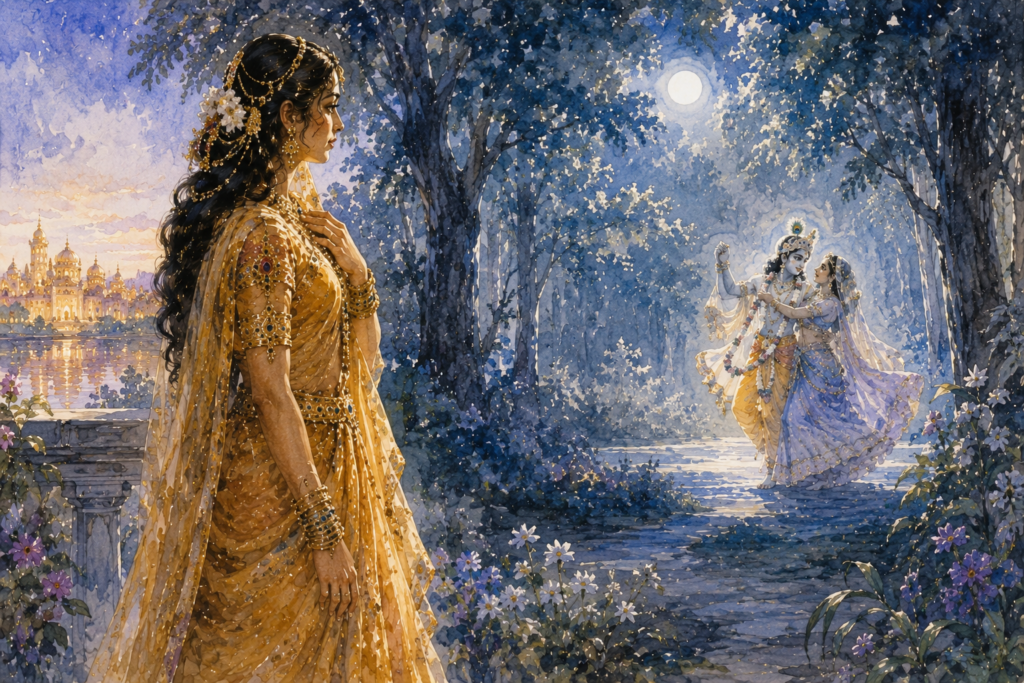
“Krishna’s sixteen thousand one hundred and seven queens believed — ‘We are fortunate that we got Krishna.’ But there was one chief queen, Satyabhama, who clearly believed — ‘Krishna is fortunate that he got me!’
This is the story of Satyabhama, who identifies herself as Krishna’s most beloved wife. Standing in the crossroads of the world, looking eye to eye with firm conviction, she says — even though I did not dance the Raas like Radha…”
And that final line changes everything.
Because suddenly Satyabhama is not being written as Radha’s opposite or replacement. She is fully aware of Radha’s place in Krishna’s story. The novel begins from that awareness — and from the question of what it means to love Krishna differently and still refuse to stand smaller because of it.
What the Novel Covers
The novel covers Krishna’s life from the perspective of Satyabhama — walking through the streets of Dwarka and the villages of Gokul, Barsana, Mathura, Panchal and Vidarbha. It presents Satyabhama not just as a consort but as a warrior queen who knows her worth while remaining deeply devoted to Krishna.
The film critic who reviewed Krishnavataram for Beyond Bollywood captured the novel’s central insight precisely — in Krishna’s eyes his relationships embodied different qualities: Radha represented sacrifice, Rukmini represented wisdom, Satyabhama represented devotion and Jambavati represented inner beauty.
That framework — four women, four qualities, one divine being who held all of them — comes directly from Raam Mori’s novel. The film is built on it.
The same review noted another detail that the novel makes explicit: the film’s Satyabhama is called Bhama first and later named Satyabhama for daring to speak truth. Raam Mori built the naming into his narrative — not as a fact from any Purana but as his own literary insight about how a name can be earned through the quality of a life lived.
The Director’s Vision — Hardik Gajjar
Hardik Gajjar is a Gujarati filmmaker who had previously made Bhavai — a 2021 Hindi romance featuring Pratik Gandhi. He is not a star director by any conventional measure. He is a careful, research-driven storyteller from the same cultural world as Raam Mori.
When the Krishnavataram team met Uttar Pradesh Chief Minister Yogi Adityanath before the film’s release, Gajjar said something that became widely quoted:
“This is our history, not mythology. This is what we can impart to the future generations. We can advocate and propagate our culture and religion as much as we can from this medium.”
That is the director’s understanding of what Raam Mori’s novel was doing — not retelling a mythological story but reclaiming a historical truth about a woman who had been underrepresented for centuries.
The producer Sajan Raj Kurup of Creativeland Studios — the agency and film production house he founded — made a bet that is now being talked about across the industry. An all-new cast, all debutants, no established stars. New music. A mythological IP that had never been attempted at this scale. Everything on the strength of the story and the novel.
The New Cast — Carrying a Forgotten Queen
The film’s cast was entirely new to cinema. Siddharth Gupta as Krishna, Sanskruti Jayana as Satyabhama, Sushmitha Bhat as Radha, Nivaashiyni Krishnan as Rukmini and Jackie Shroff in a pivotal supporting role.
When Sanskruti Jayana was asked who had the original idea to adapt the novel, her answer was direct: as far as I know it was the book’s author Raam Mori and our director Hardik Gajjar who had this thought. The author and the director together. A Gujarati writer and a Gujarati filmmaker bringing a Gujarati novel to the world’s largest cinema audience.
The film’s trailer was unveiled not at a multiplex or a press conference but at the sacred Krishna Janmabhoomi in Mathura — extending to Raman Reti Temple, Radha Rani Temple, Prem Mandir and ISKCON Vrindavan simultaneously. The makers were making a statement about what they considered this film to be.
Why This Matters — A Gujarati Novel and a Queen’s Reclamation
For centuries the story of Krishna has been told primarily through the lens of Radha — the Gita Govinda of Jayadeva, the Bhakti poetry of Mirabai, the devotional tradition of Gaudiya Vaishnavism. These traditions are beautiful and profound. Radha’s love is the supreme expression of devotion in the entire tradition.
But somewhere in that emphasis, Satyabhama — the warrior, the earth goddess incarnate, the woman who stood on a battlefield and shot the arrow that killed Narakasura — became a footnote. The jealous wife. The proud queen. The one who almost gave Krishna away because of wounded ego.
Raam Mori — a 33-year-old from a village in Saurashtra, known for writing stories about women — looked at that and decided to tell a different story.
He gave Satyabhama her voice back. Not by diminishing Radha. Not by competing with the devotional tradition. But by standing Satyabhama in the crossroads of the world, letting her acknowledge what she did not have and what she did have, and letting her say with complete certainty — Krishna is fortunate that he got me.
That is the novel’s gift. And the film carried it to millions of people who had never read a line of Gujarati literature.
From Me to You
What stays with me most about this story is how quietly it began. A young writer from a small village in Saurashtra deciding that Satyabhama — a queen most retellings barely pause for — deserved to speak in her own voice again. There is something deeply moving about that kind of creative faith. The belief that an old story still has living emotions inside it waiting to be heard.
And then somehow, that story travelled. From a Gujarati novel that most of India had never heard of, to the screen, to millions of people watching Krishnavataram and suddenly seeing Satyabhama differently. Not as a side character. Not as a stereotype. But as a woman with longing and pride and vulnerability and love.
I also keep thinking about that line — “Even though I did not dance the Raas like Radha…” — and everything that follows it. There is such aching humanity in it. The desire not to compete with another love story, but simply to be seen fully within your own.
Maybe that is what fascinates me most about stories. We often only see the final form — the famous film, the beloved scene, the dialogue everyone remembers. But before that, there was one person sitting somewhere quietly, writing words into existence and hoping they would matter to someone someday.
| Sources Sources: Wikipedia — Krishnavataram Part 1: The Heart (Hridayam); Raam Mori; Beyond Bollywood film review (beyondbollywood.home.blog, 7 May 2026); Bollywood Hungama — Krishnavataram reviews and maker interviews; MSN/Box office reports — Krishnavataram crosses Rs 20 crore; ANI — Hardik Gajjar meets CM Yogi Adityanath, April 17 2026; BookPratha.com — Satyabhama Gujarati book description; Amazon India — Satyabhama by Raam Mori reader reviews; ProKerala — Krishnavataram movie review; IWMBuzz — film review including music details. All reflections the author’s own. |
Continue Exploring — Tales of Krishna
- Satyabhama — The Warrior Queen of Krishna
- Bhama to Satyabhama — The Name She Was Born With and the Truth That Completed It
- Rukmini’s Letter — The Most Beautiful Love Letter in Hindu Mythology
- Krishnavataram — Everything You Need to Know About the Mythology Behind the Film
- The Narakasura Battle — The Day Satyabhama Fulfilled a Mother’s Boon
Did you know about the novel before you watched the film? Share this with everyone who loved Krishnavataram and wants to know where the story really came from. And explore the full Tales of Krishna series on Fables n Tales.