

There are a lot of Panchatantra stories, most of which we heard as kids, or watched online or read in a book. I read a lot of these in magazines and in Chandamama magazine growing up. Later when my daughter was young, I watched a lot of these on YouTube as cartoons.
We all know someone who simply cannot stop talking — even when staying quiet, just for a moment, would be the best thing they could possibly do.
This next story is for that person. And if we’re honest, it’s a little bit for all of us too. It’s short, it’s vivid, and it ends rather suddenly, but it carries one of the gentlest, most memorable lessons in all of Indian storytelling.
This is the story of the Tortoise and the Two Geese.
Three Friends by the Lake
On the edge of a beautiful lake lived three close friends — two geese and a tortoise. They had grown up together. They shared their meals, watched the sunsets together, and spent their days in that easy, comfortable way that only old friends can.
But one year, the rains didn’t come. Slowly, the lake began to shrink. The water dropped, the reeds dried up, the fish disappeared. It became clear that if they stayed, it would be hard for either of them to survive.
A Plan with One Important Rule
For the two geese, leaving was simple. They could just fly away.
But the tortoise couldn’t fly. And he couldn’t walk fast enough, either, before the lake dried up completely.
So, the geese thought about it and came up with a plan.
“Here’s what we’ll do,” said the elder goose. “We’ll find a strong stick. Each of us will hold one end in our beak. You, dear friend, will grip the middle with your mouth. We’ll fly, you’ll hold on, and together we’ll carry you to a new lake.”
The tortoise was overjoyed. It was a wonderful plan!
But the younger goose looked at him seriously. “There is one rule,” she said. “You must not open your mouth. Not for anything. Not even for a second. If you let go of the stick — even to speak — you will fall.”
“I promise,” said the tortoise. “Not a single word. I won’t make a sound.”
Up, Up, and Away
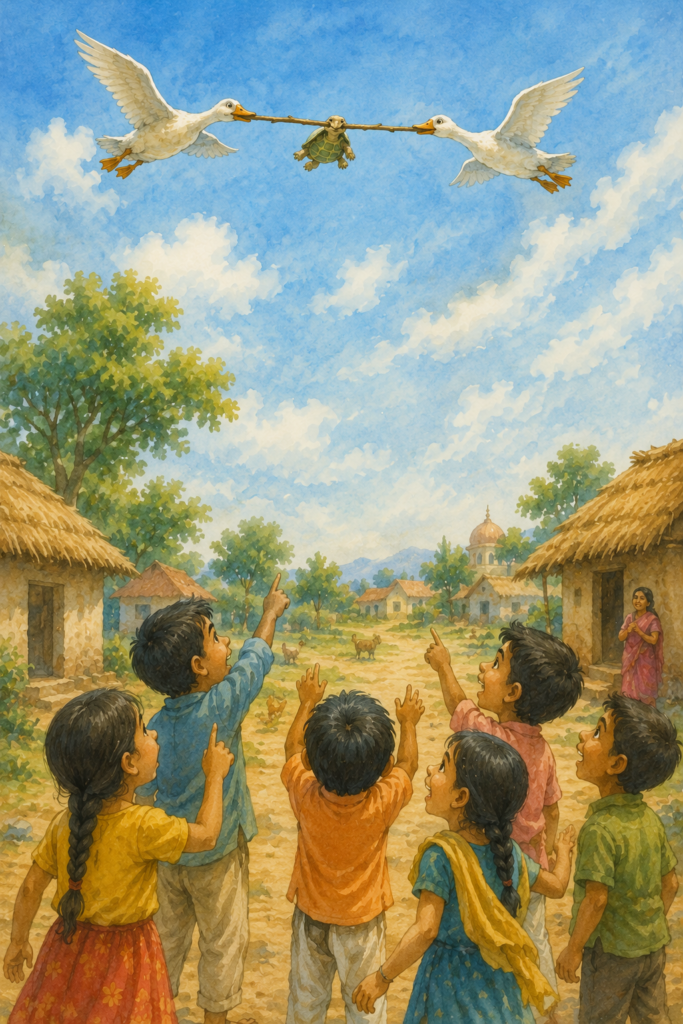
The next morning, the geese picked up the stick. The tortoise clamped down on the middle of it with his mouth. And slowly — wings beating hard — the geese lifted off the ground.
It was incredible. The tortoise, who had spent his whole life close to the ground, was suddenly flying — soaring above the treetops, watching the forest spread out beneath him like a green carpet, with tiny villages passing far below.
One Moment of Pride
In one of the villages below, some children spotted the strange sight high in the sky, the two geese, carrying a tortoise!
“Look at that!” they shouted, pointing and laughing in amazement. “A flying tortoise! Who could have come up with such a clever idea?”
And the tortoise heard them.
His chest swelled with pride. After all — this had been his plan too, hadn’t it? He had agreed to it. He deserved a little credit, didn’t he?
He wanted to say so. He needed to say so.
He opened his mouth.
“It was MY idea!”
And he fell all the way down, just a stone, with a thud.
So, What Can We Take from This?
This story does something quite rare — it teaches its lesson in just one sentence, one single moment. And yet that moment says so much:
- The tortoise wasn’t foolish. He helped design the very plan that could have saved him.
- But pride — the need to be noticed, to get credit — can be stronger than even our best instincts.
- There is a time to speak, and a time to simply enjoy the moment quietly. Knowing the difference matters.
- One small, impulsive moment can undo a great deal of careful thought and planning.
Isn’t that such a human story, really — for one that’s about a tortoise and two birds?
We live in a world full of comment sections, group chats, and the constant pull to react, respond, and be heard. How often do we speak not because we truly need to but simply because staying quiet, even for a moment, feels unbearable?
The tortoise wasn’t a bad creature. He was a proud one. And in the one moment his pride spoke louder than his promise, everything changed.
A Little About the Panchatantra
This tale comes from the Panchatantra, an ancient Indian collection of stories divided into five books, each built around a different kind of practical wisdom. This particular story belongs to a thread the old storytellers returned to again and again — the surprising cost of saying the wrong thing at exactly the wrong moment.
The tortoise’s fall wasn’t caused by an enemy, or bad luck, or a broken plan. It was caused by his own voice, which, if you think about it, is how a lot of our own troubles begin too.
Read More Such Stories
The Lion and the Hare — how a tiny hare outsmarts the mightiest beast in the forest
The Blue Jackal — a funny and wise tale about pretending to be someone you’re not
The Monkey and the Crocodile — a story about friendship, trust, and thinking fast
Did this story make you smile or wince, just a little? Share it with someone who could use a gentle reminder about the power of staying quiet, and explore more tales from the Panchatantra.