

Before I tell you any of the stories themselves, the lion and the bull, the monkey and the crocodile, the clever jackal who became blue, I want to take a step back and tell you what this whole collection actually is.
Because here’s the thing about the Panchatantra: almost everyone in India has heard a story or two from it, usually as a child. But very few people have ever been told what it really is, where it came from, or just how enormous and clever the whole thing actually is.
So consider this your map. Read this one first, and every other Panchatantra post we ever write will make a little more sense.
What the Word Actually Means
Panchatantra simply means “five treatises” or “five principles” — Pancha for five, Tantra for a strategy or a thread of thought. It isn’t one story. It’s five books, each built around a different theme, each containing a whole nest of smaller stories inside it.
It was written in Sanskrit, somewhere around 200 BCE, in India — though, as we’ll get into in another post, nobody is entirely sure who actually wrote it, or whether the man it’s credited to was even a real person.
Why It Exists — The Story Behind the Stories
The Panchatantra opens with its own little story, almost like a wrapper around everything else. A king named Amarashakti has three sons who are, to put it gently, hopeless. They have no interest in learning anything. Every tutor the king hires fails. Out of options, he turns to a scholar named Vishnu Sharma, who makes an unusual promise — give me six months, no payment required, and I’ll teach your sons everything they need to rule wisely.
Instead of lecturing the princes, Vishnu Sharma tells them stories. Animal stories. Stories about lions and jackals and crows and turtles, each one quietly carrying a lesson about trust, power, greed, or good judgement. And by the end of six months, the text tells us, the three useless princes had genuinely transformed.
That frame — wisdom taught through story rather than instruction — is the whole reason the Panchatantra exists in this form at all.
The Five Books, Briefly
Each of the five books carries its own theme and its own central story, with dozens of smaller tales nested inside:
- Mitra Bheda — The Loss of Friends. How a perfectly good friendship can be destroyed by someone with something to gain from breaking it.
- Mitra Labha — The Gaining of Friends. The warm opposite of Book One — how friendship is actually built, tested, and proven.
- Kakolukiyam — On Crows and Owls. A story of war, spies, and strategy between two old enemies.
- Labdhapranasam — Loss of Gains. What happens when something you’ve built — a friendship, a fortune — is put at risk by someone else’s greed.
- Aparikshitakarakam — Ill-Considered Action. The shortest, darkest book — about what happens when we act before we think.
Stories Inside Stories Inside Stories
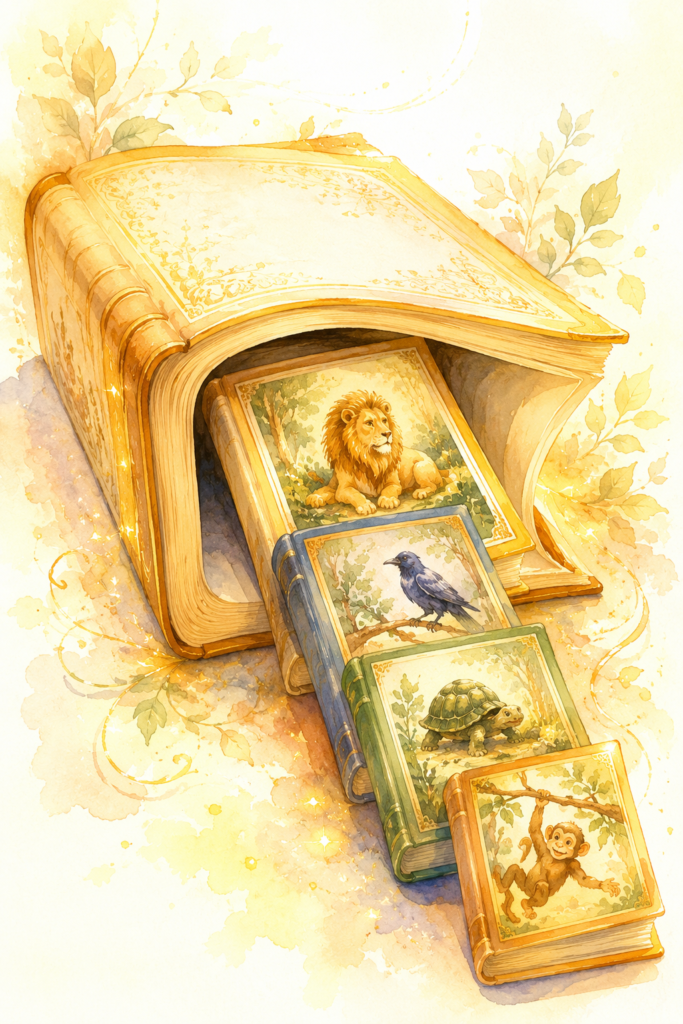
Here’s what makes the Panchatantra genuinely unusual, even today. It isn’t a simple list of fables, one after another. Each book has one larger story running through it — and inside that story, characters tell each other smaller stories to make a point, win an argument, or warn a friend. And sometimes, inside those stories, there’s another story still.
It’s a little like a set of nesting dolls. You open one story and find another one waiting inside it. This technique would later show up in The Arabian Nights and Boccaccio’s Decameron — but the Panchatantra was doing it first, more than a thousand years earlier.
Why It Travelled So Far
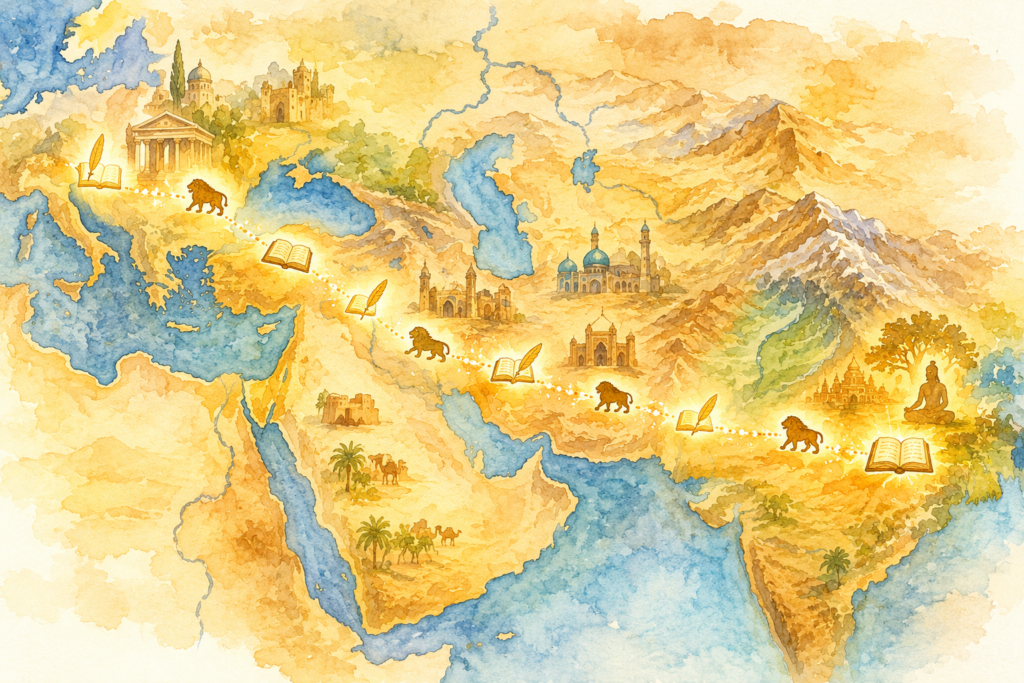
Somewhere around the 6th century, a Persian king heard about this remarkable Indian book and sent his personal physician all the way to India just to bring back a copy. It was translated into Persian, then into Arabic as Kalila wa Dimna, then into Hebrew, Greek, Latin, and eventually into nearly every major European language.
By some counts, the Panchatantra has been translated into more languages than almost any book in human history, second only to the Bible. Most people who’ve enjoyed Aesop’s Fables, or grown up on stories about clever foxes and foolish donkeys, have unknowingly been touched by a tradition that started in India over two thousand years ago.
So, What Should You Take From This?
- The Panchatantra isn’t one story — it’s five interconnected books, each with its own theme and its own central tale.
- It was built on a simple but powerful idea — that stories teach what lectures can’t.
- And it travelled the entire world, quietly shaping fable traditions everywhere from Persia to France, long before most of us ever heard its name.
What strikes me most, every time I come back to this collection, is how deliberately built it all is. Nothing here is random. The five books move in a clear order — from making friends, to losing them, to fighting your enemies, to protecting what you’ve earned, to simply learning to think before you act. It reads less like a storybook and more like someone’s entire philosophy of how to live carefully in a complicated world, wrapped gently in fur and feathers so it never feels like a lecture.