

Let me tell you a story. I think this is a very old one, and you might have heard this before from your mom or grandmother, but it still makes sense today. I think the reason for this is that a few things never change, and it is the the difference between being strong and being clever.
Here is how the story goes.
A Forest That Had Stopped Laughing
Once, in a thick green forest, there lived a lion. He was huge, golden, and proud and he loved to hunt. Not just when he was hungry. He hunted every single day, just because he could.
You can imagine what that did to the rest of the forest. The deer, the rabbits, the foxes, the monkeys, nobody felt safe. Nobody knew whose turn it would be next. The forest, which used to be full of birdsong and chatter, had gone quiet.
One day, all the animals got together. They were tired of living in fear, and they had an idea.
A Deal with the King
The oldest deer was chosen to speak to the lion.
“Great king,” he said, bowing low, “please hear us out. Every day you hunt, many of us die — far more than you actually need. So here is what we propose. Stay in your den. Each day, one of us will come to you, on our own, as your meal. That way, you will never go hungry, and the rest of us can finally stop being afraid all the time.”
The lion thought about it. It sounded easy — food delivered to his door every day, no chasing required. He agreed.
And so, for a while, it worked exactly like that. Every day, one animal walked slowly to the lion’s den.
Until one day, it was the little hare’s turn.
The Hare Takes Her Time
Now, the hare was small. But she was also very, very smart.
While every other animal had simply walked to the lion’s den feeling sad and scared, the hare did something different. She sat down quietly first — and she thought.
By the time she finally set off, she was very late. And she had a plan.
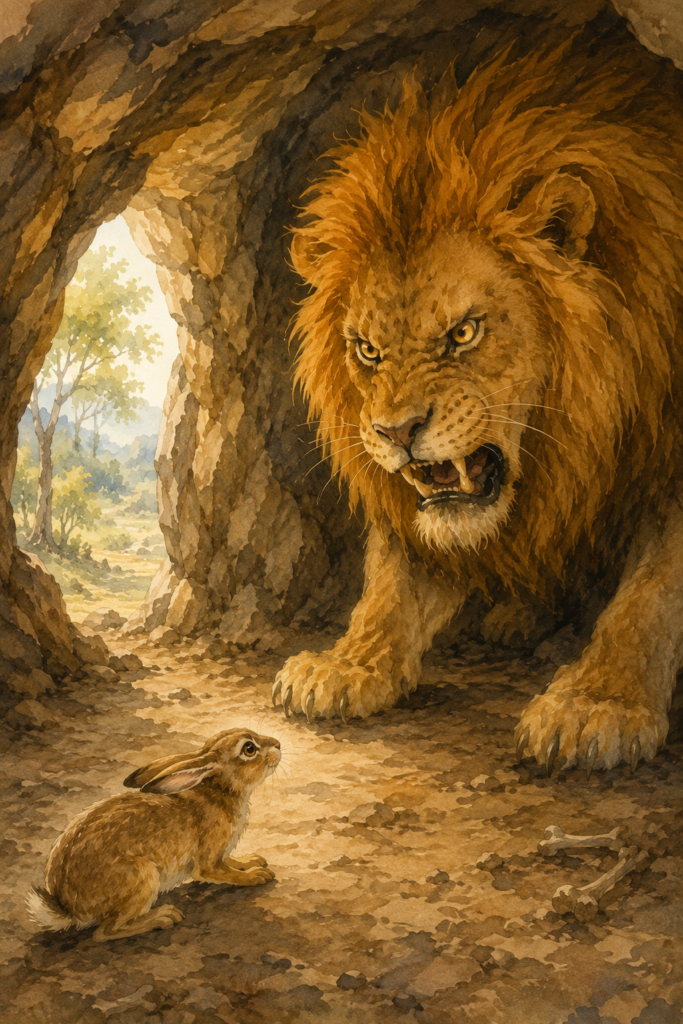
When she reached the den, the lion was pacing back and forth, growling with hunger and anger.
“WHERE have you been?” he roared. “I should eat TWO of you for keeping me waiting!”
The hare bowed low, trembling — just enough to look frightened.
“Forgive me, great king,” she said. “I was on my way, truly I was. But another lion stopped me on the path. He said HE was the real king of this forest, and that I belonged to him, not you. I only just managed to get away to come and warn you.”
Show Me This Other Lion
Well. That did it.
“ANOTHER lion? In MY forest? Take me to him AT ONCE!”
The hare led the way, walking just slowly enough for the furious lion to follow. After a while, they came to an old stone well, deep and dark.
“He’s down there, great king,” said the hare quietly.
The lion stomped over, leaned right over the edge of the well, and looked down.
And there — staring back up at him from the water, just as big, just as golden, just as fierce — was another lion.
Of course, it wasn’t another lion at all. It was his own reflection. But the lion didn’t know that. All he saw was an enemy in his territory.
With a roar that shook the trees, he leapt straight into the well.
He never came out.
The Forest Breathes Again
The little hare walked back through the forest, her heart still pounding. And when the other animals heard what had happened, the celebration was enormous. After so long, the forest was finally safe again — and it was a tiny hare, not a mighty creature, who had set everyone free.
Think about it — the hare never fought the lion. She never even raised her voice. She just gave him a mirror, and let his own nature do the rest.
I think that’s worth remembering, for kids and grown-ups alike. The next time something — or someone — feels too big to handle, maybe the answer isn’t to push back harder. Maybe it’s to pause, breathe, and think like the hare.
A Little About the Panchatantra
This story comes from the Panchatantra — a collection of animal fables written in India more than two thousand years ago by a scholar named Vishnu Sharma. It was originally written to teach young princes how to think clearly, lead wisely, and understand people (and lions) a little better.
But really, these stories were never just for princes. They were for anyone who ever needed a gentle reminder, wrapped up in a good tale.
More Panchatantra Stories
The Blue Jackal — what happens when you pretend to be something you’re not
The Tortoise and the Two Geese — the cost of talking at the wrong moment
The Monkey and the Crocodile — a story about friendship, trust, and thinking fast
If this story made you smile, share it with someone who could use a little reminder that brains always beat brawn — and come back for more tales from the Panchatantra.