

Before the Syamantaka Mani. Before the battle with Narakasura. Before the tree from heaven and the duel in the skies above the clouds.
Before all of it — there was a girl in Dwarka who grew up in the same city as Krishna and made a quiet decision about him long before circumstances gave her the chance to act on it.
This is the story of how Satyabhama and Krishna began. The part that most people skip straight past on their way to the dramatic episodes. But I think it is the part that makes all the dramatic episodes make sense.
The City They Both Called Home
Dwarka was not a large city in the way modern cities are large. It was extraordinary — golden palaces, a magnificent harbour, the most prosperous Yadava kingdom in the world — but it was still a royal court. And in a royal court, everyone of consequence knows everyone else.
Satyabhama was the daughter of Satrajit — a powerful Yadava nobleman, the man who kept the Syamantaka jewel gifted by the Sun God within his private shrine. She was beautiful, proud, trained in warfare, and entirely unafraid of her own opinions. She moved easily within the highest circles of Dwarka’s society.
Though King Ugrasena formally ruled Dwarka, Krishna was its true center of gravity. The person every eye turned toward when he entered a room. The man whose presence could alter the atmosphere of an entire gathering without speaking a word.
They would have seen each other often.
At court ceremonies. Religious festivals. Royal celebrations. The kind of gatherings a prosperous city holds constantly — and the kind that people of their rank would always attend.
The texts do not give us a single dramatic first moment. No glance across a garden that changed everything. No instant declaration of love.
What they give us instead is something quieter, and perhaps more real.
Two people living within the same world, moving slowly toward one another the way gravity works — steadily, inevitably, without announcement.
How She Heard About Krishna
Satyabhama grew up hearing stories about Krishna.
Not just the stories everyone in Dwarka knew — the child of Gokul who lifted Govardhana, the slayer of Kamsa, the prince who built a city beside the sea. She heard the quieter stories too, the ones that travelled from voice to voice among people who had actually stood in his presence.
The way he treated ordinary people.
The quality of attention he gave to whoever stood before him, as though for those few moments nothing else in the world mattered. The strange grace that people struggled to describe even after they had witnessed it themselves.
She heard about his mind as much as his power. The clarity with which he understood people and situations. The way confusion seemed to settle into certainty after he spoke. The weight his words carried long after conversations had ended.
And, inevitably, she heard about his beauty.
The dark complexion.
The peacock feather.
The smile that poets and Puranas have spent centuries trying to put into words.
At some point — and the texts do not mark the exact moment, because there probably was no single moment — these stories stopped being stories to her.
They became longing.
Satyabhama was proud, fiercely aware of her own worth, and not someone who gave her heart easily. But slowly, quietly, and without announcement, she had given it completely to the man she saw across crowded court halls and heard spoken of in every corner of Dwarka.
The Syamantaka Was the Door — Not the Beginning
I want to say this clearly, because I think it matters.
Most retellings of Satyabhama’s story begin with the Syamantaka Mani — the divine jewel, the false accusation, Krishna entering the cave, the marriage offered afterward by Satrajit. As though the jewel itself is where the story begins.
I do not think it is.
The jewel was simply the door that finally opened.
By the time Satrajit offered Satyabhama’s hand to Krishna as repentance for the false accusation, it is difficult to imagine that she saw him as merely a distant ruler or political match. They had lived within the same world for years — the same court, the same city, the same orbit of stories, festivals and royal gatherings.
And here is what I find extraordinary about that.
Satyabhama — proud, fierce, entirely certain of her own worth — may have carried that love quietly long before destiny gave it shape. In a city where Krishna stood at the center of everything, she waited without chasing, without pleading, with the strange certainty of someone who already knew where her heart belonged.
The Syamantaka Mani did not create the marriage.
It merely gave destiny a path.
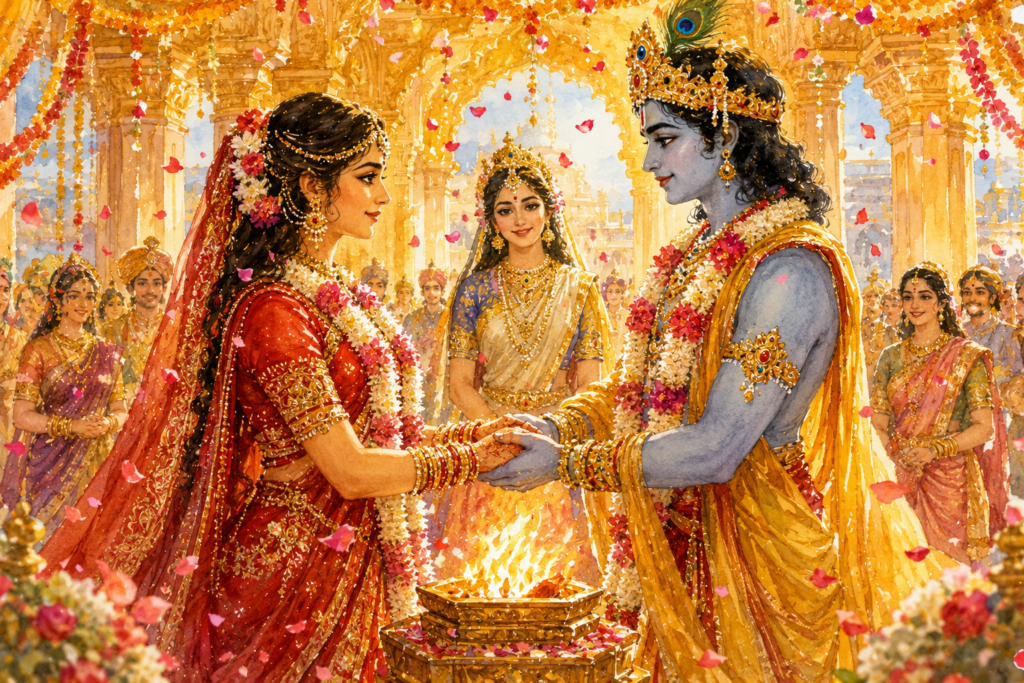
The Wedding — and Rukmini
When the marriage was arranged and preparations began across Dwarka, there was one person whose response mattered more than anyone else’s.
Rukmini.
Rukmini was already Krishna’s first and principal queen. Her own arrival in Dwarka had become legend — the secret letter, the temple escape, the chariot racing away while Shishupala’s forces pursued them. She was Lakshmi incarnate: deeply devoted, inwardly serene, and utterly secure in her place beside Krishna.
And now Satrajit’s daughter was entering that same world.
The traditions do not describe dramatic tension between the two women, nor do they linger over rivalry in the way later retellings sometimes do. If anything, they suggest something more restrained and far more difficult: coexistence shaped by dignity.
Rukmini seems to have understood something fundamental about Krishna long before anyone else did — that love around him did not diminish; it multiplied. She was too deeply rooted in her own bond with him to feel undone by another woman’s devotion.
And that is not a small thing.
To have crossed kingdoms and risked war to stand beside the man she loved, and then to receive another queen without bitterness or coldness, required a kind of grace that the epics rarely speak loudly about, but quietly admire.
That grace shaped everything that followed between the two women.
At times competitive.
At times emotionally complicated.
But beneath it all ran something deeper than rivalry.
Respect.
And perhaps, over the years, even a kind of friendship — something glimpsed later in the forest conversations remembered in the Mahabharata traditions, where affection and familiarity move quietly beneath their words.
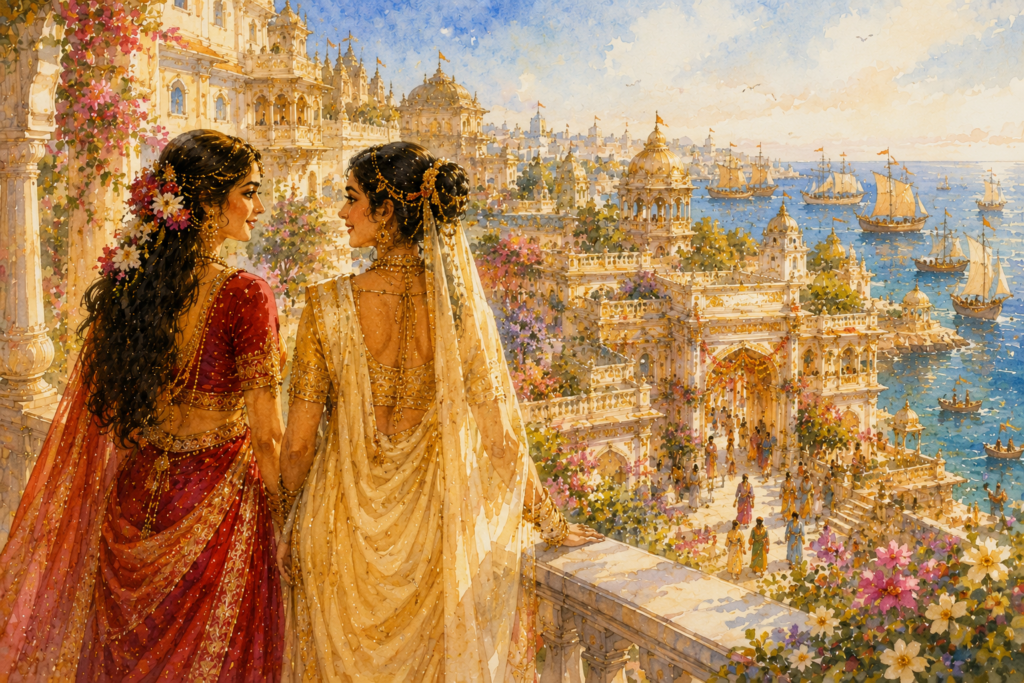
Two Women, One Palace, One Krishna
So this was the beginning of Satyabhama’s life in Dwarka.
She had married the man she had quietly chosen long before the marriage itself became possible. She was now a queen within the same city where she had once watched him from across crowded halls and royal ceremonies.
And beside her stood a woman who was, in many ways, her opposite.
Rukmini was serenity where Satyabhama was fire. Quiet where she was expressive. Inwardly surrendered where Satyabhama loved with fierce intensity. One moved like still water; the other like sunlight.
The traditions surrounding Krishna often portray their love for him as two entirely different expressions of devotion.
Rukmini’s love feels like a lamp — steady, gentle, unwavering, complete within itself.
Satyabhama’s feels like the sun — radiant, passionate, impossible to ignore, filling every space it touches.
And Krishna, somehow, loved both completely.
Not in the same way, but with the strange fullness that seems to define every relationship around him.
What came afterward — the second chapter of the Syamantaka Mani, the battle against Narakasura, the Parijata tree brought from heaven, the conversations with Draupadi years later in the forest — all of it grew from this beginning.
From a girl who grew up in Dwarka hearing stories about a king.
From a love carried quietly before destiny gave it shape.
And from two queens who, from the very beginning, chose dignity over rivalry and respect over resentment.
| Sources and References Sources: Bhagavata Purana (10th Canto, Chapters 56-57) — the Satyabhama marriage story; Vishnu Purana (Book 5); Harivamsha Purana — additional details on Satyabhama; Wikipedia — Satyabhama, Rukmini, Ashtabharya; historified.in — Satyabhama: The Warrior Queen and Consort of Lord Krishna; vedicfeed.com — Eight Wives of Lord Krishna. All reflections are the author’s own. |
From Me To You
What stays with me most in this story is Satyabhama’s certainty. Not loud or dramatic certainty — the quieter kind. The kind that settles into someone slowly and then never leaves. She grew up in the same city as Krishna, heard stories about him from every corner of Dwarka, watched him move through rooms filled with kings and warriors, and somewhere along the way simply knew where her heart belonged.
And I think that is why the Syamantaka story feels so meaningful to me. The jewel did not create the love. It only gave destiny a way to finally bring into the open what had already been growing quietly for years.
Continue Exploring — Satyabhama Series
- Before the Syamantaka: Who Was Satyabhama Before She Met Krishna
- The Syamantaka Jewel: How a Diamond, a Bear King and a False Accusation Brought Her to Krishna
- Satyabhama — The Warrior Queen of Krishna
- Rukmini — The Princess Who Wrote a Secret Letter to Krishna
- Krishnavataram — Everything You Need to Know About the Mythology Behind the Film
Did the quiet beginning of this love story surprise you? Share it with someone who loves the parts of mythology that usually get skipped. And explore the full Satyabhama series right here on Fables n Tales.