

This is one of those old stories that hides inside a much bigger book, where hardly anyone notices it. It sits tucked away in the Mahabharata, told by the sage Markandeya as a small tale within the great epic, and it is easy to read straight past on your way to the famous battles and the famous heroes.
But I have always loved it. It is strange and tender and a little sad, and it has a frog king in it, and it explains, in the way that only the oldest stories do, why a whole kingdom once went to war against frogs. I read it again not long ago, to my own daughter, and watching her face as it unfolded reminded me why these small buried tales are worth digging out.
Let me tell it to you.
Long ago, in the line of kings who ruled from Ayodhya, there was a king named Parikshit. Not the famous one you may be thinking of, this was a different Parikshit, an earlier one, of the ancient Ikshvaku line, the same royal house that Rama himself would one day be born into.
One day this king went hunting in the forest. He saw a stag, and gave chase, and the stag ran, and ran, and ran, leading him deeper and deeper into the trees, until the king had left his companions far behind and was entirely alone. And then, the way these things happen in stories, the stag simply vanished. One moment it was ahead of him, and the next there was no trace of it anywhere.
The king found himself alone in a part of the forest he did not know, tired and thirsty and far from any human path.
And then he heard it.
A voice, singing. A sweet melody drifting through the trees, so lovely that it filled his tired heart with a sudden joy. He forgot the lost stag. He forgot that he was lost himself. He followed the sound toward its source, and there, beside a pool covered in lotus flowers, he found a young woman gathering blossoms and singing to herself, more beautiful than anyone he had ever seen. She was, he thought, as much a delight to his eyes as her song was to his ears.
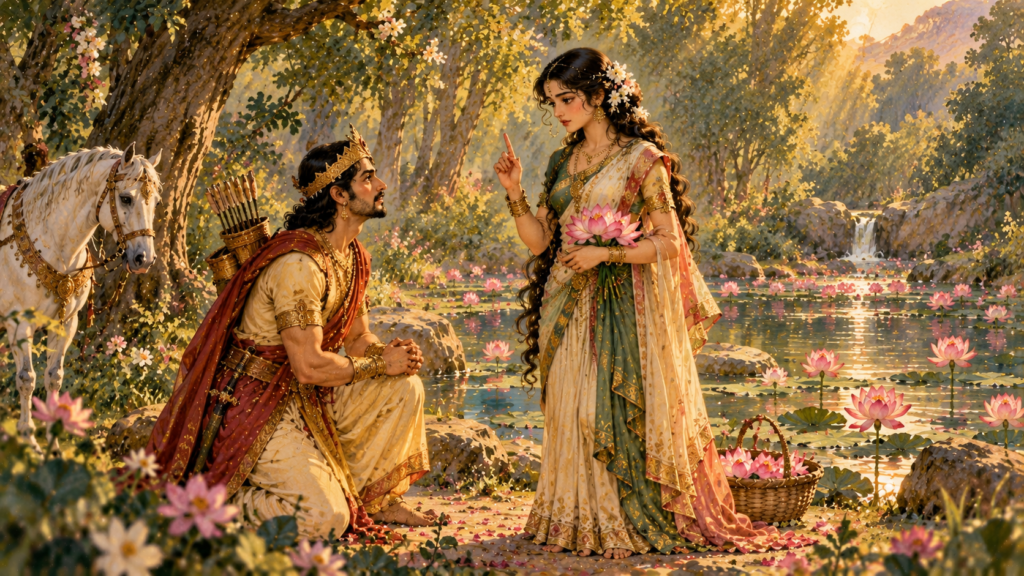
Who are you, the king asked her. Why are you here all alone. Whose daughter are you, and whose wife.
I am not anyone’s wife, she answered. My name is Sushobhana.
The king’s heart lifted even higher. Then will you marry me, he asked. Just like that, a king who had lost a stag and found something far better, asking on the spot.
And the young woman looked at him, and said, I will. I will marry you, on one condition. You must promise me that you will never, ever take me near water.
It was a strange condition. But the king was so taken with her that he would have promised almost anything. He gave his word gladly. And so Parikshit married Sushobhana, and brought her back to Ayodhya, and for a time the two of them lived together in great happiness. He kept his promise faithfully. He simply made sure, in all their days together, that she never came near a pool, a river, or a well. It seemed a small enough thing to do for someone he loved so much.
A promise slowly forgotten
But you know how these things go. A promise kept for a long time begins, slowly, to be forgotten.
One day the king and his queen were walking together in the pleasure gardens of the palace, enjoying the cool of the evening, and their walk brought them near the great bathing pool. And the king, who had guarded his promise for so long that he had stopped even thinking about it, turned to his wife in the happiness of the moment and said, without a second thought, come, let us bathe together in the pool.
And the moment Sushobhana stepped into the water, she was gone.
She did not sink. She did not cry out. She simply vanished, the instant the water touched her, as though she had never been there at all.
The king went half mad. He called for her, searched the water with his own hands, and when he could find nothing, he ordered his servants to search the pool from end to end. They searched, and searched, and at last, near the bottom, all they found was a single large frog, sitting quietly beside a hole in the mud.
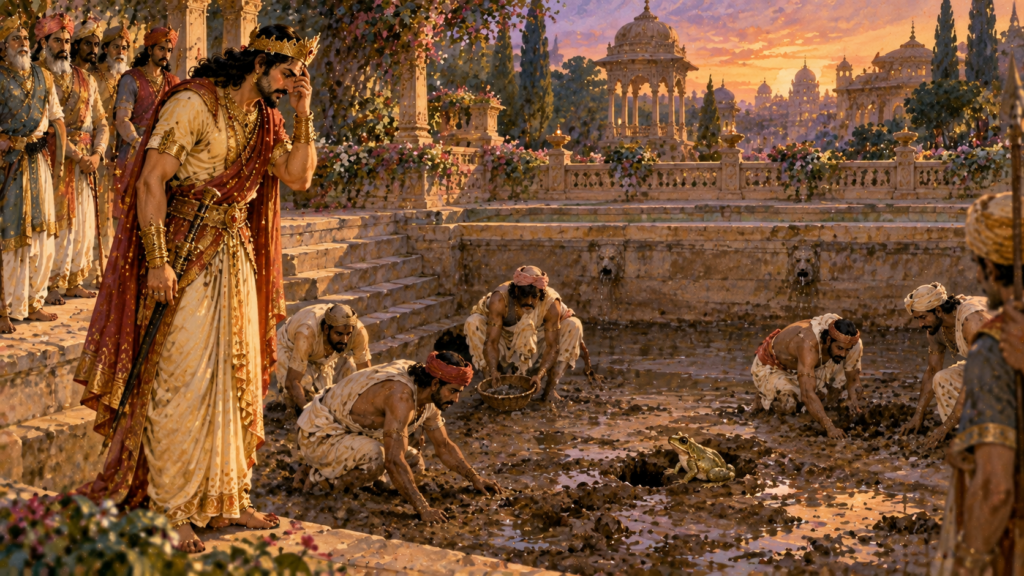
A grief that turned to slaughter
And here the king’s grief turned into something darker, and less wise.
Looking at that frog, sitting there where his wife had disappeared, a terrible thought took hold of him. A frog. A frog had been here when she vanished. Surely, surely this creature, or its kind, had something to do with it. Surely a frog had swallowed his beloved wife.
It made no sense, of course. Grief rarely does. But the king was beyond reason. And because he was a king, his unreason did not stay a private sorrow. It became law.
He gave a terrible order. Every frog in the kingdom was to be killed. He commanded that no one should come before him without bringing a tribute of dead frogs, and so, across the whole of his realm, the slaughter began. People went out and killed frogs by the thousand, in every pond and paddy field and ditch, to satisfy the grief maddened order of their king.
The frog king walks into court
Now, the frogs of the world had a king of their own. And when the frog king saw his people being wiped out, helpless, innocent, dying in their thousands for a crime none of them had committed, his heart broke for them.
So he took the form of an old ascetic, a wandering holy man, and he made his way to Ayodhya, and he came before the throne of King Parikshit.
O King, he said. This is not right. What you are doing is a terrible thing. These frogs have done nothing to you. Why are you destroying an entire innocent people.
And the king, still burning with his grief, told him. A frog took my wife. A frog swallowed the person I loved most in the world. Why should I ever show mercy to frogs. I will go on killing them for as long as I live.
The old ascetic looked at the king for a long moment. And then he set down his disguise.
O King, he said. Look at me. I am no ascetic. I am the King of the Frogs, and my name is Ayu. And I have come to tell you the truth that will end all this killing.
The young woman you married, Sushobhana, she is my daughter. She is a frog princess, who can take the form of a woman. That is why she made you promise never to take her near water. In the water, her true nature returns, and she becomes what she was born as. When you led her into that pool, you broke the one promise that kept her by your side, and she slipped back into the water and came home to me. No frog swallowed your wife, O King. Your wife is a frog. And she is safe, and she is mine.
The king stood in stunned silence as the whole terrible misunderstanding came clear before him. All those frogs. All that death. All of it born from a grief that had never even understood what it was grieving.
What became of them
The Frog King, seeing the king’s genuine sorrow, both for his lost wife and now for the innocent frogs he had destroyed, took pity on him. He agreed to give Sushobhana back. He returned to his own kingdom beneath the water, and he called his daughter, and he told her to go back to her husband and be a true wife to him. And she did. Sushobhana returned to Ayodhya, and the killing of the frogs stopped at once, and the king had his wife again.
The old tellings say they lived on together after that, and had sons, and that from this union came a line of kings. But the part of the story I always come back to is not the ending. It is the middle, that stretch where a good king, undone by grief, did something monstrous, and a whole innocent people paid the price, all because no one had ever told him the truth of what he had lost.
It took the King of the Frogs himself, walking into the court in disguise, to finally say the thing that ended it. She is not dead. No one swallowed her. You have been grieving a lie, and killing my children over it. Stop.
What stays with me about this old story is how much damage the king does while completely convinced he is honouring his love. His grief was real. His love for Sushobhana was real. And out of that real love came an order that killed thousands of innocent creatures who had nothing to do with anything. When we are hurt badly enough, we go looking for something to blame, and we are rarely careful about whether we have found the right thing. The king needed someone to punish for his pain, and the frogs were simply near, and that was enough. It took someone brave enough to walk right up to his throne and tell him the truth to break the spell. It is a small, strange story, buried deep inside a much larger one, but it has stayed with me for exactly that reason.
MORE FOLK TALES
The Frog and the King, a Story About Seeing Worth in the Lowly