

Across India, countless folktales have been passed down through generations, each carrying a simple story and a timeless lesson. This is one such story, a very old and popular folk lore which I heard and read in a story book when I was in my school.
This is a story about a very rich man who was also a very mean man, and about the clever trick he tried to play and how it came back around on him in the most satisfying way imaginable. It is the kind of story that makes you laugh out loud at the end, and I have been looking forward to telling it to you.
✦ ✦ ✦
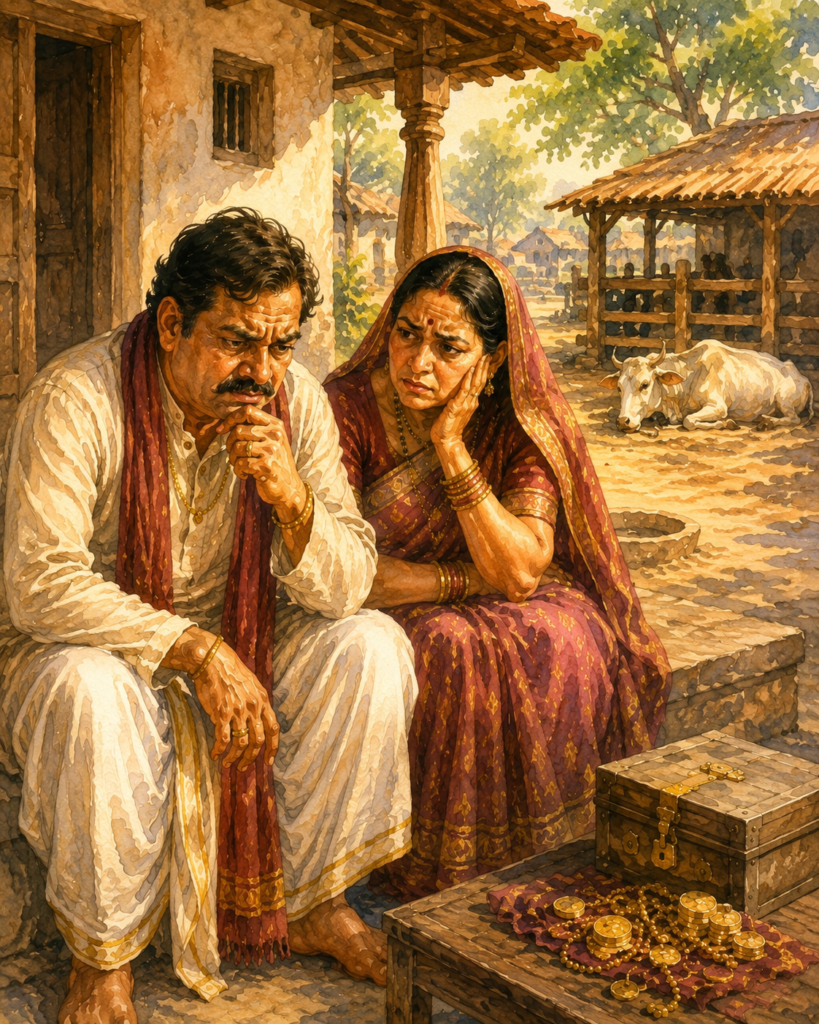
In the village of Chandranagar there lived a patwari, a village landlord and record-keeper — who was enormously rich. He had lands stretching further than the eye could see, and cattle beyond counting. And yet, for all his wealth, no one in that village had ever once seen him part with so much as a single copper coin. He guarded his possessions the way a dog guards a bone, and he loved his money far more than he loved any person alive.
Now it happened one day that one of the patwari’s cows fell ill. Badly ill. Its stomach was bloated, it could barely breathe, and it was plainly about to die.
And the patwari was plunged into deep sorrow, but not, you understand, out of any love for the cow. His grief was over something else entirely. Because when the cow died, he would not only lose the animal itself, he would also have to pay to have the carcass taken away. The man whose job it was to remove dead cattle charged two rupees for the service.
Two whole rupees, out of the patwari’s own pocket, gone forever. It was almost more than the miser could bear.
He talked it over with his wife, who was, if anything, even more tight-fisted than he was. Two heads are better than one, after all, and a shared sorrow is easier to carry.
“Let the cow die, we can’t stop that now,” she said. “But do try to save the expense.”
“Yes, yes,” said the patwari miserably. “That is exactly what is troubling me too.”
✦ ✦ ✦
And then, as the patwari sat there on the veranda of his house stewing over his two rupees, he happened to see a Brahmin beggar coming down the street. A holy man, going door to door as such men did and, importantly, a new arrival in the village, a stranger who knew nothing about the patwari or his reputation.
And the miser was suddenly struck with a truly wicked idea.
“O Brahmin!” he called out, all warmth and welcome. “I was just about to send for you, and here you are, arrived of your own accord! What good fortune!”
“Well, sir,” said the Brahmin, coming closer. “What is the matter?”
“When I fell ill some time ago,” said the patwari, arranging his face into an expression of great piety, “I made a solemn vow. I swore that I would gift a cow to a deserving Brahmin. I have been shamefully putting it off but today, at last, I have decided to fulfil my sacred promise. And you are a man with children, are you not? A cow will be so useful to you. Come, please come with me and take away the cow.”
The Brahmin could hardly believe his luck. He had a houseful of children, and finding milk for them all was a daily struggle. A cow of his own! He was only a little surprised, because he had already heard, even as a newcomer, whispers that this patwari was the stingiest man in the district, a man who avoided giving away anything at all. But here he was, offering a cow, freely. Perhaps the rumours were unfair.
“I shall be very happy to receive your gift,” said the Brahmin. “Only, today is the eighth day of the moon, and tomorrow the ninth. Both are inauspicious days. So, I shall come and take the cow the day after tomorrow, when the time is right.”
“No, no!” said the patwari, far too quickly. “You must take it today. This very day. I cannot abide postponing things, and I have postponed this holy vow far too long already. And besides,” he added piously, “there is nothing like an inauspicious day for receiving the gift of a cow. The worse the day, the better, in these sacred matters.”
Now the Brahmin was genuinely a little uneasy about inauspicious days. But he reasoned with himself, if he refused to take the cow now, this changeable rich man might well give it to somebody else by the day after tomorrow. Better to take it while it was being offered. So, he agreed.
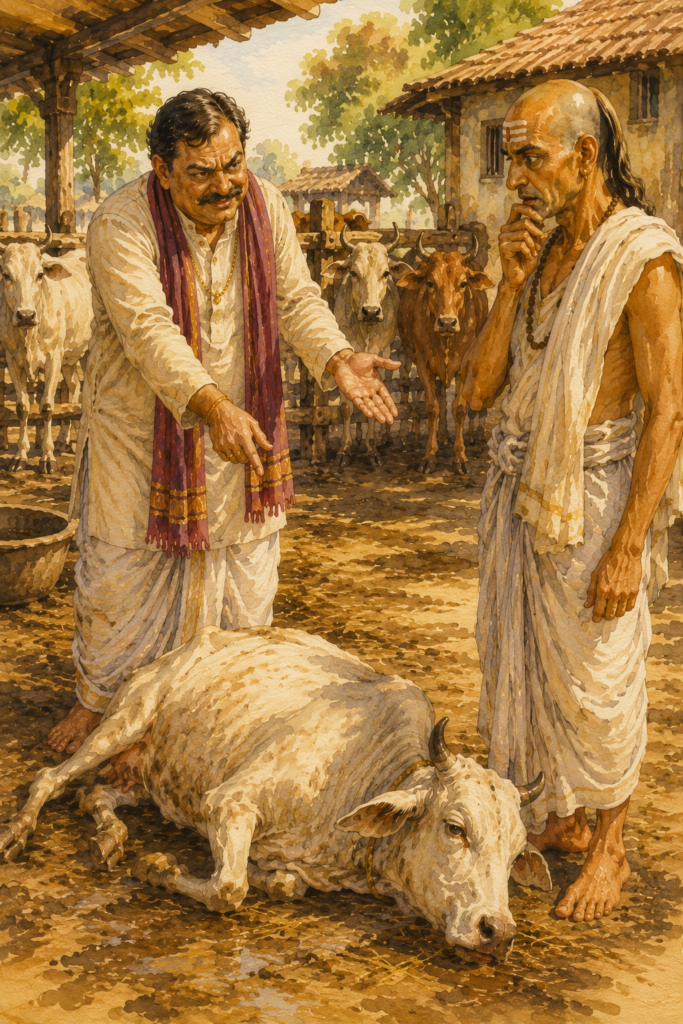
And the two of them walked together to the patwari’s cattle yard.
✦ ✦ ✦
The Gift Turns Out to Be a Trick
The patwari led the Brahmin straight to the sick cow, the bloated, gasping, dying one and said grandly, “There is your cow. Take her away.”
And in that instant the Brahmin understood everything. Why the stingy patwari was suddenly so eager to give away a cow. Why he had insisted it must be today, this very moment, no delay. Why an inauspicious day was suddenly so perfect. The whole thing was a swindle. The man was not gifting a cow at all, he was trying to unload a dying animal onto a gullible stranger, so that when it died, it would be the Brahmin who had to pay the two rupees to have it carted away.
But the Brahmin did not let his face show what he had realised. Instead, he looked at the cow with gentle concern.
“Poor thing,” he said mildly. “It seems to be ailing.”
“Did I say it was not?” the patwari retorted at once, dropping all pretence now that the trap was sprung. “This is the cow I wanted to give away. Sick or dead, she is now yours. I have gifted her to you, and every responsibility for this cow is now yours and yours alone.”
He was very firm about that part.
He wanted it absolutely clear that whatever happened to that cow next, including its death and its disposal was no longer his problem, and no longer his two rupees.
“So be it,” said the Brahmin calmly. “One cannot alter another man’s luck. Give me a few minutes, and I shall take my cow away.”
✦ ✦ ✦
The Brahmin Sees Through the Trick
And here the story turns, beautifully.
Because what the patwari did not know — what he had no way of knowing about this ragged stranger — was that the Brahmin’s father had been a highly gifted veterinary physician. A true healer of animals. And the son, growing up at his father’s side, had learned a great many of the ailments that cattle suffer, and the cures for them.
The Brahmin looked at this bloated, gasping cow, and he did not see a hopeless case that would cost him two rupees. He saw a specific, familiar, treatable illness, one he had watched his father cure many times.
He walked calmly about the yard, searching the ground, until he found the particular leaves he was looking for. He picked them, crushed them in his hands, and squeezed their juice into the nostrils of the ailing cow.
The effect was immediate and dramatic. The cow gave a tremendous, violent sneeze, and out of its mouth dropped a great lump of mucus that had been choking it. And with that obstruction gone, the cow drew a clean breath, and shook itself, and then calmly rose to its feet, entirely well, as though there had never been anything the matter with it at all.
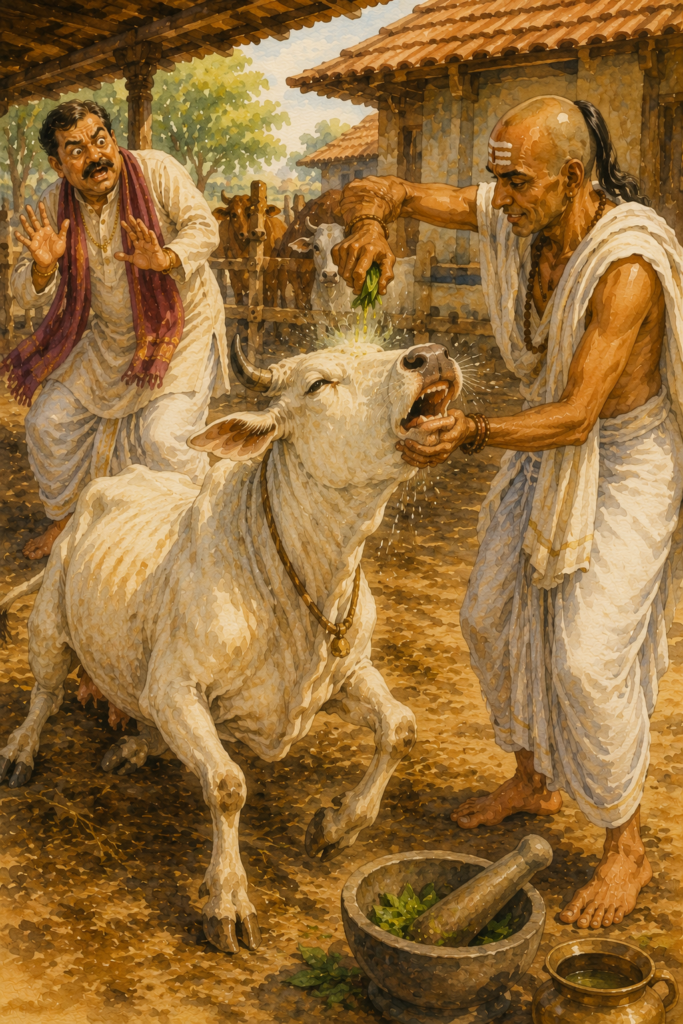
The Brahmin, without a moment’s hesitation, slipped a halter around the neck of the now perfectly healthy cow. He turned to the patwari, pressed his palms together, and thanked him with great and genuine warmth for his generous, sacred gift — a fine, valuable milk-cow, given freely to a poor Brahmin with many children to feed.
And he led the cow away.
The patwari stood in his own cattle yard, absolutely speechless. He had tried to trick a stranger into taking a dying animal off his hands to save two rupees and instead he had watched that stranger cure the cow in about a minute and walk off with one of the finest milkers in his herd, a gift the patwari had declared, in front of witnesses and in the name of a holy vow, to be irrevocably and completely given.
He could not take it back. He had been far too clever about making sure the cow was the Brahmin’s, sick or dead. Now it was the Brahmin’s, alive and well, and there was not a single thing he could do about it.
✦ ✦ ✦
Many Indian folktales remind us that justice does not always arrive through kings, courts, or miracles. Sometimes, it comes through a person’s own actions. In this story, the patwari’s greed becomes the very reason for his loss, while the Brahmin’s knowledge and honesty quietly turn the tables. It is a gentle reminder that wisdom often succeeds where cunning fails.
MORE FOLK TALES
Joy and Luck — The Two Sisters and the Man Who Sold Brooms
The Rupee Tree — A Story About Honest Wealth
The Unlucky Face — A King, a Washerman, and a Very Hasty Conclusion
Did the patwari get exactly what he deserved? Share this satisfying little tale with someone who’ll enjoy the ending as much as we did and explore more folk tales on Fables n Tales.
Source: This story is part of India’s rich oral storytelling tradition and has appeared in different regional retellings over the years. As with many folktales, the names, dialogue, and certain details may vary between versions.