

If you watched Krishnavataram you may remember this moment — the film suggesting that she was originally called just Bhama and that she was called as Satyabhama later, earned through the Syamantaka episode. That the truth she chose to stand by gave her the name she is known by today.
It is a beautiful idea. And I went looking for it in the original texts.
Here is what I found — which is more interesting than a simple yes or no.
What the Scriptures Actually Say
The primary texts — the Bhagavata Purana, the Harivamsha, the Vishnu Purana, the Mahabharata — all give her the name Satyabhama from birth. There is no recorded moment in any of these where she is renamed. She is born Satyabhama. She remains Satyabhama.
She is also called Satrajiti throughout — meaning daughter of Satrajit. And informally, simply Bhama — which is a short form of her name the way we might call someone by a shortened version of their full name.
The Monier-Williams Sanskrit dictionary defines Satyabhama as — having true lustre. The brilliance of truth.
So the scriptural record does not give us the renaming story the film presents. That is the film’s own creative choice — and a beautiful one.
But here is the thing. The film was pointing at something real.
The Name Itself – What Is Packed Into It
The name Satyabhama has three Sanskrit elements woven into it.
Satya — truth.
Bha — brilliance, radiance, luminosity. The same root that gives us Bharat — the land of light.
Ma — glory, Lakshmi, abundance.
Put together: the brilliance of truth. The radiance that belongs to genuine things. Not borrowed light. Not reflected glory. The luminosity that comes from being authentically, completely what you are. The name Bhama alone — just Bhama — means the radiant one. The beautiful one. The dazzling one. Satya is what precedes it. What qualifies it. What makes the Bhama genuine rather than merely spectacular.
Who Was She Before The Jewel
Satyabhama grew up in Dwarka as the daughter of Satrajit — the wealthiest nobleman in the city, the man who had received a divine jewel from the sun god himself. She was beautiful. She was proud. She knew her own worth in considerable detail and was not shy about it.
Her world had a clear order. Her father was powerful. The jewel was the most valuable object in Dwarka. Her beauty made her the most sought-after woman in the city. She had fallen quietly in love with Krishna — the king she watched from across rooms at court gatherings — and was waiting for the world to arrange itself into the shape she already knew it would take.
She was Bhama. Radiant, magnificent, proud, certain. Satrajiti — her father’s daughter.
And then the Syamantaka Mani went missing.

The Twenty-Eight Days
When Prasena did not return from his hunting trip and the Syamantaka Mani went missing, Satrajit drew the only conclusion he felt made sense. Krishna had wanted the jewel. Krishna had been refused. Now the jewel was gone and Prasena was dead.
He said this publicly. In a city where Krishna was the king.
And here is the moment that the Krishnavataram film understood so precisely — even if they dramatised it differently from the texts.
Every social force in Satyabhama’s world was pointing in one direction. Her father — whom she loved — had accused the man she loved. The court believed it. The whispers were everywhere. A girl who was the daughter of Satrajit, living in Satrajit’s house, surrounded by Satrajit’s version of events.
She did not believe it.
Not loudly. Not as a political act. Simply — she knew who Krishna was and she knew he had not done this. And she held that knowledge quietly for twenty-eight days while Dwarka assumed Krishna had gone into a forest and died.
What Holding That Knowledge Cost
I want to be precise about what this cost her. Not everything — she did not renounce her father or make a grand declaration. She was not in a position to do either of those things. But she held her own knowledge of Krishna’s character against the official version being offered by the most powerful person in her immediate world. She did not add her voice to the accusation. She did not let the pressure of her father’s certainty become her own certainty.
That kind of internal steadfastness — maintaining your own clear understanding of something when every convenient social pressure is pointing elsewhere — is precisely what Satya means in its deepest sense.
Satya is not just factual accuracy. It is the quality of being aligned with truth — holding truth in the mind and the heart even when holding it has a cost.
When He Came Back
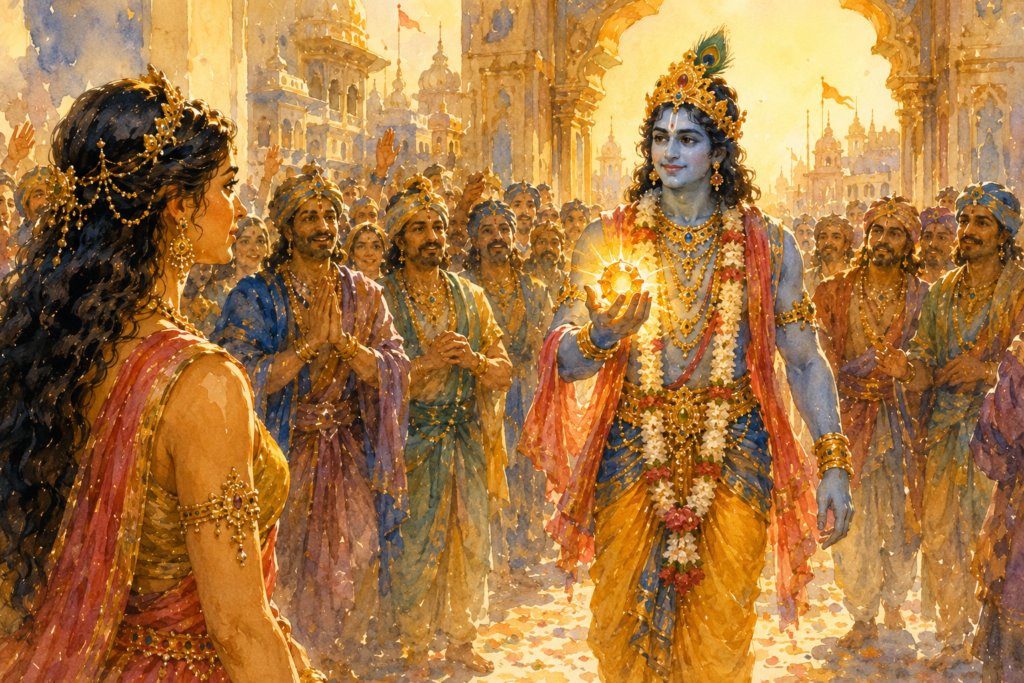
Krishna came out of the forest on the twenty-eighth day. With the jewel. Alive. Every element of Satrajit’s accusation was dismantled by the simple fact of his return.
Satrajit stood in public shame. The man he had accused of murder had spent nearly a month in a cave finding proof of his own innocence while Dwarka assumed he was dead.
And Satyabhama — who had held her belief quietly, without drama, for twenty-eight days — had been right.
Not because she knew the specifics of what had happened in the cave. But because she knew the man. And knowing the man, she had refused to accept the accusation regardless of who was making it.
The Name That Was Already There
This is what I think the Krishnavataram film was pointing at — and what the primary texts encode in a different way.
She was not renamed at this moment. She was already Satyabhama. But the Syamantaka episode was the first major test of whether the Satya in her name was real or merely given.
Names in Indian tradition are not simply labels. They are understood as carrying within them the qualities a person is called to embody. The name is a kind of prophecy — a description not just of what you are now but of what you are becoming, what you are being called toward.
Bhama — radiance, beauty, brilliance — she had always had. That was visible from the day she was born into Satrajit’s wealthy household and grew up knowing her own worth.
Satya — truth, genuineness, alignment with what is real — that had to be demonstrated. That had to be lived. And the Syamantaka episode was precisely the crucible in which it was.
The film dramatized this as a moment of naming. The scriptures encode it as the meaning of a name. Both are pointing at the same thing.
Why This Reading Matters for Everything That Follows
Once you see the Syamantaka episode this way — as the moment Satyabhama’s Satya was demonstrated in practice — every subsequent story about her lands differently.
When she refuses to take Satrajit’s side completely after the jewel is returned — when she maintains her own relationship with Krishna even as her father tries to make amends — that is the same woman.
When she stands on the battlefield against Narakasura and picks up her bow — not as a spectator but as a warrior, fulfilling the ancient boon she made as Bhudevi without fully knowing she was making it — that is the same woman.
When she sits in the forest of Kamyaka across from Draupadi and asks with genuine humility: tell me honestly how you hold a husband’s devotion — that is the same woman.
The Satya was always the deepest thing about her. The Bhama was what the world saw. The Satya was what Krishna saw.
A Note on the Film’s Choice
It is worth saying clearly — the Krishnavataram team made a creative choice that the texts do not support literally but that the texts support spiritually.
There is a long and honourable tradition in Indian storytelling of taking what is latent in a character and making it explicit — finding the moment that the name was truly earned and giving it dramatic form. The Puranas themselves do this. The regional retellings do this. Every time a story has been told and retold across generations it has been shaped by the storytellers who understood something about the character and found a way to make that visible.
The film’s instinct was correct. The Syamantaka episode is the episode where Satyabhama’s Satya was demonstrated in practice. Whether or not she was literally renamed in that moment — and the texts say she was not — the episode is the one that justifies the name she carried from birth.
She was born with the name of a quality she would have to grow into.
| Sources and References Sources: Bhagavata Purana (10th Canto, Chapters 56-57) — the Syamantaka episode and Satyabhama’s marriage to Krishna; Monier-Williams Sanskrit-English Dictionary — Satyabhama defined as ‘having true lustre’; Wikipedia — Satyabhama; Wisdomlib.org — Satyabhama definitions across twelve traditions; VedicFeed.com — Devi Satyabhama; The name etymology analysis is the author’s own reading drawing on Sanskrit scholarship. Note on Krishnavataram: the film’s renaming detail is a creative storytelling choice not found in the primary texts — the analysis here explores what the film was pointing toward and why that reading has genuine scriptural and etymological support. All reflections the author’s own. |
Continue Exploring — Satyabhama Series
- Before the Syamantaka — Who Was Satyabhama Before She Met Krishna
- The Syamantaka Jewel — How a Diamond, a Bear King and a False Accusation Brought Satyabhama to Krishna
- Before the Battles — How Satyabhama and Krishna Began
- Satyabhama — The Reincarnation of the Goddess of Earth
- Krishnavataram — Everything You Need to Know About the Mythology Behind the Film
Did this change how you think about her name — and about names in general? Share this with someone who loved Krishnavataram and wants to know what the film was really pointing at. And explore the full Satyabhama series on Fables n Tales.