

I have always loved folk tales, not just because they are good and fun to listen to, but they give us a message. This was a folk tale I read in a very old book when I was younger. Also, I do think that I found many versions of this story in Tinkle and Chandamama too, but this is the very first one I heard. So, I thought of sharing this with you, just the way I remember.
Let me tell you the end of the story first.
One morning, in a palace in the East, a king and his minister walked into a locked room where two men had spent the night. One man was bright-eyed, upright, visibly pleased with himself. He had worked all night, climbed in the dark, reached a bundle hung from the ceiling, opened it, sorted through it, eaten the peas he found inside, and thrown aside every hard little stone he encountered.
The other man was still half-asleep, blinking slowly in the lamplight, his shawl gathered loosely in his lap.
“Each of you take what you earned from this night,” said the minister.
The first man spread his hands. He had nothing as he had picked only the peas and as he ate them, they were long gone. He looked quite confused on what he can take home, and looked at this empty hands and pockets.
The second man, still yawning, shook open the folds of his blanket. There were diamonds. Not just one or two, but dozens of them. When he picked them up, they shone as bright as the sun in the morning sunlight, and filled the whole room with the light.
But, do you know that the first man had held each one of those diamonds in his own hands during the night. He had thrown every single one of them away.
But why? How did both these men get here, and what exactly happened. We need to know the events that look place the night before to know.
What Happened the Night Before
The lamp was lit. The court was quiet. And the king turned to his minister with the kind of question that tends to start long conversations.
“Tell me honestly,” the king said. “Do you believe in luck? That some people are simply born fortunate, and others are not, regardless of how hard they work?”
“I do believe in luck, Maharaj,” said the minister, without hesitation. “Can you prove it?”
“Give me one night, and two men, one who believes luck is everything, and one who believes that only hard work and effort matter. I will show you both at once.”
The king agreed. Two men were summoned; Bhagya, a gentle, unhurried soul who had always said that whatever was meant for him would find him when the time was right, and Parishram, a driven, sharp-eyed man who believed with complete conviction that if something good hadn’t found you yet, it was simply because you hadn’t worked hard enough for it yet.
The minister looked at them both with a quiet satisfaction. They couldn’t have been more different if he had designed them on purpose. Which, of course, in a way, he had.
What the Minister Did While Everyone Slept
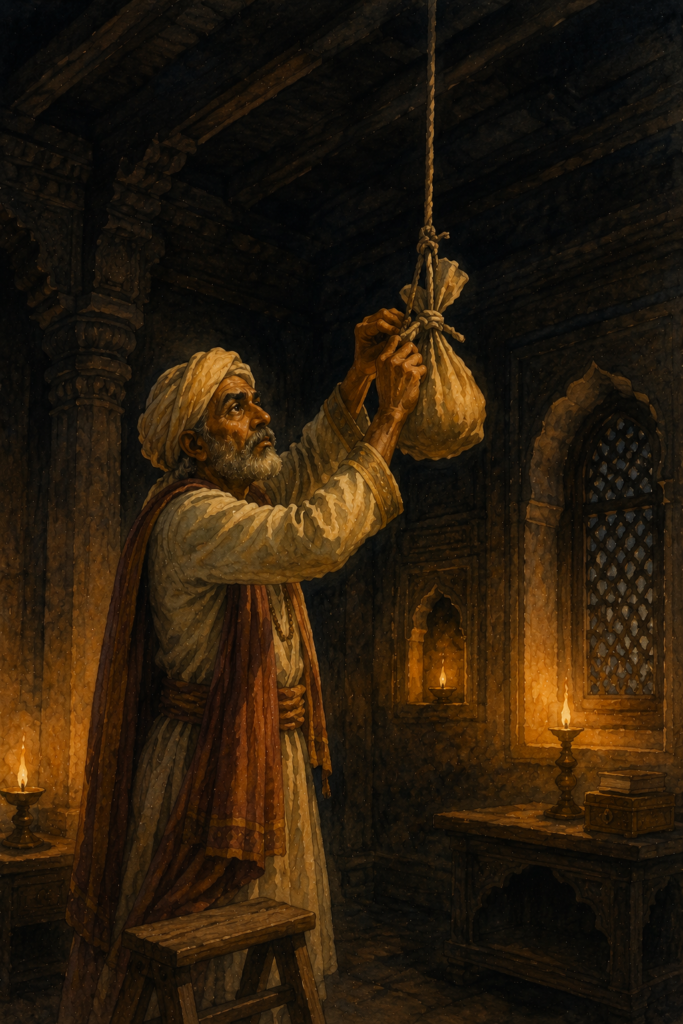
That night, alone in one of the palace’s inner chambers, the minister prepared his proof.
Into a small cloth bundle, he placed a generous measure of ordinary dried peas that were round, hard, and completely worthless. Mixed carefully throughout, he tucked in a small fortune in diamonds, each one no larger than a pea, each one worth more than most men earned in an entire year.
He tied the bundle to a rope and, climbing carefully, suspended it from the highest point of the chamber ceiling high enough that reaching it in the dark would take real effort, real persistence, real ingenuity.
Then Bhagya and Parishram were led in, given no explanation, and left alone as the lamp was taken away and the door shut behind them.
Two Men in One Dark Room
Bhagya looked around, saw nothing in the darkness, and decided, quite reasonably in his own view, that there was nothing to be done. He found a comfortable patch of floor, spread out his shawl, and went peacefully to sleep. Whatever this night held for him would find him. It always had.
Parishram could not have slept if you’d begged him.
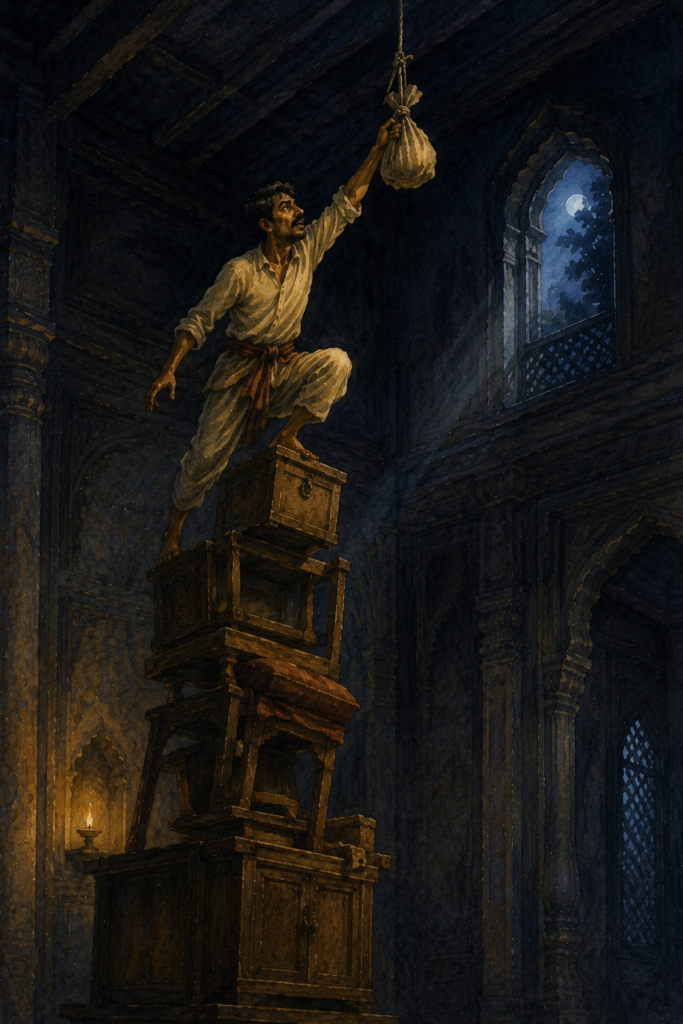
He paced. He felt the walls. He looked upward, and after some time, noticed something hanging faintly above, a dark shape against the dark ceiling. He had no idea what it was. But it was there. And as far as Parishram was concerned, anything above him was worth climbing toward.
He stacked everything he could find, first a chest, a stool, folded cloth, and then a wooden block into a precarious tower, climbed it carefully, and finally reached the bundle with his fingertips. He tugged it free, climbed back down, and sat on the floor to open it in the darkness.
What he found in it were peas, round and hard. He was hungry, so he ate them steadily, one by one. And every so often, one felt different that was harder, sharper, smoother at the edges. Clearly just a pebble mixed in by accident, useless for eating.
Each time he found one of these, he tossed it away in the dark toward where he could hear Bhagya breathing.
“Here,” he muttered, flicking each small stone toward his sleeping companion, “are some pebbles for your idleness.”
Bhagya stirred slightly each time something landed near him, and without really waking, gathered the small hard things into the folds of his blanket from sheer habit, then drifted back to sleep without any curiosity about what they were.
Well, It Was Morning
Which brings us back to where we started.
Parishram, empty-handed. Bhagya, holding a lapful of diamonds that he never asked for, never worked for thrown there, one by one, through the night, by the very man now staring at him in disbelief.
The king turned to his minister. “So, you are saying that luck is everything? A man just sleeps and grows rich?”
“Not quite, Maharaj,” said the minister carefully. “I am saying luck is real but look at what it actually looks like. Peas mixed with diamonds, in the dark, where you cannot tell which is which. It does not announce itself. It does not arrive wearing a sign.”
He paused. “And notice this too: Parishram worked all night with tremendous effort and real intelligence. He solved the problem. He reached the bundle. But he was so certain he already knew what he was holding that he threw away every diamond he touched without once wondering if he might be wrong. His effort did not fail him. His certainty did.”
The king was quiet. “So, what should a person actually do?” he finally asked.
The minister smiled. “Work hard. Stay patient. And when something lands in your hands in the dark, before you decide it is worthless and throw it away perhaps look at it more carefully first.”
Why Is This Story Relevant Even Today?
Well, many of us do believe in luck, and I feel that luck is indeed real. But it looks exactly like everything ordinary around it, and it rarely announces itself. Having said that, effort and hard work is needed to. It can be said that effort paired with the certainty that you already know everything can make you throw away the very thing you worked so hard to find.
In this story Bhagya did not win because he was lazy. There is another way to look at it. He won as he did not throw anything away. In life, people who are wise should hold to both the effort and the open hands like that of Bhagya. It is also important to have the wisdom to know which one to hold on to when the moment comes.
What stays with me most is the image of Parishram’s hands in the dark. He held a diamond. He felt it carefully. He decided it was a pebble and threw it away. Then he held another. And did the same thing again. All that effort, all that determination, and he talked himself out of the treasure every single time because he was too sure of himself to wonder if he might be wrong.
We all do some version of this, I think. Work so hard and with such focus toward one idea of what success should feel like that we fail to notice when something valuable arrives in a form we weren’t expecting.
I think the story doesn’t say ‘work hard and you’ll succeed.’ It doesn’t say ‘just trust the universe.’ It says something much harder: that luck and effort are both real, both imperfect, and both capable of failing you in different ways.
MORE MORAL TALES
The Rupee Tree — A Maharashtrian Folk Tale About Honest Wealth
Surigaadu and Porigaadu — The Woodcutter and the River Goddess
The Tank Full of Milk — What Happens When Everyone Makes the Same Small Choice
Did this story make you think about the diamonds you might have thrown away without knowing? Share it with someone who needs a reminder to look carefully before letting go and explore more tales on Fables n Tales.