

There are a few stories that you read one and they are stuck with you for life. I came across this Indian folk tale, the first time when I attended a reading club event at a park near my house. I read it in a book from a co-reader who attended the event, but I somehow did not take the note of the books name as it had a cover. Later I shared this with my daughter, and many other kids.
This story of seven sisters, a forest, some cream I did remember the snippets of it, but the details had blurred with time, the way certain stories do when you carry them in your memory for too long without being able to find them again. I finally tracked it down, and I am so glad I did, because this story deserves to be told properly.
This amazing story comes from Bihar. It is old, but under its gentle surface, one of the most quietly devastating and then quietly beautiful folk tales I have ever come across.
A Family That Was Always One Meal Short
There was once a Brahmin who lived in a village with his wife and seven daughters. He was a priest by vocation, which meant he lived on whatever the villagers could spare. Sometimes it was just a handful of grain here, a length of cloth there, given in exchange for the religious rituals he performed at their homes.
The villagers, though, were themselves poor. They had small plots of land, a few cattle between them, and barely enough to go around. What they gave the Brahmin was given from their own scarcity.
As the years passed and the daughters grew, the family’s needs grew with them. This happens with every household we see. The family needed more food and more of everything actually. The Brahmin walked from door to door every single day and still, on certain nights, he and his wife went to sleep without eating anything at all. Whatever was given to the brahmin by the villagers were just adjusted to meet the needs of their daughters.
A Bowl of Kheer
One day the Brahmin felt a craving for kheer, that simple, sweet rice pudding that tastes somehow of every good thing at once. He mentioned it to his wife, almost shyly, as if the wish itself were an indulgence he wasn’t quite entitled to.
His wife, who loved him completely and hated to see him go without, said, “Go to the cattle-rearing farmers tomorrow morning. Beg a little milk, some rice, some sugar. I will cook it for you.”
He did. He walked to distant villages the next day and came home at dusk with just enough milk, sugar and rice, carefully gathered.
His wife measured it out. “It’s enough for one,” she said quietly. “Just about enough.” She made a decision without fuss, the way mothers make their hardest decisions. “I will feed the girls something simple first, and put them to sleep. Then I will cook the kheer, and you shall eat it in peace.”
She did exactly that. Long after midnight, when all seven daughters were sleeping, she set the kheer on the fire and cooked it slowly, and brought it to her husband.
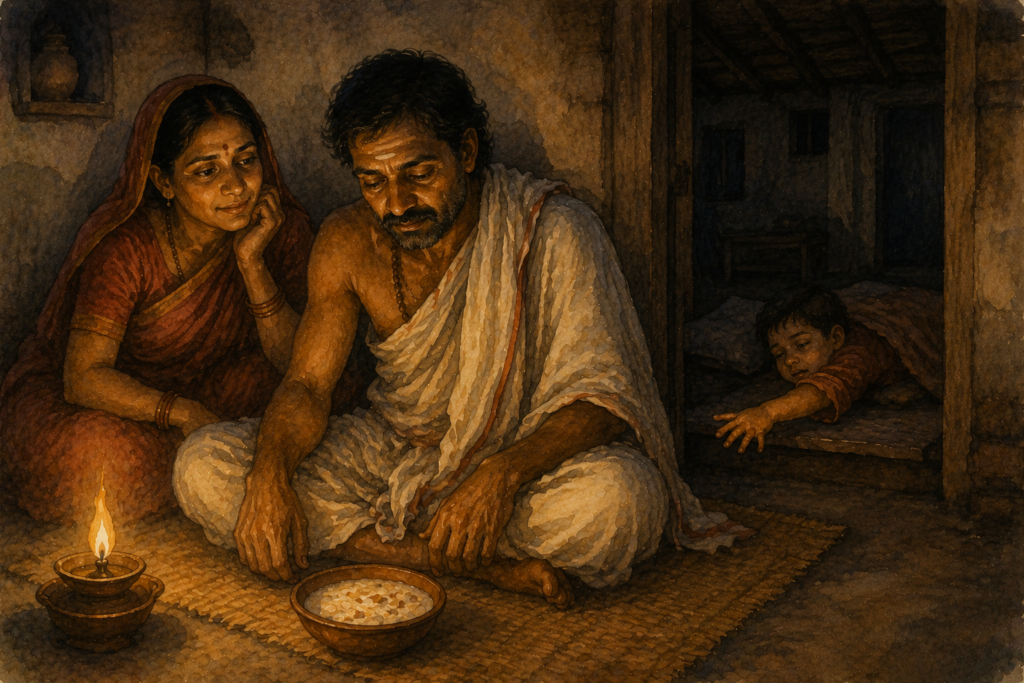
As soon as he lifted the first spoon to his mouth, the youngest one woke up.
Her mother quickly murmured, “Hush come here quietly.” The Brahmin, helpless against his own heart, put a spoonful of kheer into his smallest child’s mouth to help her go back to sleep.
The second daughter woke. Then the third. One by one, drawn by some instinct that sleeping children have for food, all seven daughters woke and found their way to their parents in the dark. One by one, he fed them.
The bowl was empty. He and his wife went to sleep hungry again, exactly as they had so many nights before.
The Thought That Should Never Have Been Thought
The next morning, the Brahmin woke feeling the full weight of everything. He sat with his despair for a while. How would he marry off seven daughters? He could barely feed them. The thought circled his mind, getting darker with each turn, until it landed somewhere very wrong.
He told the girls about a tree in the forest which was laden with the most wonderful berries, sweet and fat and ripe. Their eyes lit up at once. They hadn’t had a proper treat in longer than they could remember. He then took them to the deepest part of the forest.
He shook the branches until the fruits fell, and the seven girls bent to pick them up and eat, heads down, fingers busy, utterly absorbed.
And then their father slipped quietly away, using the old excuse that he needed to attend to nature’s call. He didn’t come back.
I want to be careful here, because this is the part of the story that is hardest to sit with. He was not a cruel man. He was a desperate one. These are not the same thing. But the line between them, in that moment in the forest, was very thin.
Seven Sisters, Alone in the Dark
When the fruits were gone and the girls looked up, the sun was low. The forest had grown quiet in that particular way forests do at dusk suddenly full of invisible things. They were scared and started calling for their answer. But there was no one.
They called again and again, but all they could hear was silence and the echo of their voices.
Some of the younger ones began to cry. The eldest sister, who was the most level-headed of them all, put a stop to that quickly. “Father will not come,” she said, without malice, just plainly. “We need to find somewhere safe before dark.”
They walked. And by some grace they could not have planned for, they came across an old house. The house looked like it was long abandoned, standing at the edge of a clearing. They went inside.
What they found there stopped them in their tracks.
Seven stoves. Seven clay pans, each set on a stove. And in each pan, there was freshly boiled milk, and it was covered with a thick, unbroken layer of cream. They ate. Every last spoonful of it. And then, exhausted and full for the first time in a long while, they found a corner and fell asleep.
The Bears Come Home
The house belonged to seven black bears.
Every morning before daylight the bears milked their seven buffaloes, poured the milk into the pans to boil, and went out into the forest to graze their herd. When they returned each evening, the cream would be waiting for them, thick and rich and they would eat it with the milk underneath.
That evening, they came home to seven pans of milk with no cream on them at all. They looked at the pans. They looked at each other. They searched the house thoroughly and found nothing, and nobody.
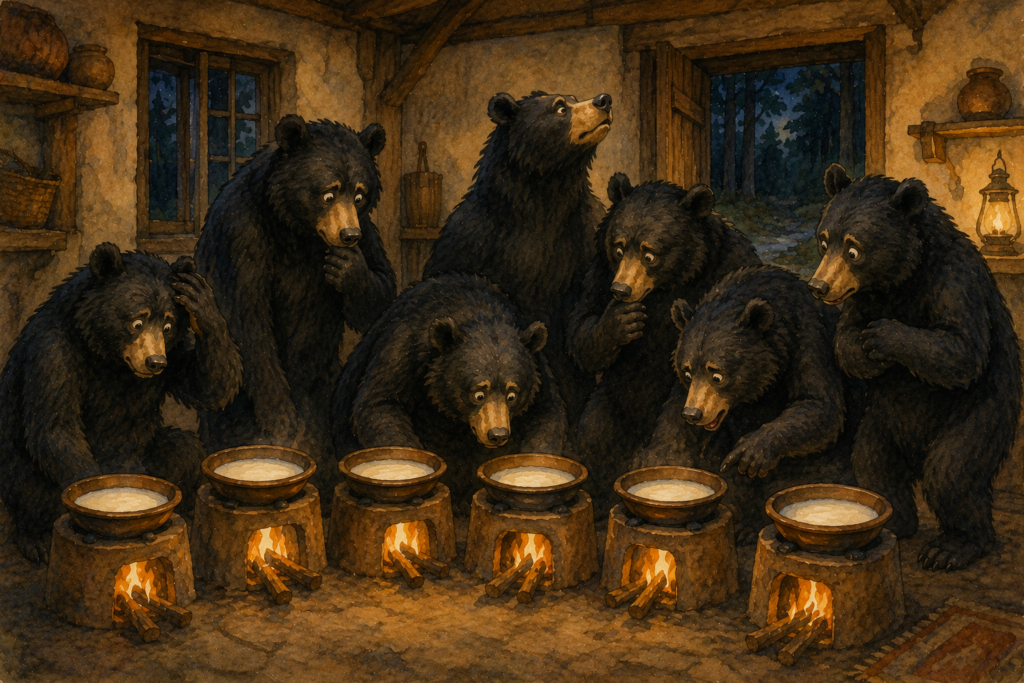
The bears just drank the cream-less milk. They went to sleep, confused. The next morning it happened again. And the morning after that. For seven or eight days, the same thing. The cream was gone, no milk left, and there was no trace of anyone.
The bears held a conference. They considered every explanation. They could find no evidence of any visitor, any thief, any animal clever enough to take only the cream and leave the rest.
The eldest bear always the most cautious arrived at the only conclusion left: “It must be ghosts. Invisible ones. If they are eating our cream today, they may devour us tomorrow. We should go, before that happens.”
The other bears agreed without much debate. All seven of them, left the house, walking out of their own home, abandoning their buffaloes and their stoves and everything they had built, because they were frightened of something they couldn’t see.
The Life They Built
After the bears were gone, the seven sisters had a house, seven buffaloes, and seven stoves.
They herded the buffaloes each morning. They boiled the milk each afternoon. They made cream and yoghurt and sold what they could. In the evenings they came home to warmth and food and each other.
In a few weeks, their cheeks filled out. Their step lightened. They began to laugh again in the way young women laugh when they are not afraid, easily, suddenly, over small things.
Though they had had been abandoned in a forest, they were living very quietly, and happily.
The Father Who Couldn’t Forget
Meanwhile, the Brahmin’s conscience had not left him alone for a single day since he walked out of that forest. He thought of his daughters constantly, their faces when they were eating those berries, heads bent down, completely trusting. He had walked away from that trust and it had not left him.
One day he went back into the forest to look for them. He found the house. He found seven healthy, happy daughters who ran to him with more warmth than he deserved. He broke down completely.
“Forgive me,” he said. “Forgive me for leaving you. Come home. Your mother is waiting. Please come home.”
The girls, after some hesitation agreed. They came home, bringing all seven buffaloes with them. And just like that, overnight, a man who had nothing became a man with seven buffaloes, a dairy, an income, and daughters healthy enough to be married to good families and that did happen in time.
Well, like they say, you never know when and how your luck will smile on you.
So, What Can We Take from This Story?
- Despair can push even a loving person to a terrible decision. This doesn’t excuse it but it explains it, which is not the same thing.
- The eldest sister’s steadiness in the forest — no wailing, just thinking — is the reason any of them survived. Quiet leadership in a crisis is its own kind of extraordinary.
- The bears’ fear of the invisible is what gave the girls their future. Fortune sometimes arrives not through your own effort but through someone else’s misunderstanding of a situation.
- And a father who comes back — genuinely remorseful, genuinely changed — deserves, perhaps, to be met halfway. The daughters’ warmth when they saw him is part of what makes this story beautiful rather than simply sad.
What stays with me most is that small detail of the eldest sister in the darkening forest. She didn’t pretend everything was fine. She didn’t waste time on anger. She said plainly what was true that the father is not coming back. She then immediately turned her mind to what needed to happen next. She was, at that moment, more of an adult than any adult in this story.
I also think about the bears. Seven bears, who had built a good, steady life, undone by seven mouthfuls of cream they couldn’t explain. I suppose that’s a story too, about how fear of the invisible can make you abandon the very thing that sustains you. But that story belongs to the bears, and this one belongs to the sisters.
MORE FOLK TALES
Why the Moon Is Loved and the Sun Is Feared — A Very Old Indian Folk Tale
Surigaadu and Porigaadu — My Father’s Story of the Woodcutter and the River Goddess
The Golden Stag — The Wish He Carried All His Life
Did this story stay with you? Share it with someone who needs a reminder that fortune sometimes arrives through the most unexpected door and explore more folk tales on Fables n Tales.