

There are some things a person carries alone for a whole lifetime. It can be a sight they can’t explain. A wish they’re afraid to say out loud. Something seen once, in the hills, far from the city, when the light was just so and then never again.
An old hunter carried something like that. He had seen a golden stag, just once, when he was young. He told no one. Not his wife, not his friends, not a single person in all the years between that morning in the hills and the last night of his life.
Only then, lying on his deathbed, did he finally tell his son.
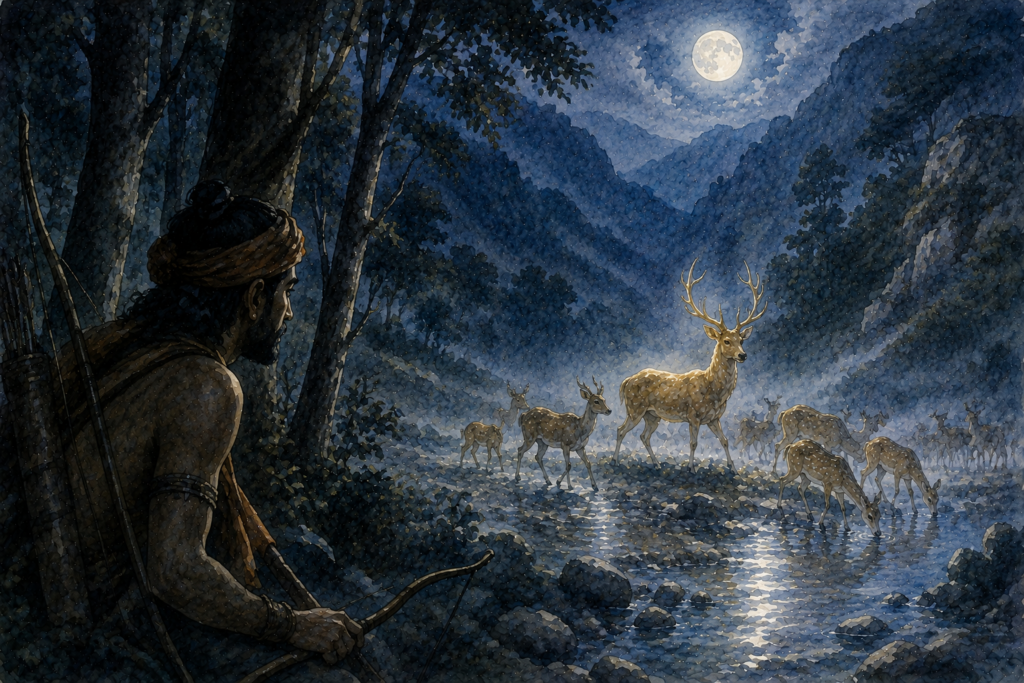
It was up in the hills, far from the king’s city. A rill ran over sands of silver. The golden stag led a herd of deer down to the rill, to drink.
His son listened. And understood, in the way that children of hunters understand things, that this was not just a story. It was a trust being placed in his hands.
A Son Who Was a Hunter Only by Birth
The son was a hunter too but not by heart.
He felt love for all living things, and had no wish to kill. What he truly wanted, deep in the quietest part of himself, was to leave hunting behind entirely. To go into the hills, live simply, and grow wise.
But he had been born the son of a hunter. And so, a hunter he had to be, because that was simply how life worked, and he had not yet found a way around it. Until the day the queen had a dream.
A Dream, and a Command
The queen dreamed of a golden stag seated on a golden throne, teaching. The things he spoke were so wise that she woke with tears on her face and one word in her mouth catch him. She told the king. The king asked his hunters if any had heard of such a creature.
Only one had. “My father saw it, Sire,” the young hunter said. “He told me on his deathbed. It lives in the hills, far from the city.”
“Go,” said the king. “Bring it to the queen.”
And so, the hunter went up into the hills his father had described, until he found a rill running over sands of silver. He set a snare in the path the deer always took to water. He hid himself among the trees.
That night, in the moonlight, the herd came down to drink. And at their head walked the golden stag.
The Cry of Capture
The golden stag stepped into the snare. He cried out, that particular cry an animal makes when it knows it is caught and the whole herd scattered instantly into the dark. But not all of them.
Two deer turned back. They came to the golden stag, struggling against the thong that cut into his leg, and tried with their teeth and hooves to free him. The snare held.
“Go,” the golden stag said to them. “Go with the rest. You are still free.”
“We will not go,” said the two deer. “We will stay and die with you.”
The hunter, hidden in the trees, felt something move in his chest. Something he had no word for, but which made it impossible to stay where he was. He came out from among the trees with his knife in his hand. He stooped down. He cut the snare. He set the golden stag free.
The Wish of the Heart
The golden stag stood and looked at him. “Why did you snare me, hunter?”
The hunter told him about the queen’s dream. About the king’s command. “Then why do you set me free?”
“Out of love and pity,” said the hunter.
The golden stag was quiet for a moment. Then he said something that no one had ever said to this man before.
“Hunter, you are no hunter at heart. What is the wish of your heart?” And the hunter, for the first time in his life, said it out loud. “To be a hermit. And grow wise.”
The golden stag said: “Brush my back with your hand.”
The hunter did. Golden hairs from the stag’s back clung to his palm.
“Keep them. When a man feels love for all things, hairs from the back of a golden stag can make him wise. Now look into my eyes.”
The hunter did.
“What I know, you know,” said the golden stag quietly. “Go back now to the queen. What to say to her will come to you.”
Then he turned, and walked into the trees, and was gone.
The Words That Came from Somewhere Else
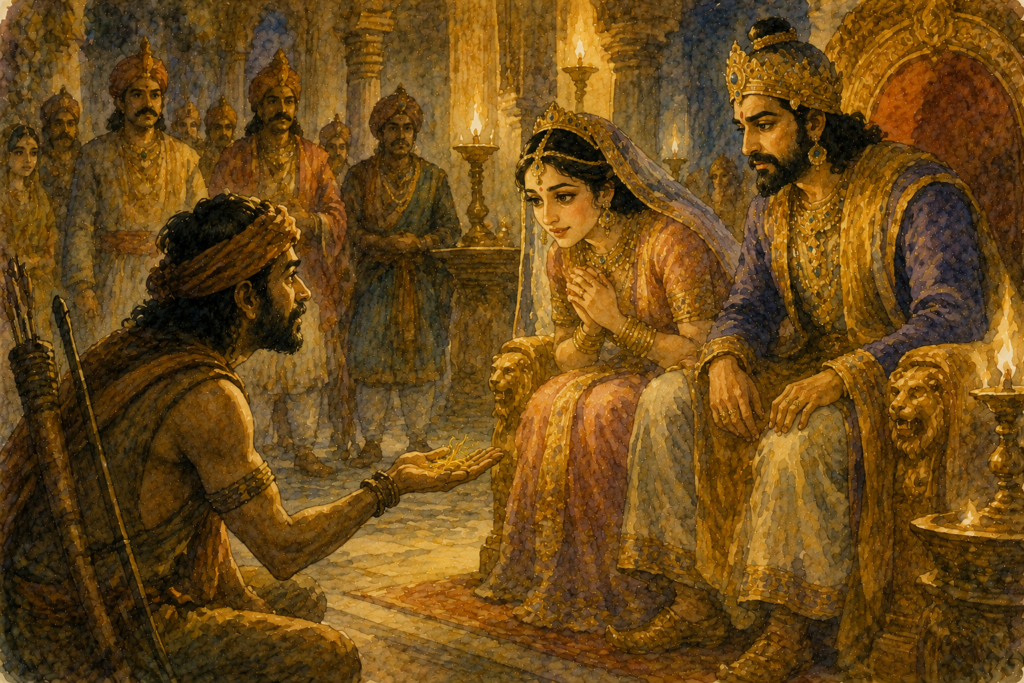
The hunter went back to the city. He came before the king and the queen and told them everything. All about the snare, the two deer who would not leave, the cutting of the thong, everything the golden stag had said.
And then new things began to come into his mind, wise things, things he did not know he knew, things that simply arrived as he spoke, the way sunlight arrives through a window you’ve stopped noticing is there.
When he finished, the queen was weeping.
“This is exactly how the golden stag spoke in my dream,” she said. She turned to the king. “Sire, give this man the wish of his heart. Let him be a hermit.”
“I will,” said the king.
And so, the hunter was a hunter no more. He went to the hills, lived simply, and grew wise and wiser, in time, than anyone in the kingdom had expected. So wise that even the king came to sit at his feet. So wise that the golden hairs in his palm, which he kept all his life, never seemed to lose their quiet warmth.
A wish held silently for a whole lifetime does not disappear, it waits, and sometimes it waits for exactly the right moment to be heard. The story also teaches us about compassion. The hunters simple act of cutting a snare because he cannot bear to watch a creature suffer opened a door for them that no amount of clever effort ever could.
Also, the two deer who turned back when the whole herd fled are easy to miss in this story. But they are its quietest and most important detail – loyalty.
What moves me most is that small moment before the hunter cuts the snare. He came out from the trees with his knife in his hand. He could have used it either way. He chose the one that cost him the king’s reward, his duty, everything expected of him and gained, in its place, everything he had ever actually wanted.
I found this story in an old book on the internet archive, and it stopped me completely when I read it. Not because of the golden stag, magical as he is but because of that hunter, born into a life he never chose, carrying a wish he never said out loud, waiting all those years.
We don’t always get to be what we truly are from the beginning. Sometimes life places us in a role that doesn’t quite fit, and we wear it dutifully for years while the real wish sits quietly in the deepest part of us.
I love that in this story, it was an act of pure compassion, not cleverness, not ambition. I was just the inability to watch two deer try to die for their friend, and that finally turned the key. The golden stag didn’t give the hunter wisdom because he was talented. He gave it because his heart was already in the right place. It always had been.
MORE FOLK TALES
Surigaadu and Porigaadu — My Father’s Story of the Woodcutter and the River Goddess
The Rupee Tree — A Maharashtrian Folk Tale About Honest Wealth
Bhagya aur Parishram — The Morning a Lazy Man Opened His Blanket and Found Diamonds
Did this story reach something quiet in you? Share it with someone who has been carrying a wish they haven’t yet said out loud and explore more folk tales on Fables n Tales.