

I can say this is a very old story, something I heard when I was five from my grandmother. It was a very beautiful story of why the sky is the way it is now. Why do we love the moon more than the sun? Well, as per my grandmom and her mom, there is a story about it. And, like most of the stories, it starts at a dinner party.
It Started When the World Was Young
Once upon a time, when the world was still new, the sky itself was a living, breathing mother. She had three wonderful children.
The Sun was the eldest of them all. He was always blazing, and was proud and very certain of this own importance. Well, we all know how important sun is to us. The youngest was the Wind. He was restless, very shard tongued and was always in a hurry.
She had a daughter too. And, you may have guessed by now. The Moon was her daughter. She was very gentle, quiet, the kind of child who notices things that others walk straight past.
One day, their uncle Thunder and their aunt Lightning invited all three children to a great feast. The Sky, their mother, blessed them warmly as they left, hoping they would enjoy themselves and settled in at home to wait for their return.
Now, you should know, the Sky never went to feasts herself. She was always at home, working. Always watching. Always waiting. She was very similar to most mothers back then.
The Feast
Oh, what a feast it was. Thunder and Lightning had laid out the most magnificent spread rich curries, sweet things, dishes piled high with every good thing imaginable. The kind of spread you remember your whole life.
The Sun and the Wind fell upon it immediately. They ate and ate, dish after dish, savouring every bite, congratulating their uncle and aunt on the food, and thinking not once, not even for a single moment of their mother sitting quietly at home.
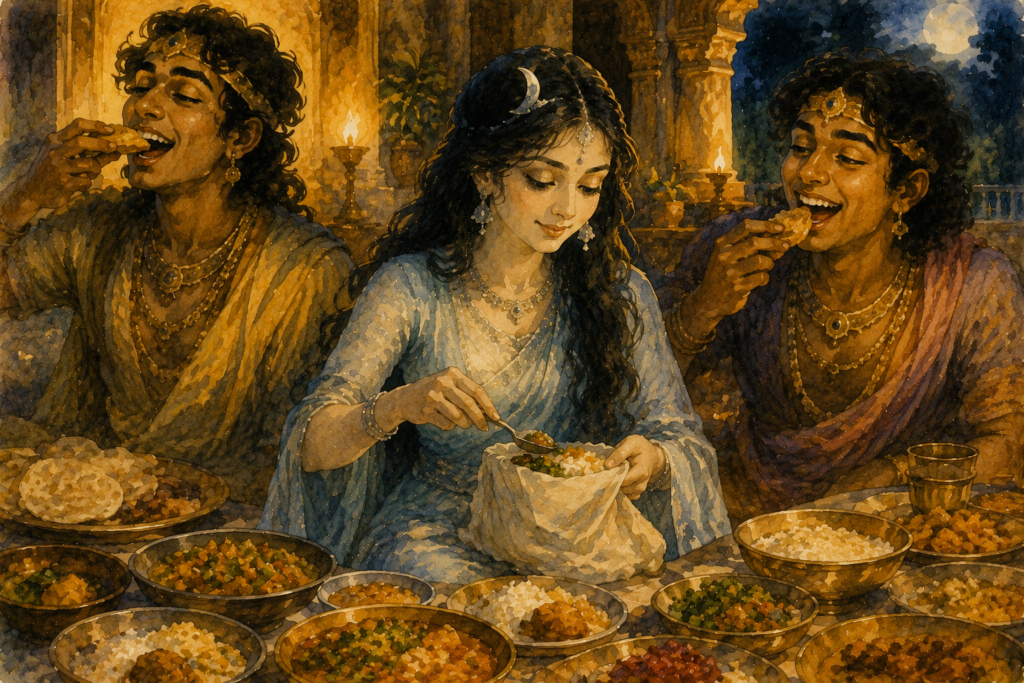
But the Moon ate differently.
Of every dish that was placed before her, she took a small taste and then, quietly, she set a little aside. A spoonful of this. A small piece of that. Tucked carefully into a cloth she kept in her lap, saving it, thinking of someone who wasn’t there. Nobody noticed. They rarely do, with the quiet ones.
Coming Home
When the feast was over and the three children returned home, the Sky looked up from where she had been waiting. “Well, my children,” she said, and her voice was warm and hopeful. “What have you brought for me?”
The Sun stared at her. Then he drew himself up to his full, blazing height.
“What do you mean?” he said, with magnificent indignation. “I went to a feast to eat and to enjoy myself not to carry food home like a servant! Besides,” he added, looking her up and down, “you wouldn’t even appreciate such delicacies. You have very coarse ways of eating, and you have no teeth! What would you even do with fine food?”
“To be sure!” snapped the Wind, not to be outdone. “You don’t know how to eat! And what did you expect us to do stuff our pockets, spoil our good clothes, wrap food in our handkerchiefs like children? It isn’t done in respectable houses. But then, how would you know anything about that?”
The Sky said nothing. She had no words left for this only a grief so old and so large it had gone quiet inside her. Then the Moon stepped forward.
“Don’t,” she said, to her brothers, quietly but with a firmness that surprised even herself. “Don’t speak to our mother like that.”
She turned to the Sky and held out the cloth bundle she had been carrying all the way home. “Mother,” she said simply. “I brought you a little of everything. Taste it please.”
The Mother’s Answer
The Sky looked at her daughter for a long moment. Then she took the cloth bundle, and held it against her heart before she opened it. “May you live long, my moon-child,” she said softly. “May you live long.”
And then she turned to her sons. What came out of her then was not quite anger, and not quite grief. It was something older and quieter than either. Something that had been waiting a long time to be said.
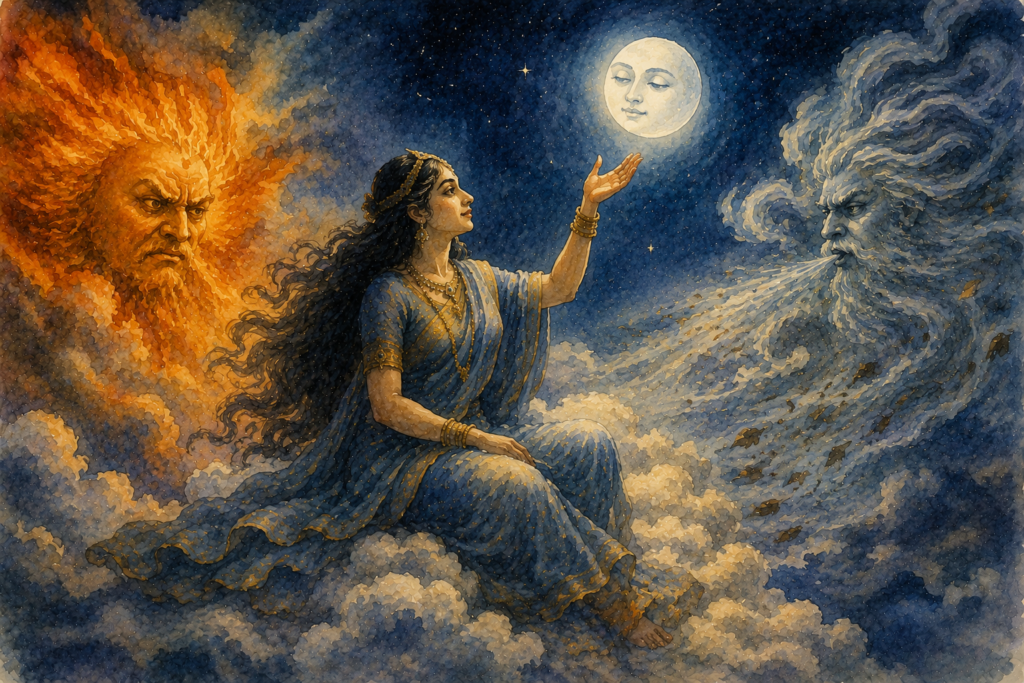
“You, my eldest, you who went out to feast and never once thought of the mother who waits for you, who works for you every day of your life you shall roast in eternal fire. Your rays shall scorch. You shall burn everything you touch. And when you blaze your brightest, men shall turn their faces away from you and curse your pride.”
“And you, my little Wind, you who are always blowing and puffing and talking of good manners while showing none you shall blow in dry heat and parch everything in your path. Men shall dread you when you are about.”
Then she looked at her daughter, and her voice changed entirely.
“And you, my Moon, you who remembered me when no one else did, you who kept a little warmth in your hands all the way home. You shall be cool and calm and beautiful always. Men and women will lift their faces to you with love. Children will reach for you. Poets will sing to you. And all your life, wherever you go, you will be called blessed.”
And That Is Why
This is why, even now, the Sun in his fiercest hours beats down without mercy and men squint and sweat and wish he would go away.
This is why the Wind, when he is strong and dry, shrivels the leaves and chaps the lips and makes everyone close their windows.
And this is why the Moon, rising soft and silver over the rooftops, over the fields, over the sleeping city, is loved by everyone who sees her, without quite knowing why.
She remembered her mother. That’s all. She just remembered.
What I love about this story is how ordinary the Moon’s gesture actually is. She didn’t do anything extraordinary. She just thought of someone who wasn’t in the room. That’s it. That’s the whole thing. And somehow, across all these centuries and all these retellings, that small act of remembering is still the most beautiful thing in the story.
This is one of those stories that has been told around fires and on verandahs and at bedsides for so long that nobody can quite say where it started. I think most of us have been all three of these children at some point. We’ve been the Sun, too full of our own feast to think of anyone at home. We’ve been the Wind, using good manners as a weapon. And if we’re lucky, just every once in a while, we’ve been the Moon, remembering to tuck something away, to carry a little of the good thing home, for someone who waited.
MORE FOLK TALES
The Golden Stag — The Wish He Carried All His Life
Surigaadu and Porigaadu — My Father’s Story of the Woodcutter and the River Goddess
The Rupee Tree — A Maharashtrian Folk Tale About Honest Wealth
Did this old story feel familiar to you? Share it with someone who always remembers to bring something home and explore more folk tales on Fables n Tales.