

The Bhagavata Purana is one of the most beloved texts in all of Indian literature. It runs to twelve cantos and thousands of shlokas. And in the tenth canto — the canto dedicated entirely to Krishna’s life — there is a chapter called Rukmini’s Message to Lord Krishna.
Chapter 52. Shlokas 37 to 43.
Seven shlokas. That is all.
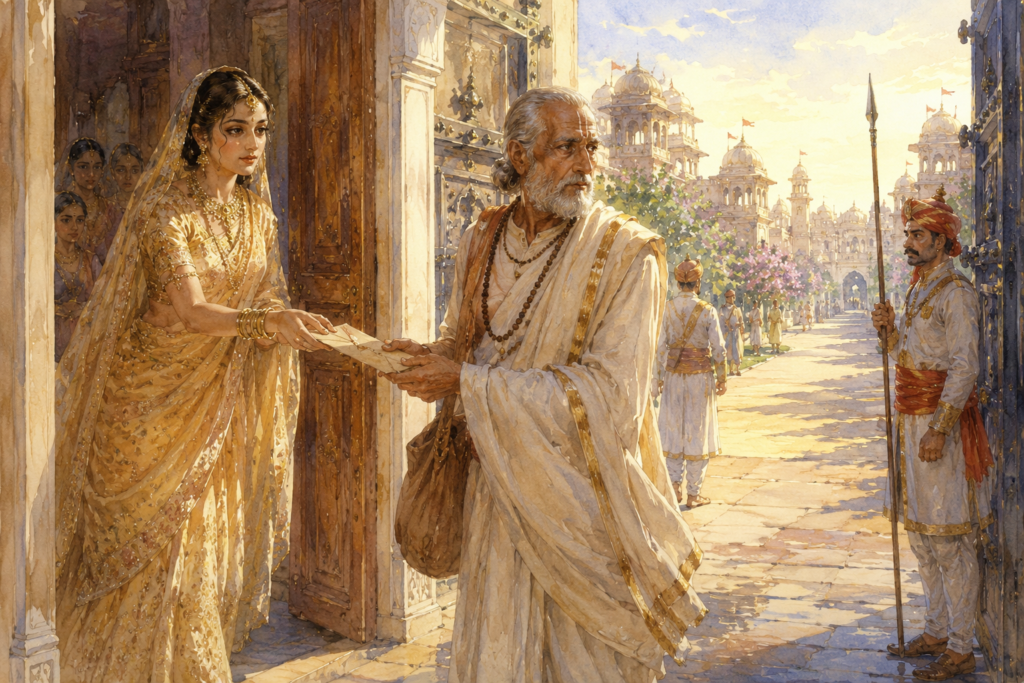
Seven shlokas that a princess in Vidarbha sent to a king in Dwarka through a trusted Brahmin messenger named Sunanda — because she had been promised in marriage to someone she did not choose and she refused to accept that fate without speaking.
These seven shlokas are the complete text of Rukmini’s letter. They are preserved exactly as she wrote them. And they are, in my view, one of the most extraordinary declarations of love in all of Indian literature.
Before the Letter — What She Was Facing
To understand what this letter cost her — what it took to write it — you need to understand the situation Rukmini was in when she wrote it.
Her brother Rukmi had arranged her marriage to Shishupala, the king of Chedi. Rukmi was the most powerful person in her immediate world and he had made this decision firmly. Her father Bhishmaka privately favoured Krishna but could not override his eldest son. There was no one in her family who would advocate for her.
The wedding preparations were already underway. The date was set. Shishupala and his allies — including the formidable Jarasandha, king of Magadha — were already travelling toward Vidarbha.
And Rukmini had never met Krishna. She knew him only through stories that had reached her across kingdoms — through travellers and sages and the quiet accumulation of everything she had heard about him over years.
She had no guarantee he would come. She had no guarantee he would even receive the letter. She had no guarantee that even if he received it, he would act on it.
She wrote it anyway.
The Letter — All Seven Shlokas
What follows is the complete text of Rukmini’s letter as preserved in the Bhagavata Purana, Chapter 52 of the 10th Canto, Shlokas 37 to 43. Each shloka is given with its meaning and a reflection on what she was saying.
Shloka 1 — SB 10.52.37
srutva gunan bhuvana-sundara srnvatam te / nirvisya karna-vivarair harato ‘nga-tapam / rupam drsam drsimatam akhilartha-labham / tvayy acyutavisati cittam apatrapam me
O beauty of the worlds — having heard of Your qualities, which enter the ears of those who hear and remove all bodily distress, and having heard of Your beauty, which fulfills every visual desire of those who see — my shameless mind has become fixed upon You, O Achyuta.
She opens not with grief or desperation but with something completely unexpected — joy. She has heard about him and the very hearing of it has removed her distress. His qualities enter through the ears like medicine. His beauty fulfills the eyes completely. And then she uses a word that has stayed with readers for centuries — apatrapam — shameless. Her mind has fixed itself on him shamelessly. Not apologetically. Not cautiously. Completely and without shame. This is her opening line. This is how she begins.
Shloka 2 — SB 10.52.38
ka tva mukunda mahati kula-sila-rupa / vidya-vayo-dravina-dhamabhir atma-tulyam / dhira patim kulavati na vrnita kanya / kale nr-simha nara-loka-mano-‘bhiramam
O Mukunda — O lion among men — who among the wise, sober-minded and aristocratic girls of good family would not choose You as her husband when the proper time comes? You who are unmatched in lineage, character, beauty, knowledge, youthfulness, wealth and influence — You who delight the minds of all mankind.
The second shloka is an argument. She is not just declaring love — she is making a case. She says: what woman of good family and sound mind would not choose You? She is framing her choice not as unusual or desperate but as the most rational decision any clear-eyed woman could make. She lists his qualities — lineage, character, beauty, knowledge, youth, wealth, influence — seven qualities, all unmatched, all incomparable even to himself. This is not the language of someone swept away by feeling. This is someone who has thought about it clearly and is telling him exactly what she has concluded.
Shloka 3 — SB 10.52.39
tan me bhavan khalu vrtah patir anga jayam / atmarpitas ca bhavato ‘tra vibho vidhehi / ma vira-bhagam abhimarsatu caidya arad / gomayu-van mrga-pater balim ambujaksa
Therefore, my dear Lord — O lotus-eyed one — I have chosen You as my husband and I surrender myself entirely to You. Please come swiftly, O almighty one, and make me Your wife. Let not Shishupala touch the hero’s portion — like a jackal stealing the share of a lion.
This is the pivot of the letter. She has described who he is and why she has chosen him. Now she asks. And the way she asks is extraordinary — atmarpitas, she says — I surrender myself to You. Not: please consider this request. Not: I hope you might find it in your heart. She has already given herself. She is asking him to honour what she has already decided. And then the jackal and the lion — one of the most vivid images in the entire Bhagavatam. Shishupala as a jackal reaching for the lion’s portion. She is telling Krishna not just that she wants him but that anything less would be a cosmic indignity.
Shloka 4 — SB 10.52.40
purtesta-datta-niyama-vrata-deva-vipra / gurv-arcanadibhir alam bhagavan paresah / aradhito yadi gadagraja etya panim / grhnatu me na damaghosa-sutadayo ‘nye
If the Supreme Lord — worshipped through charitable acts, fire sacrifices, austere vows, worship of the devas and brahmins and gurus — is truly pleased with me, then let Gadagraja, the elder brother of Gada, come and take my hand. Let it not be Shishupala or any other.
This is one of the most theologically profound lines in the entire letter. She is not just asking Krishna to come — she is staking her entire accumulated spiritual merit on this moment. All my prayers, all my vows, all my worship — if any of it was real, if any of it reached You — prove it now by coming. She is placing her complete devotional life on the line. This is not a romantic request. This is a prayer from the depths of a soul that has been preparing for this moment through years of sincere practice.
Shloka 5 — SB 10.52.41
sriya urasi vibhato dama-komalayam / nityam samahita-drsam vadanam ca visnoh / krsnasya tad bhavatu me padam arhanaiyam / tat-pada-sparsa-sukhaya namo namah
O Krishna — whose chest is always adorned by Shri herself, whose lotus face is always seen with composed and gracious eyes — may my feet be placed at Your feet, which are worthy of all worship. I offer my obeisances again and again to those feet.
Here she speaks of Lakshmi — Shri — who eternally rests on Krishna’s chest. She is describing herself as the one who longs for that same closeness. She is asking for what Lakshmi has — not wealth, not power, not position — but nearness. The specific intimacy of belonging to Krishna completely. May my feet rest at Your feet. This shloka is deeply devotional — it moves from the personal to the theological and back again. She is not just a princess writing to a king. She is a soul asking the divine for union.
Shloka 6 — SB 10.52.42
tan me ruciranam caturbhujam / ananya-bhave hrdi bandhu-sakhyam / punar bhavantam nanu dhira-cittah / katham nu visyeta manisini yosit
How could a wise woman with a steady mind ever abandon You — whose four-armed form is so beautiful, and whose friendship and kinship lives in the hearts of all who have given themselves to You without reservation?
This shloka asks the question that contains its own answer. How could any wise woman abandon You? The answer is: she could not. Rukmini is not threatening. She is stating what she understands to be true — that once a soul has given itself to Krishna without reservation, there is no going back. Not because of attachment. Because of understanding. Because she has seen clearly and what she has seen leaves no room for any other choice.
Shloka 7 — SB 10.52.43
kalinda-ja-panka-ruheksanena / tvayy acyutavesa-vilobhitanam / asad-grahad yosid iva prakrstam / nayasva mam niravasesamam
O Achyuta — with Your lotus eyes like those of the one born in the Yamuna — those who have become enchanted by Your form, their minds absorbed in You — deliver me from this situation as You would deliver one who has been wrongly seized. Rescue me completely.
The final shloka. She has described him, made her case, stated her choice, staked her spiritual merit, asked for closeness and declared her unwavering certainty. And now she closes with one word that contains everything — deliver me. Nayasva mam. Take me. Not someday. Not if convenient. Now. She adds niravasesamam — completely, without remainder. Do not half-rescue me. Rescue me entirely. This is the last line of the letter. This is how she ends.
What Krishna Did When He Heard It
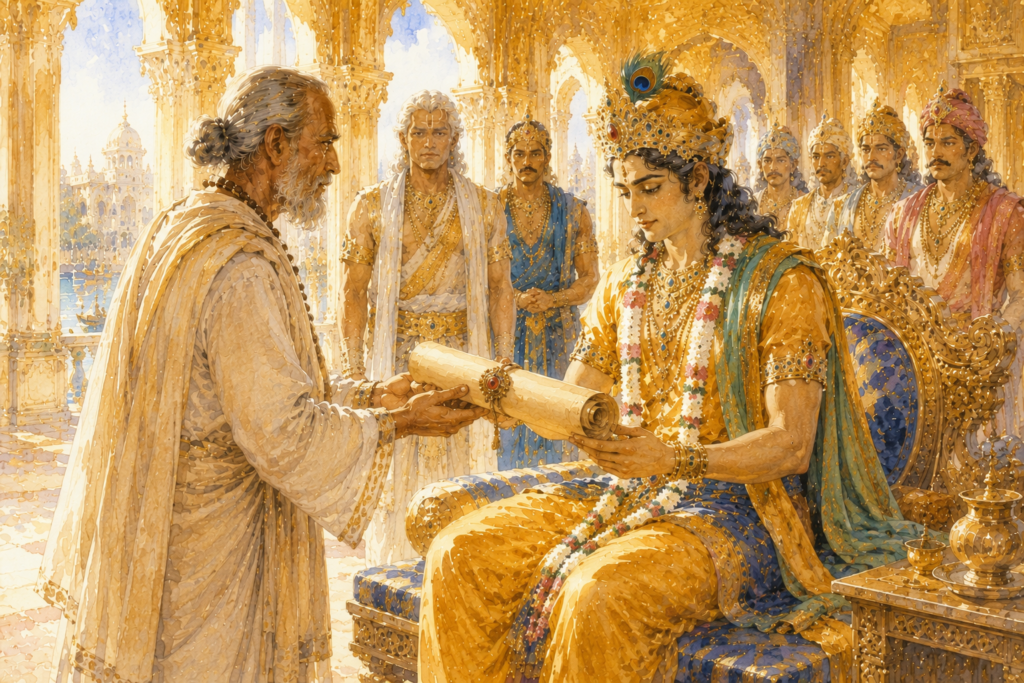
The Brahmin Sunanda recited the letter to Krishna — the Bhagavatam tells us he broke the seal of the letter privately and delivered its contents to Krishna alone. The letter was confidential. Only Krishna heard it.
The Bhagavatam then records what happened next with a single extraordinary detail. When the Brahmin finished reading, Krishna gripped his hand.
Not a formal acknowledgement. Not a considered royal response. A physical reaction — a hand reaching out and holding on. The text says Krishna smiled as he heard the letter. He told the Brahmin that he had been thinking of Rukmini too. That the same longing she had carried in Vidarbha, he had been carrying in Dwarka.
Two people in two kingdoms — she thinking of him, he thinking of her — neither knowing the other felt the same way until this letter crossed the distance between them.
That same night, Krishna set out for Vidarbha.
What Makes This Letter Extraordinary
The Bhagavata Purana was composed thousands of years ago. The world Rukmini lived in was entirely different from ours — different in its social structures, its expectations, its understanding of what a woman could or could not do.
And yet the letter she wrote is completely, recognisably human.
The clarity of knowing her own mind. The courage of speaking it directly. The theological depth of staking her spiritual merit on a single request. The vivid image of the jackal and the lion. The final word — completely, without remainder — that tells you she was not asking for a half-measure.
She was a king’s daughter in a world that had already arranged her future. She had no weapon and no army and no political leverage.
She had a pen and seven shlokas and a trusted Brahmin.
And it was enough.
From Me to You
What stays with me most about this letter is how fearless Rukmini’s love feels. In the very first shloka, she calls herself shameless for loving Krishna before even meeting him — and yet there is no hesitation in her words. Only honesty. Only certainty. There is something deeply moving about a woman who knew exactly whom her heart belonged to and was brave enough to say it aloud.
I also keep thinking about the fact that she placed everything on this one moment — her prayers, her vows, her devotion, all the spiritual merit she had gathered through years of worship. She was willing to surrender all of it for the chance to be with Krishna. Not out of desperation, but with complete faith.
And perhaps the most beautiful part is this — Krishna had been thinking of her too. But he only knew because she chose to send the letter. Because she spoke. Because she reached out first. There is something timeless in that kind of courage.
What moves me most, though, is the ending. Niravasesamam — completely, without remainder. After all the devotion and longing and surrender, she asks not to be half-chosen. Not partially rescued. Take me entirely. There is such quiet strength in that. Such fullness. And somehow, that feels like the most Rukmini thing of all.
| Sources and References Primary Source: Srimad Bhagavatam (Bhagavata Purana), 10th Canto, Chapter 52, Shlokas 37-43 — Rukmini’s letter in full, titled ‘Rukmini’s Message to Lord Krishna’. Translations referenced: A.C. Bhaktivedanta Swami Prabhupada (Vedabase.io); ISKCON Desire Tree — Letter of Rukmini to Krishna; Kanfusion blog — Seven Shlokas of Rukmini (free translation). The interpretive reflections on each shloka are the author’s own reading of the text and are not meant as authoritative commentary. |
Continue Exploring — Rukmini Series
- Before the Letter: Who Was Rukmini and How She Fell in Love with a Man She Had Never Met
- The Elopement: What Happened After the Letter Was Sent
- Rukmini vs Satyabhama — Two Queens, Two Kinds of Love
- Pradyumna — The Son Stolen at Birth Who Grew Up to Be a Legend
- Krishnavataram — Everything You Need to Know About the Mythology Behind the Film
Rukmini’s letter has been in the Bhagavata Purana for thousands of years. Share it with someone who has never read it — someone who deserves to know what she said. And explore the full Rukmini series on Fables n Tales.
1 Comment