

I stayed in Pune for almost two years, this was the story I heard back then from my neighbour. She was sharing this story with her grandchild and I too happened to be there. I love this story a lot, as on the surface is just sounds like any other tale from India, or that it is something magical.
Imagine a tree that actually grows money, it is magical is it? But when you sit and process the story, you understand that it has a much deeper meaning. It’s about something far rarer than a tree full of silver coins.
It’s about a man who would rather have nothing than take something he hadn’t earned.
A Brahmin Who Refused the King’s Money
There was once a poor Brahmin who lived simply, the way many holy men did in those days. He was only surviving on whatever alms kind people offered him from day to day. One morning, his wandered and ended up at the steps of the royal palace, and he stood there, as he did everywhere, asking quietly for alms.
Word reached the king, who came out himself, reached into his own treasury, and offered the Brahmin a generous handful of coins.
And the Brahmin, very politely, refused.
The king was puzzled. “Is something wrong with this money?” he asked. “Take it. It is freely given.”
“Maharaj,” said the Brahmin, bowing respectfully, “I have no doubt your money is good. But it comes from your treasury, and it is collected through taxes, tributes, and the wealth of your kingdom. I would only ever accept money that you yourself have earned, with your own two hands, through your own labour. Anything else, forgive me, I cannot take.”
A King Goes to Work
Now, most kings might have simply sent the strange old man away and thought nothing more of it. But this king was curious and, if we’re honest. He was a little intrigued by a man poor enough to need alms, yet proud enough to refuse a king’s own treasury.
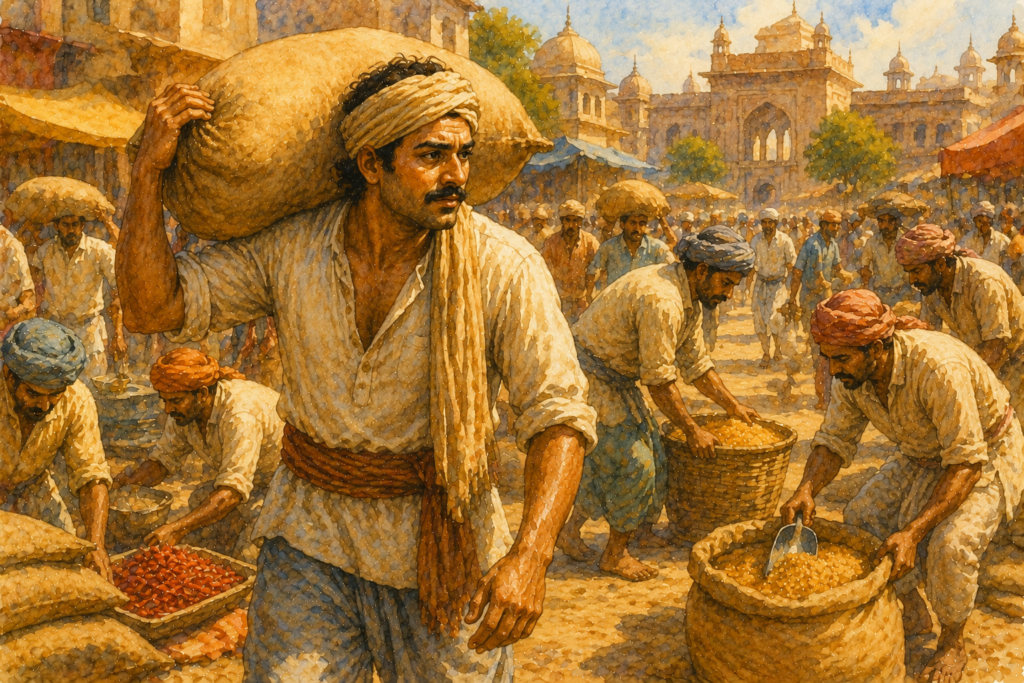
So the very next day, he did something kings rarely do. He removed his royal robes, dressed himself as an ordinary labourer, and walked out into his own capital city, looking for work.
He carried loads at a marketplace. He helped lift sacks of grain. He laboured through the heat of the day exactly as any common worker would, until, by evening, he had earned exactly one rupee, all by the sweat of his own brow, with his own two hands.
“This Rupee, I Earned Myself”
The next morning, when the Brahmin came again to the palace gates, the king himself came out to meet him and placed a single rupee in his hands.
“Here,” the king said. “This rupee, and only this one, I earned with my own labour, yesterday, in my own city. Will you accept it now?”
The Brahmin’s face lit up with genuine joy. He took the coin with both hands, the way you might receive something truly precious, and thanked the king warmly. Then he went home and instead of spending it, he did something rather unusual.
He planted it.
Right there in his small courtyard, he dug a little hole, placed the king’s hard-earned rupee into the earth, and watered it every day, the way you might tend any seed you hoped would grow into something good.
A Tree Grows Where the Coin Was Planted
And then something really magical happened. It can be called a blessing for the honest effort and hard work of the king, or some gentle magic, a sapling started to grow from that one rupee the brahmin planted.
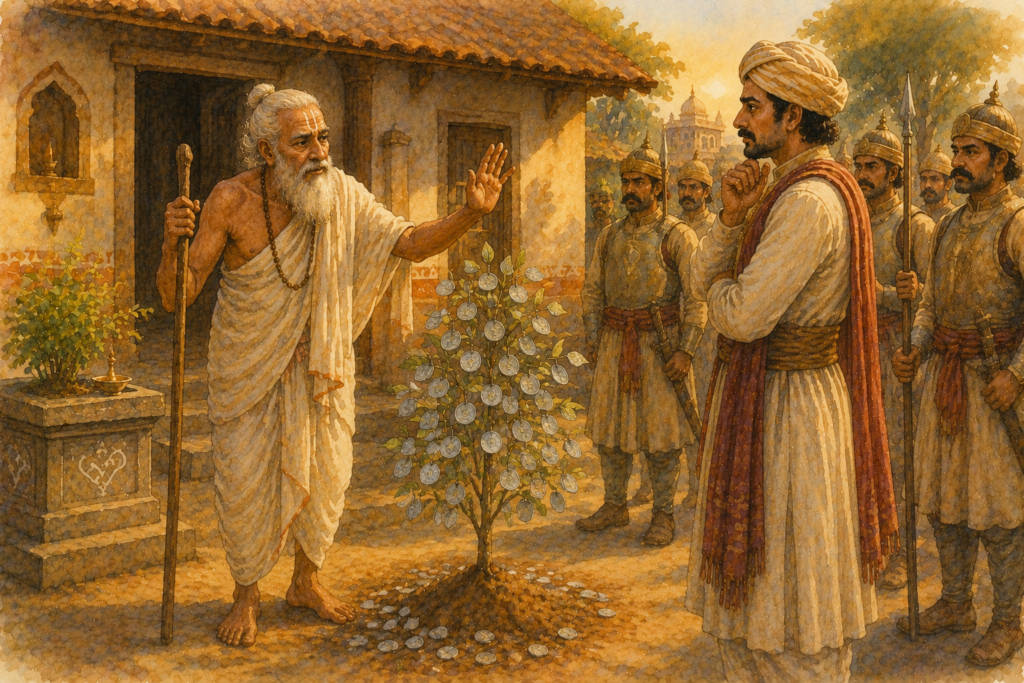
Day by day, it grew taller. And as it grew, something extraordinary happened: instead of leaves and fruit, the tree began to bear shining silver rupees, hanging from its branches like a harvest nobody had ever seen before.
Word of this travelled quickly, as such things do. Soon, the king’s own soldiers, passing by on patrol, noticed the strange and wonderful tree in the old Brahmin’s courtyard and hurried straight back to report it.
“Maharaj,” they said, eyes wide, “there is a tree in the Brahmin’s backyard that bears rupees instead of fruit!”
The King Wants His Tree Back
The king, astonished and more than a little tempted, ordered his men to go and uproot the tree at once and bring it to the palace.
But when the soldiers arrived, the Brahmin stood firmly in front of his tree and would not let a single one of them so much as touch it.
The king himself came to see what the trouble was.
“This tree must come to the palace,” the king said. “Surely you do understand that such a wonder belongs to the kingdom, not to one man alone.”
The Brahmin’s Quiet Question
The Brahmin simply looked at him and asked one gentle, unanswerable question.
“Maharaj, do you remember the rupee you gave me? The one you earned yourself, with your own hands, carrying sacks in your own marketplace?”
“I remember it well,” said the king.
“This tree,” said the Brahmin, “grew from that very rupee. Nothing more was ever added to it. So tell me, Your Majesty, if you take this tree now, are you not simply taking back the very thing you once freely gave me?”
The king stood there for a long moment, turning the Brahmin’s words over in his mind. There was no clever answer to give. The Brahmin was right, plainly and completely and the king, to his credit, was wise enough to recognise it.
He lowered his head, asked his soldiers to step back, and left the tree exactly where it stood in the modest courtyard of a man who had asked for nothing he hadn’t earned, and now refused to give up nothing he hadn’t been given.
What stays with me about this story is how much dignity is packed into such a small refusal. The Brahmin doesn’t lecture the king about honest labour. He simply waits patiently, without complaint until the king himself understands why it matters. And the king, to his great credit, doesn’t take offence. He goes and lifts sacks of grain in his own marketplace, like anyone else would, just to earn the right to give a gift that means something.
That, to me, is the real treasure in this story. Not the tree. Not the rupees. Just two people like a king and a brahmin, who both refused to take the easy way out.
From Me to You
I think what I love most about this story is that nobody in it is greedy, not really even the king, wanting the tree back, isn’t acting out of malice. He’s simply forgotten, for a moment, what made the tree special in the first place. And the Brahmin’s question brings him right back to it, gently, without a single harsh word.
I find myself thinking about this whenever I’m given something that took someone real effort to offer a favour, a kindness, a bit of their time. Some gifts are just rupees. And some gifts, if you plant them carefully and tend them with the same care they were given, can grow into something neither person ever expected.
MORE FOLK TALES
The Sun’s Grandmother — The Old Woman Who Sold Tickets to See Where the Sun Slept
Birbal Ki Khichdi — The Story of a Cold Night and a Clever Lesson
Everything Happens for Good — The Story Behind Birbal’s Most Tested Belief
Did this story move you? Share it with someone who values honest effort over easy wealth — and explore more folk tales from across India on Fables n Tales.