

I want to tell you something about Satyabhama that changes everything.
You already know she was Krishna’s queen — fierce, passionate, magnificent. You know she fought Narakasura in battle and went to heaven to get a tree. You know she is one of the most vivid personalities in all of Krishna mythology.
But here is what most people do not know.
She was not just a queen. She was a goddess.
Specifically — she was the goddess of the earth herself, walking around in a human body, living a human life, loving a god who had also taken human form. And once you know that, every single story about Satyabhama lands completely differently.
Bhudevi – The Goddess Who Reincarnated as Satyabhama
Bhudevi — also known as Bhu Devi, Prithvi, Dharani, or simply Mother Earth — is one of the two principal consorts of Vishnu. The other is Lakshmi.
Think about that for a moment.
Vishnu — the preserver of the universe — is eternally accompanied by two divine feminine forces. Lakshmi, the goddess of wealth, beauty, grace and luminous abundance. And Bhudevi, the goddess of the earth itself, who holds, sustains and bears all of physical existence.
In Vaishnava temples across India — especially in the great temple traditions of the South — Vishnu is often depicted standing between them: Lakshmi on one side, Bhudevi on the other.
Always beside him. Always part of the same cosmic balance. And yet they represent two entirely different expressions of divinity.
Lakshmi is celestial grace — radiant, auspicious, overflowing like light itself. She is abundance that descends from above.
Bhudevi is something quieter, deeper, and in many ways more enduring.
She is the earth beneath your feet.
The ground that carries mountains, oceans, kingdoms and generations without ever asking to be seen.
She is patience.
Fertility.
Endurance.
The immense and silent strength that sustains life even while being wounded by it.
And perhaps that is why Bhudevi feels so different from many other goddesses in Hindu mythology.
She does not merely bless the world.
She carries it.
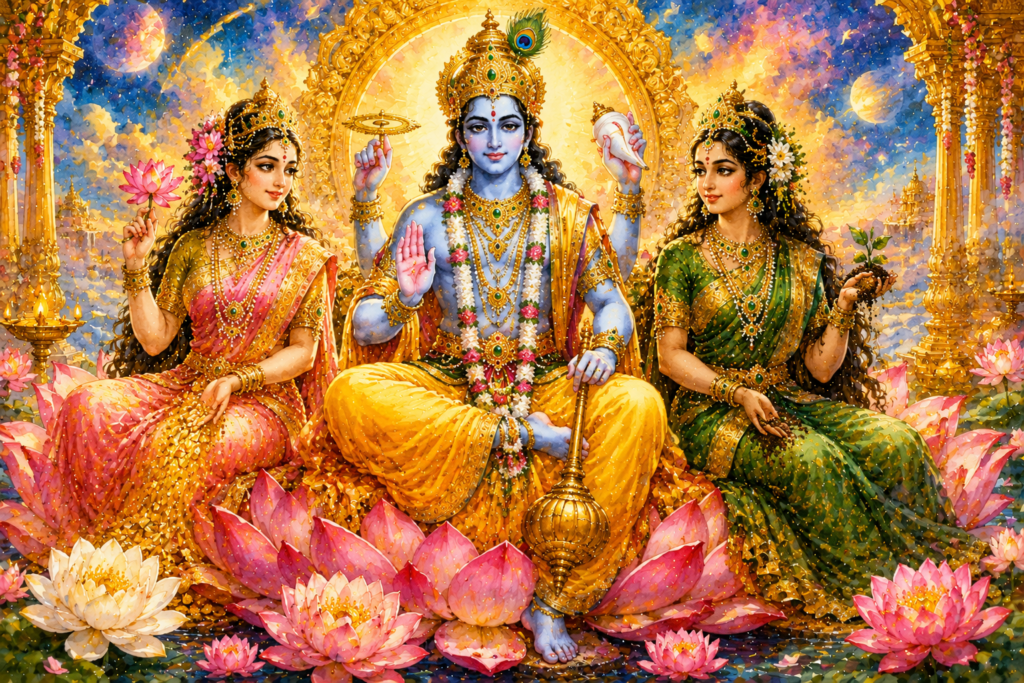
The Reason Bhudevi Came to Earth as Satyabhama
When Vishnu decided to take his great Krishna avatar — his most complete and most human incarnation — his two eternal consorts followed him down. They always do. Where Vishnu goes, Lakshmi and Bhudevi go too.
Lakshmi came as Rukmini — serene, devoted, perfectly gracious. The queen who wrote a letter and waited at a temple with extraordinary composure.
Bhudevi came as Satyabhama — fierce, passionate, demanding and completely unafraid of any of it.
But Bhudevi’s descent was not just about being Krishna’s queen. She had a specific job to do. Something that only she could do. Something that had been set in motion long before she arrived.
The Son She Had to Let Go
Here is the part of the story that I find genuinely extraordinary.
Narakasura — the demon king who had conquered both the earth and the heavens, who had stolen Aditi’s earrings and imprisoned sixteen thousand women — was Bhudevi’s son.
He was born when Vishnu took the Varaha avatar — the great boar who rescued the earth from the cosmic ocean. In that moment of rescue, as Varaha held the earth tenderly after the battle, Narakasura was born from their union. Son of a god. Son of the earth goddess. Gifted with immense power and divine weapons.
Bhudevi loved him. Of course she did. He was her son.
And so, she asked Brahma for a boon — that Narakasura would live long and that when the time came, he would only be killed by someone from her own line.
She thought she was protecting him. What she was actually doing — without knowing it — was writing the exact terms of the battle that would happen thousands of years later on a battlefield in Pragjyotishpura.
Because the only person from her own line who could fulfil that boon was her own reincarnation. Satyabhama.
The Weight of The Boon
I want to pause here because I think this is one of the most extraordinary things in all of mythology.
Bhudevi loved her son enough to ask for his protection. And then she came back to earth as Satyabhama, stood on a battlefield beside Krishna, picked up her bow, and was the one whose arrow struck Narakasura down.
The mother who protected him was also the mother who ended him.
The boon she asked for was also the boon that made her the instrument of his death.
The love was real in both directions. And it had to hold both things at once — the protection and the ending. The fierce maternal love that says I will guard you for as long as I can. And the same fierce love that says I will be the one who comes for you when the time is right.
Bhudevi’s Previous Life — The Woman Named Gunavati
One tradition preserved in the Skanda Purana adds another deeply human layer to Satyabhama’s story.
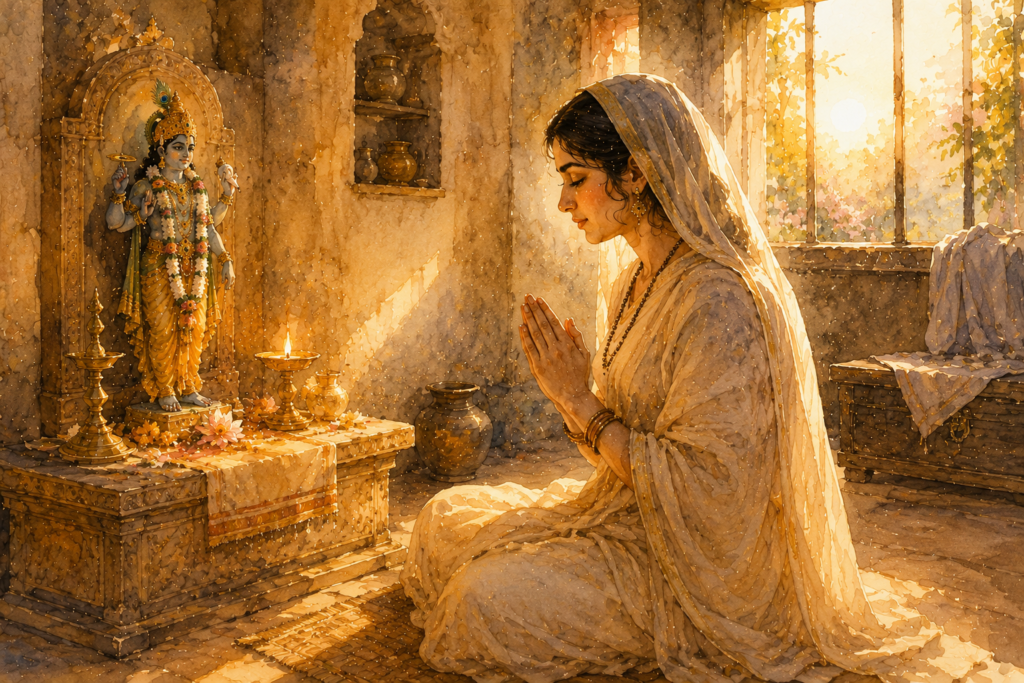
Before being born as Satyabhama, she is said to have lived a previous life as a woman named Gunavati.
Gunavati lost both her father and husband soon after her marriage and was left alone in grief. She sold everything she possessed, performed the sacred rites for her departed family, and devoted the rest of her life entirely to Vishnu.
She observed every Ekadasi fast without fail. She kept the Kartika vow year after year with unwavering devotion. Not for reward or recognition — but because devotion became the one thing that sustained her.
Moved by the sincerity of her worship, Vishnu granted her a boon: in her next birth, she would marry Vishnu himself in his Krishna avatar.
That future birth would be Satyabhama — who many traditions identify as an incarnation of Bhudevi.
Which means the queen who would one day stand beside Krishna in battle and demand the Parijata tree from heaven had once been a grieving woman praying quietly in solitude, with no witness except the god she loved.
Why This Changes How You Read Satyabhama
Knowing that Satyabhama is Bhudevi reframes everything.
Her pride is not the pride of a spoiled queen. It is the confidence of the earth itself — which does not apologise for being what it is, does not shrink to make others comfortable, does not pretend to be less than it is.
Her fierceness is not temper. It is the force of the earth — patient for centuries, capable of the gentlest flower and the most devastating earthquake, holding everything and asking nothing.
Her love for Krishna is not possessiveness in the ordinary sense. It is the earth’s relationship to the sun — drawn toward it completely, needing it, circling it, and absolutely not willing to share it without a fight.
And her role in the Narakasura battle is not just a warrior queen proving herself. It is a goddess fulfilling a promise she made to her own son before either of them was born into this life. The most personal cosmic act imaginable.
The Contrast That Makes Both Women Beautiful
I keep thinking about Rukmini and Satyabhama standing in the same palace. Both are Vishnu’s eternal consorts. Both are completely devoted to Krishna. Both are extraordinary.
And they could not be more different.
Rukmini is Lakshmi — she is the grace that flows, the light that does not demand, the abundance that comes quietly. The single tulsi leaf that outweighs all of Satyabhama’s gold.
Satyabhama is Bhudevi — she is the ground that holds everything up, the force that does not ask permission, the love that goes to war in the sky above the clouds for a tree.
The mythology is not saying one is better. It is saying that Vishnu — and by extension creation itself — needs both. The grace and the ground. The light and the earth. The devotion that surrenders and the love that fights.
| Sources and References Sources: Bhagavata Purana (10th Canto) — Bhudevi as Satyabhama; Vishnu Purana (Book 1) — Bhudevi as Vishnu’s consort; Skanda Purana (Vaishnava Kanda, Kartikamasa Mahatmya) — the story of Gunavati; Pancharatra texts — Bhudevi in Vaishnava theology; Wikipedia — Bhudevi, Satyabhama; Isvara.org — Satyabhama Warrior Wife of Sri Krishna. All reflections are the author’s own. |
Continue Exploring — Satyabhama Series
- Satyabhama — The Warrior Queen of Krishna
- The Battle Against Narakasura — The Day Satyabhama Fulfilled a Mother’s Boon
- Krishnavataram — Everything You Need to Know About the Mythology Behind the Film
Did knowing Bhudevi’s story change how you see Satyabhama? I would love to know in the comments. And explore the full Satyabhama series right here on Fables n Tales.