

So here is something I want to tell you before I get into this story.
Every year during Diwali — specifically on the day we call Naraka Chaturdashi, the day before Lakshmi Puja — we light lamps and celebrate a victory. We have been doing this for thousands of years. And the victory we are celebrating is this one. The battle of Satyabhama and Krishna against the demon king Narakasura.
Which means every time you light a diya on that morning, you are lighting it for Satyabhama.
I think that is worth knowing.
Who Was Narakasura?
The story of Narakasura does not begin with a villain. It begins with something much more interesting than that.
Narakasura was the son of Bhudevi — the goddess of the earth — and the Varaha avatar of Vishnu. Which means, if you stop and think about it, he was the son of a god and a goddess. Born with divine blood on both sides. Gifted with extraordinary power, divine weapons, and a natural brilliance that should have made him one of the great rulers of his age.
For a while, he was. He was pious. He was capable. He governed well.
And then something shifted. Power does that sometimes — it starts as a tool and ends as an addiction.
Narakasura conquered one kingdom, and then another, and then another, until he had brought the entire earth under his control. Most rulers would have stopped there. But he looked up at the sky and thought: why not heaven too?
He marched on Svarga. Indra — the king of heaven himself — could not hold him back and had to flee. Narakasura became the ruler of both earth and sky.
And then he started taking things that were not his.
He stole the sacred umbrella of Varuna, the god of the cosmic waters. He broke off a peak from the holy mountain Mandara — the same mountain that had been used as the churning rod during the Samudra Manthan — and carried it away like a trophy. He abducted sixteen thousand women from across the three worlds and imprisoned them in his palace.
And then he did the thing that sealed his fate.
He tore the earrings from the ears of Aditi.
Why Aditi Matters
Let me tell you who Aditi is, because this is important.
Aditi is the mother of all the gods. She is the original divine mother — the one from whom the Devas themselves were born. Her earrings were not just jewellery. They were luminous, sacred, glowing objects that were part of her identity as the cosmic mother. Tearing them from her was not just a theft. It was a deliberate desecration of divine motherhood itself.
The gods went to Vishnu, as they always do when things get this bad. Vishnu had already promised — long before, when Bhudevi had asked for a boon at the time of Narakasura’s birth — that her son would be allowed a long reign, and that when the time came, he would be killed by someone from her own line.
The time had come.
Aditi, knowing who Satyabhama was — knowing that Satyabhama was the human incarnation of Bhudevi, her son’s own mother reborn — went to Dwarka. She went not to Indra, not to Krishna, not to any of the gods.
She went to Satyabhama.
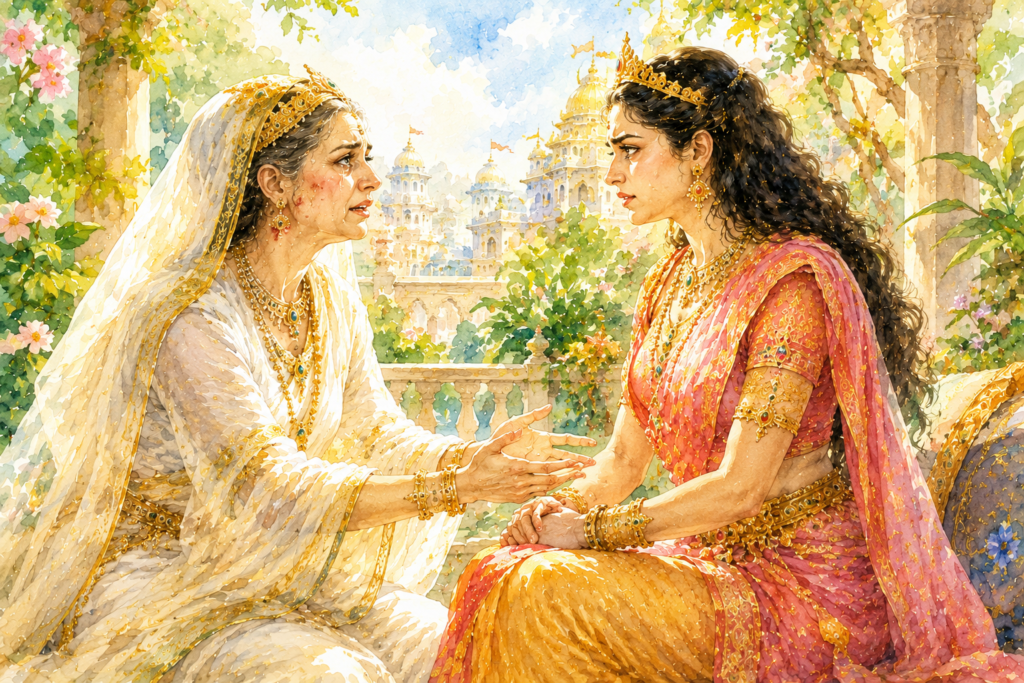
The Conversation in the Garden
I imagine this meeting — and the texts do not give us all the details, so I am filling in the space — as something very quiet and very devastating.
Aditi, who was a relative of Satyabhama’s, came to her in the palace gardens of Dwarka. And she wept. She told Satyabhama about her earrings. She told her about the women imprisoned in Narakasura’s fortress. She told her about what her son had become.
And Satyabhama sat there and listened to the mother of all the gods cry.
Now here is the thing about Satyabhama that this story turns on. She was not just a queen. She was not just Krishna’s wife. She was the goddess Bhudevi in human form — the very earth herself, and Narakasura was her son. Not in this life, but in the cosmic sense — she was the mother whose boon had protected him, whose love had shaped what he became, whose divine presence was the original source of his power.
When Aditi finished speaking, Satyabhama made a decision.
She was going to end this. Not as a bystander. Not by sending Krishna on her behalf. She was going herself.
Asking Krishna
Satyabhama went to Krishna and asked for his permission to join him in battle against Narakasura.
I want to be clear about something here because it matters to the story. She did not ask Krishna to go fight Narakasura for her. She asked him to take her along. She asked to be there, bow in hand, as a warrior in the battle — not as a witness.
Krishna said yes.
They mounted Garuda together and flew toward Pragjyotishpura — Narakasura’s capital, which the texts say was in the region of present-day Assam — a fortress surrounded by seven layers of defence: mountains, water, fire, wind, darkness, clouds and a great barricade. Narakasura had spent years building something that was supposed to be impenetrable.
It took Krishna and Satyabhama one morning.
The Fortress of Seven Walls
The Bhagavata Purana describes the attack on Pragjyotishpura with the kind of detail that tells you this was not a small skirmish. This was a full military engagement against one of the most powerful Asura kingdoms in the world.
The seven defensive barriers fell one by one. Krishna’s Sudarshana Chakra cut through the mountains. His weapons of fire, wind and divine force dismantled each layer of the fortress’s protection. Garuda — enormous, golden-winged, with a wingspan that eclipses the sun — flew through the destruction with Krishna and Satyabhama on his back.
And then came Mura.
Mura was Narakasura’s general — a demon of terrifying power who guarded the inner fortress with five heads and weapons that had never been defeated. He launched himself at Krishna. The battle between Krishna and Mura is described as fierce and prolonged. Finally, Krishna’s Sudarshana Chakra took off all five of Mura’s heads at once.
This is why one of Krishna’s most beloved names is Murari — the destroyer of Mura. This battle is where that name was earned.
The Battle with Narakasura
When Narakasura heard that Mura was dead, he came out himself. He rode out of his fortress on a great battle elephant, surrounded by eleven akshauhinis — eleven complete armies, each akshauhini consisting of 21,870 chariots, 21,870 elephants, 65,610 cavalry and 109,350 foot soldiers. This was not a small force.
Narakasura threw everything he had. Divine weapons — the Narayanastra, the Agneyastra, the Nagapasha, the Brahmastra. Krishna countered each one. The Bhagavata Purana describes Krishna handling weapon after weapon from Narakasura almost effortlessly — the Nagapasha met with the Garudastra, the Brahmastra met with another Brahmastra, each attack absorbed and returned.
And through all of this, Satyabhama was fighting beside him.
She was not watching. She had her bow and she was using it — releasing arrows into the demon army with the precision of someone who had been trained in warfare and was using every bit of that training now.
Then Narakasura did something unexpected.
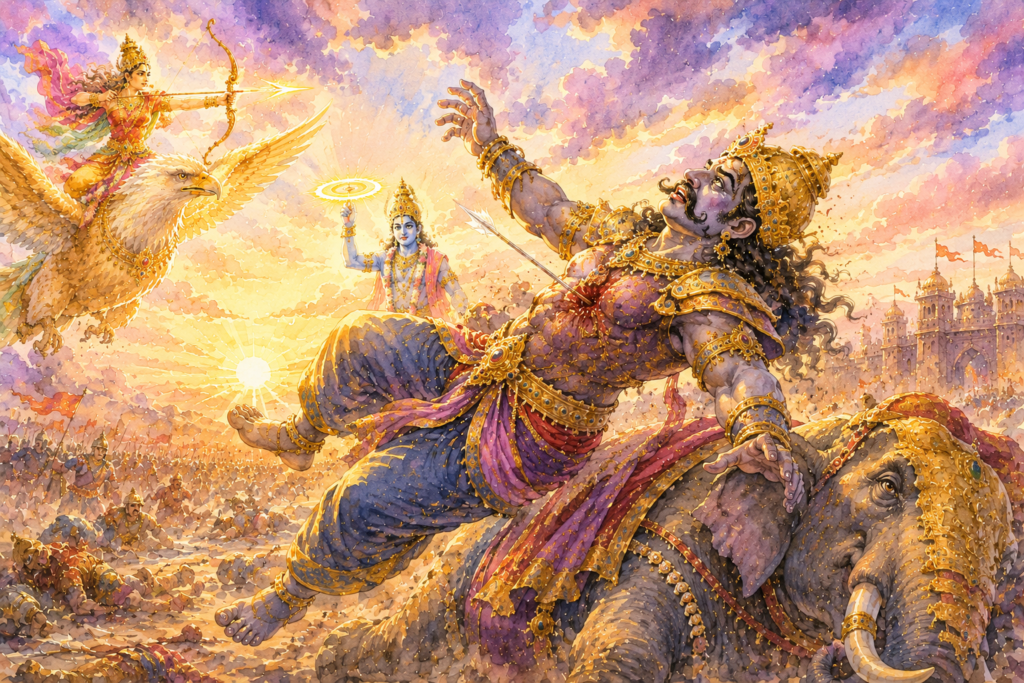
He aimed his trident directly at Krishna. And Krishna fell.
The Moment Everything Stopped
I want you to sit with this image for a second.
The battlefield. The noise of eleven armies and divine weapons and Garuda and everything that was happening. And then Krishna — the avatar of Vishnu, the supreme deity, the one they had all come here for — collapsing.
The Bhagavata Purana tells us plainly that Krishna did this deliberately. He feigned unconsciousness because of the boon that Bhudevi had asked for at the time of Narakasura’s birth — that her son could only be killed by someone from her own line. And Bhudevi had been reborn as Satyabhama.
So, Krishna fell. And he waited.
For Satyabhama.
Satyabhama’s Arrow
When Krishna fell, Satyabhama did not freeze. She did not cry out. She did not look around for help.
She picked up her bow.
The Bhagavata Purana says she was outraged — furious at what Narakasura had done to her husband, to Aditi, to the sixteen thousand women in that fortress. All of it combined in one blazing moment of clarity.
She released her arrow.
It struck Narakasura.
And in that moment Krishna rose, took his Sudarshana Chakra, and with one motion ended it.
Before He Died
Here is the part of the story that I find the most extraordinary.
As Narakasura lay dying — struck by his own mother’s arrow in the body she now inhabited, cut down by the Sudarshana Chakra of his own father’s later incarnation — he had a moment of complete clarity.
He saw Krishna’s true form. He understood what had happened. He understood who had been standing on that battlefield all along.
And he asked for a boon.
Not for his life. Not for revenge. He asked that his death would not be mourned — that instead, people would celebrate it with lights and colours and joy. That his end would be a day of happiness, not grief.
“Let the world light lamps on the day I die. Let them be happy. Let this not be remembered as a day of sorrow.”
Satyabhama granted it.
That day is Naraka Chaturdashi. The day we light the first lamps of Diwali.
What Happened After
After the battle, Krishna went into the fortress of Narakasura and freed the sixteen thousand women who had been imprisoned there. The Bhagavata Purana describes them seeing Krishna for the first time — a man of such extraordinary beauty and grace that each of them made the same decision independently: they would marry him or they would not live.
Krishna, rather than abandon them to a world that would never accept them back, married all sixteen thousand. He multiplied his form — taking a separate form for each woman, living simultaneously in sixteen thousand palaces — so that each of them had a complete husband, a complete life and a complete household. This is described in the Bhagavata Purana as one of the most extraordinary demonstrations of divine capacity in all of Krishna’s life.
After that, Krishna and Satyabhama flew to Svarga to return Aditi’s earrings. And it was on this same trip — this trip that had started with a battle and ended with sixteen thousand women freed and a divine mother’s jewels restored — that Satyabhama stood in Indra’s garden and asked for the Parijata tree.
But that is another story. You can read it here.
The Boon That Was Always There
I keep coming back to the beginning of this story — to Bhudevi asking Brahma for a boon at the time of Narakasura’s birth. That he would live long. That when the time came, he would be killed by someone from her own line.
She was asking, without knowing it, for the exact circumstances of this battle. She was asking for her own reincarnation as Satyabhama to be the one who ended her son’s reign. She was asking, in the cosmic language of divine boons, for the chance to be the one who finally said: enough.
There is something about that I cannot stop thinking about. A mother’s love that was fierce enough to protect her son for centuries — and a mother’s love that was fierce enough, finally, to let him go.
| Sources and References Sources: Bhagavata Purana (10th Canto, Chapter 59) — the Narakasura episode in full; Vishnu Purana (Book 5, Chapter 29); Harivamsha Purana (Vishnu Parva) — additional battle details; Wikipedia — Narakasura; Vedabase.io — Bhagavatam 10.59 translation (Prabhupada); Hindutone.com — The Legend of Narakasura; Isvara.org — Satyabhama, Warrior Wife of Sri Krishna. All reflections are the author’s own. |
Continue Exploring — Tales of Krishna
- Satyabhama — The Warrior Queen of Krishna
- The Parijata Tree — Why Satyabhama Wanted More Than Just a Flower
- The Syamantaka Jewel — How a Diamond Brought Satyabhama to Krishna
- Krishnavataram — Everything You Need to Know About the Mythology Behind the Film
Every Diwali when you light that first diya on Naraka Chaturdashi morning — now you know whose story you are celebrating. Share this with someone who loves mythology and lights lamps every Diwali. And explore the full Tales of Krishna series on Fables n Tales.