Have you read this Indian fable about ego? There is a particular kind of confidence that is immune to evidence. It does not crumble when the facts contradict it. It does not soften when reality intervenes. It simply adjusts its story — and carries on, entirely certain of itself.
You have probably met this confidence in other people. You may have recognised it, occasionally, in yourself.
This Indian fable about a crow and the dawn has been told in various forms across the Indian subcontinent for generations. It is short, funny, and just sharp enough to sting — because the crow’s mistake is one that requires no special foolishness to make. It only requires a human mind.
The Story: The Crow and the Dawn
The Crow on the Neem Tree
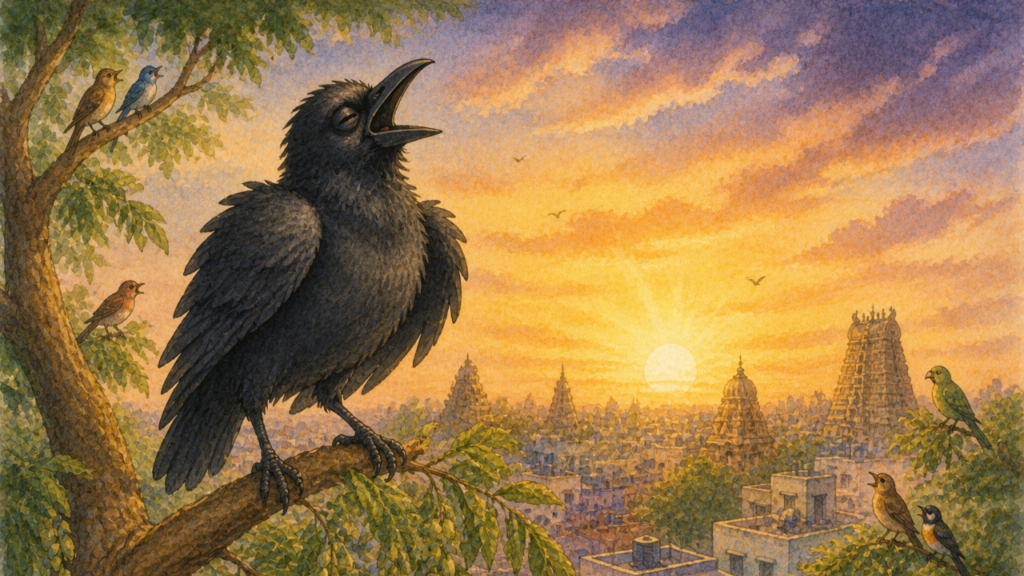
In the old quarter of a city in eastern India, there stood an ancient neem tree whose branches spread wide over the rooftops and lanes below. The tree had housed many birds over many seasons, but its most distinguished resident was a crow — large, glossy-feathered, and possessed of an opinion of himself that far exceeded his modest station in the world.
Every morning, before the city had properly woken, the crow would ruffle himself awake on his branch, survey the dark pre-dawn sky with proprietorial satisfaction, and wait. And then, as the first pale light began to rim the eastern horizon, he would throw back his head and caw — loud, confident, and thoroughly pleased with himself.
“Caaaw! Caaaw!”
And the sun would rise.
Every single morning. Without fail.
A Theory Takes Shape
It is not clear exactly when the crow first made the connection. Perhaps it was gradual — the slow accumulation of mornings spent cawing, each one followed by a sunrise, until the pattern seemed too consistent to be coincidence. Perhaps it came to him all at once, in a flash of what he took to be insight.
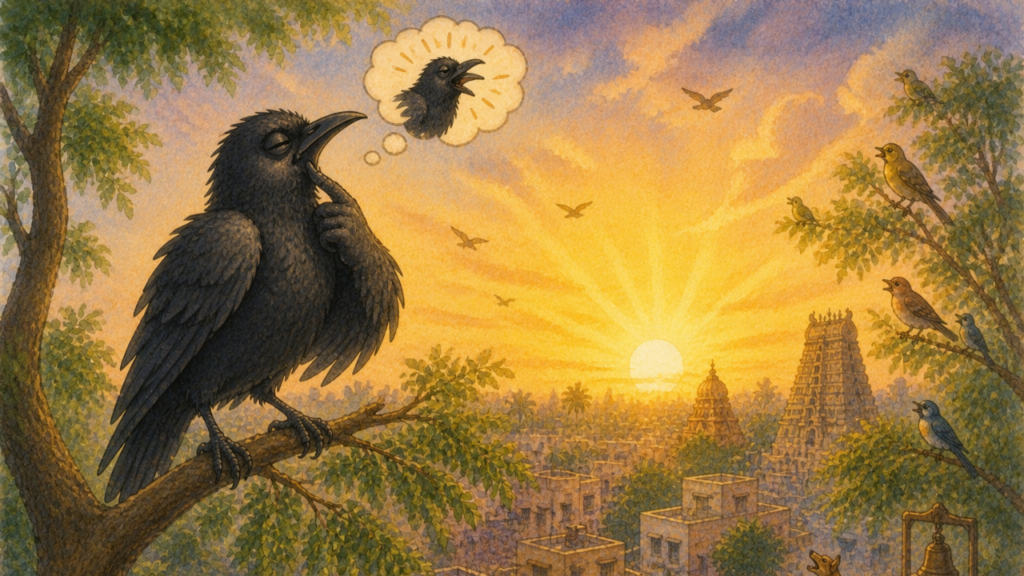
Either way, by the time our story finds him, the crow’s belief is fully formed and thoroughly settled. He sits on his branch one morning, feathers puffed magnificently, and says to himself with quiet pride:
“Oh, how important I am. It is thanks to my cawing that the world wakes up each day. Without my call, the sun would not know it was time to rise. Without me, the whole city would remain in darkness forever.”
He looks out over the rooftops, over the lanes still wrapped in shadow, over the distant horizon just beginning to lighten, and feels the full weight of his responsibility.
It is a heavy burden, being essential to the universe. But someone has to bear it.
The Experiment
And then — as happens to those who are very confident of a thing — the crow grows curious. He wants to test his theory. He wants proof, not because he doubts himself, but because he would like to see the evidence confirm what he already knows.
The plan is simple. Tomorrow morning, he will not caw. He will sit quietly on his branch and wait. And when the sun fails to rise without his call — when the city remains dark and confused and helpless — he will have his answer.
Satisfied with the elegance of his experiment, the crow tucks his head under his wing and goes to sleep, smiling to himself in the way that only the very certain can smile.
The Next Morning Surprise
The next morning, the crow woke as usual. The sky was still dark. He settled himself on his branch, pressed his beak firmly shut, and waited.
The horizon began to lighten.
He waited a little longer, now with the focused attention of a scientist watching his hypothesis unfold.
The first gold appeared at the edge of the sky.
Then the sun rose — fully, warmly, entirely without his assistance — and flooded the city with light exactly as it did every other morning. The birds in the neighbouring trees began to sing. The lanes below stirred with the first movements of the day. A dog barked somewhere. A temple bell rang.
Everything was exactly as it always was. As if he had never existed.
The Explanation
The crow sat very still on his branch for a long moment.
What had just happened did not fit his theory. A lesser mind might have paused here, considered the evidence, and revised its conclusions. But the crow’s mind was not the revising kind. It was the explaining kind.
After a long moment of thought, he ruffled his feathers, lifted his chin, and muttered to himself:
“Hmph. Obviously what happened is this — somewhere out there, another crow must have cawed. Some other crow, probably very like me, stepped in and did the job. Yes. That explains it perfectly.”
And with that settled, he spread his wings and flew off into the morning sky — as certain of his importance as he had ever been, the evidence of the last ten minutes already reorganised into a story that confirmed everything he already believed.
The Moral of the Story
This Indian fable tale about ego carries a moral that is simple to state and surprisingly difficult to live by:
- Arrogance does not just make us wrong — it makes us unable to discover that we are wrong.
- The mind that is most certain is often the one most in need of questioning itself.
- We are all capable of mistaking correlation for causation — of assuming that because two things happen together, one must be causing the other.
- The most dangerous self-deception is not the dramatic lie we tell others — it is the quiet, comfortable story we tell ourselves that explains away every inconvenient truth.
The Crow in Indian Folklore
The crow holds a special and complex place in Indian culture. It is considered intelligent, adaptable, and sharp-eyed — qualities that make it both admirable and, as in this story, a fitting vehicle for stories about the dangers of cleverness misapplied.
In Hindu tradition, crows are associated with ancestors and are fed as part of shraddha rituals — offerings made to departed souls. In some folk beliefs, the arrival or behaviour of a crow carries omens. The crow is taken seriously in Indian mythology in a way that many other cultures do not.
And yet, in fables and folk tales, the crow also frequently appears as the comic figure — the one whose sharp eyes and quick mind lead it to conclusions that are confidently wrong. This story is one of the finest examples of that tradition.
Read More Indian Fables and Folk Tales
If this story made you smile, here are more from the Fables and Tales collection on Fables n Tales:
- The Glow Worm and the Crow — Another story about unlikely characters and the nature of light
- The Friendship of the Leaf and the Lump — A Bihar folk tale about friendship that survives any storm
- Tinsel and Lightning — A tale about pride and what grounds us
- The Lion, the Fox, and the Star — On friendship, guidance, and knowing your limits
Did the crow make you laugh — or wince in recognition? Share this story with someone who needs a gentle reminder to question their certainties. And explore more Indian fables and folk tales right here on Fables n Tales!