

There are some stories in Indian mythology that stay with you not because of grand battles or dramatic wars, but because of how simple and deeply human they feel. And honestly, I think this is one of them. I first time I came across this was when watching a Telugu movie by the name Sri Krishna Tulabhaaram.
At first, the story almost sounds playful with a proud queen, a mischievous sage, a weighing scale covered in gold and jewels, and a single Tulsi leaf. But beneath all of that is one of the most beautiful lessons about love and devotion in Krishna mythology.
Satyabhama had everything a queen could possibly want — beauty, wealth, power, and Krishna’s love. But like many of us, she also wanted reassurance. She wanted to feel special. Chosen. Irreplaceable.
And Narada, as always, knew exactly how to stir those emotions. What follows is a story about pride, jealousy, love, and the quiet difference between devotion that seeks to possess and devotion that simply surrenders.
And somehow, in the end, a single Tulsi leaf becomes heavier than an entire kingdom’s worth of treasure. This is the story of how Satyabhama learned what true devotion really means.
Narada Sows the Seed
Like so many stories in Krishna mythology, this one also begins with Narada. And honestly, no one in mythology knew how to create chaos quite like him. Narada was not evil. In fact, most of the time his mischief had a purpose behind it. But he absolutely loved stirring emotions, exposing hidden pride, and setting events into motion with just a few carefully chosen words.
One day, he arrived in Dwarka and visited Satyabhama.
She was alone at the time, adorning herself with flowers and jewellery, surrounded by all the beauty and luxury of the royal palace. And Satyabhama, being Satyabhama, carried herself with confidence. She knew she was beautiful. She knew Krishna loved her deeply. And somewhere inside, she had also begun to believe she held a special place above everyone else.
Narada noticed it immediately. And then, with the innocent expression of someone simply making conversation, he asked the one question guaranteed to disturb her peace.
“My dear Satyabhama,” he said gently, as though he were simply making harmless conversation, “perhaps this old sage is mistaken… but does Krishna not seem to spend more time with Rukmini these days?”
That was it.
Just one sentence.
No accusation.
No argument.
No drama.
But Narada understood people better than almost anyone else in mythology. He knew exactly where pride hides and exactly which words would awaken it.
And for Satyabhama, the question struck deeply. Because beneath all her confidence was something very human — the fear of not being loved the most.

The Terrible Plan
Narada pressed on, offering what he called a foolproof solution. If she donated Krishna to him — gave him away formally, as a gift — and then bought Krishna back by offering gold equal to his weight, she would prove her love beyond all doubt. Krishna would be bound to her in a way he was bound to no one else.
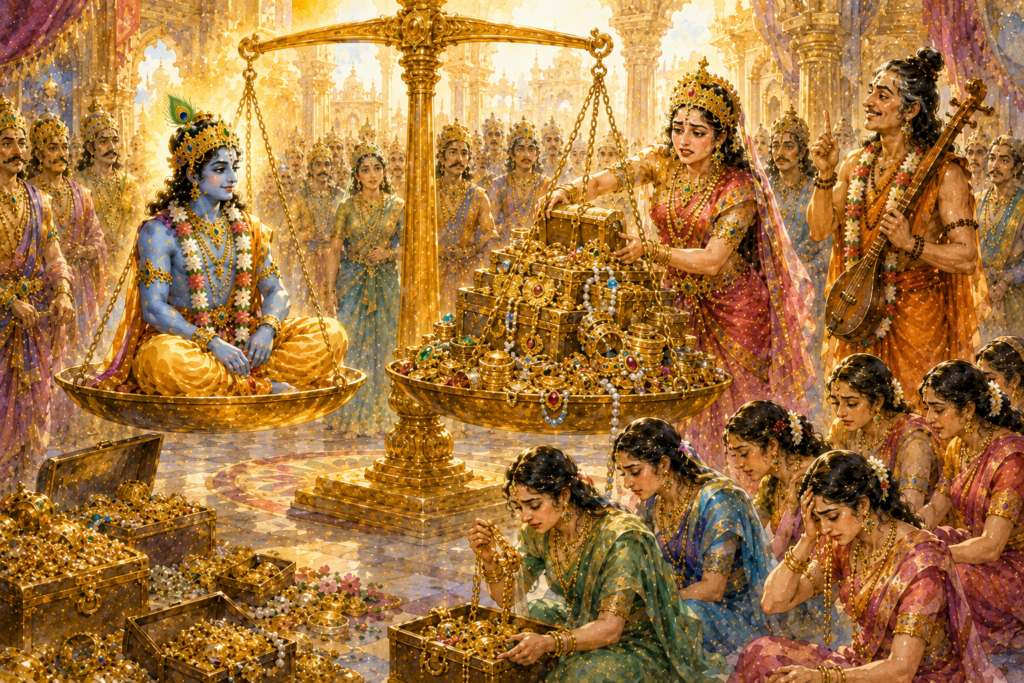
Satyabhama, dazzled by the logic of her own pride, agreed. She led Krishna to the great courtroom of Dwarka, placed him on one side of a massive weighing scale, and formally donated him to Narada.
This is when the actual trouble begins.
When Gold Is Not Enough
Finally, the time of auction arrived. Satyabhama was confident at first. After all, she was one of the wealthiest queens in Dwarka. How difficult could this really be?
Satyabhama opened her treasure houses. Gold came first, box after box carried by servants, piled onto the scale. The scale did not move. More gold. Then jewels. Rubies, emeralds, diamonds, strings of pearls. The scale did not move.
Narada stood nearby watching everything unfold with the calm expression of someone who already knew how the story would end. And every now and then, he would gently remind Satyabhama of the condition.
“If the scale does not balance,” he said almost casually, “Krishna must come away with me.” That only made her more desperate.
Soon, Satyabhama turned to the other queens for help. One by one, they removed their ornaments and added them to the pile — necklaces, bangles, earrings, every last piece of gold they possessed. Until finally, they stood there with almost nothing left except their mangalsutra.
And still…the scale did not move.
The Tulsi Leaf
By now, Satyabhama was completely shaken. All the wealth of Dwarka had been placed on the scale, and still it was not enough. The fear of losing Krishna had slowly replaced her pride. And in that moment of desperation, she finally did something her pride had stopped her from doing earlier.
Rukmini listened quietly while Satyabhama explained everything — Narada’s challenge, the gold, the jewels, the scale that refused to move.
To everyone’s surprise, Rukmini asked for all the gold and treasure to be removed.
The mountains of jewels disappeared piece by piece until the scale stood empty again.
Then Rukmini stepped into the courtyard, walked to the Tulsi plant, and gently plucked a single small leaf.
Just one.
She returned to the scale, closed her eyes for a moment in prayer, and placed the Tulsi leaf beside the treasure. And instantly, the scale moved.
Krishna’s side rose. The Tulsi leaf’s side descended. After all the gold, diamonds, pearls, and wealth of a kingdom had failed… a single leaf had succeeded.
Because this was never really about wealth. It was about devotion.
Rukmini understood something Satyabhama had not yet fully learned — Krishna could not be won through riches, pride, or possession. Only through love offered without ego. And somehow, that simple little Tulsi leaf became heavier than an entire kingdom.
A Personal Reflection — From Me to You
I think this story stayed with me for so many years because I first saw it as a child in an old Telugu mythological film starring Sr. NTR as Krishna. If I remember correctly, Jamuna gaaru played Satyabhama. Even as a kid, that weighing scale scene left such a strong impression on me.
The gold kept increasing.
The jewels kept piling up.
And still the scale would not move.
But then Rukmini comes quietly with a single Tulsi leaf… and everything changes.
There was something so simple and powerful about that moment that I never forgot it. And honestly, now when I explain this story to my daughter, I don’t explain it as just mythology. I explain it as one of the simplest lessons about love and ego.
Sometimes we think love is about grand gestures, proving our importance, or giving the biggest things we can offer. But this story reminds me that love offered with sincerity and humility carries a completely different weight.
What also moves me every time is that Rukmini never humiliates Satyabhama.
She doesn’t lecture her.
She doesn’t say “I told you so.”
She simply places the Tulsi leaf down and lets the truth reveal itself quietly.
And somehow, that makes the lesson even more beautiful.
Continue the Satyabhama Series
Read more from this series:
- Satyabhama — The Warrior Queen of Krishna
- The Syamantaka Jewel — How Satyabhama came to marry Krishna
- The Battle Against Narakasura — Satyabhama’s greatest moment of courage
Did this story stay with you? Share it with someone who needs a reminder that devotion matters more than everything else. Explore more from the Satyabhama series on Fables n Tales.