

Whenever we talk about Krishna, we cannot stop ourselves from thinking about his dear wives, and Satyabhama is one of them. When I was young, I grew up watching a couple of Telugu movies with Late N T Rama Rao garu playing the role of Krishna. The stories from those movies stayed with me and also made me want to know more.
My curiosity grew as I grew up, and to my luck, I had access to an amazing library near my house. I would visit the library everyday to get some books to learn all about Krishna, and his wives. It was my attempt to find answers to someone of the questions I had as a child.
In this post, I am going to share what I know about Queen Satyabhama. If you have something to add to what I wrote, please feel free to leave a comment.
Who Was Satyabhama?
Satyabhama was one of Krishna’s eight principal queens — the Ashtabharya — but among all of them, she’s probably the one who feels the most vivid and human even today.
She wasn’t quiet or reserved. She was bold, emotional, fiercely loving, proud at times, and completely unapologetic about how deeply she felt things. And honestly, I think that’s one of the reasons so many people are drawn to her story even now.
Even her name is beautiful in meaning. Satya means truth, Bha means radiance or brilliance, and Ma is associated with Lakshmi. Together, her name is often interpreted as “the brilliance of truth” — which somehow suits her perfectly.
Satyabhama was born to Satrajit, a powerful Yadava nobleman and the royal treasurer of Dwarka. He was the owner of the legendary Syamantaka jewel — a divine gem gifted by Surya, the Sun God himself. The jewel was said to bring immense prosperity and radiance, but it also became the center of suspicion, conflict, and one of the most dramatic episodes in Krishna mythology.
And interestingly, that jewel is what ultimately connects Satyabhama’s destiny to Krishna’s.
What begins as a story about a missing jewel and false accusations slowly turns into one of the most important relationships in Krishna’s life.
But Satyabhama’s story is not just important because she was Krishna’s queen.
According to Vaishnava traditions, she was also the earthly avatar of Bhudevi — the Earth Goddess herself. And this divine connection becomes incredibly important later in the story of Narakasura, where Satyabhama’s role is far more powerful than many people realize.
That’s what makes her such a fascinating character to me.
She exists in mythology as both deeply human and deeply divine at the same time — a queen who could argue with Krishna one moment, stand beside him in battle the next, and still love him with complete intensity through it all.
How was she different from the other Queens of Krishna
What makes Satyabhama stand out among Krishna’s queens is how intensely human she feels. If Rukmini represented calm devotion and quiet grace, Satyabhama was something entirely different. She was fiery, expressive, independent, emotional, and deeply passionate about the people she loved. She could be proud, stubborn, possessive, and fiercely protective of Krishna — and she never really tried to hide those emotions.
And honestly, that’s what makes her feel so real.
She didn’t love Krishna from a distance like someone worshipping an untouchable god. She loved him as a partner. A husband. Someone she could argue with, challenge, tease, get angry with, and still adore completely.
There’s a warmth and intimacy to their relationship that feels very different from many other divine love stories in mythology.
You can actually imagine conversations between them.
You can imagine disagreements.
Moments of jealousy.
Moments of tenderness.
And somehow, those very human emotions make her devotion feel even more powerful, not less.
Another thing that makes Satyabhama extraordinary is that she was not simply a queen standing behind Krishna in court.
She stood beside him in battle too.
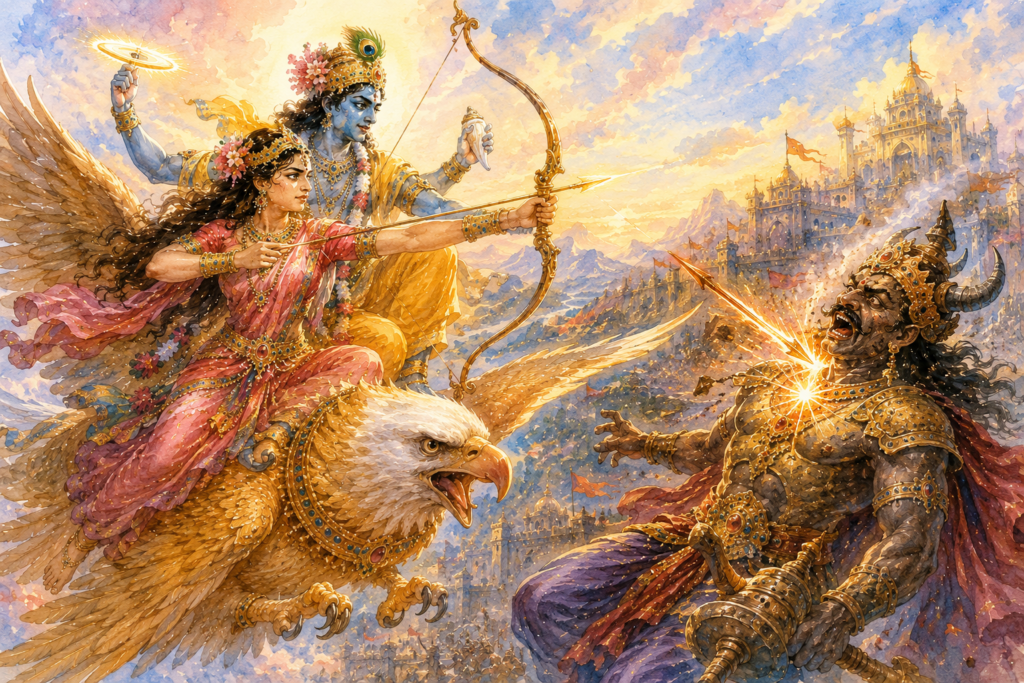
In the story of Narakasura, Satyabhama rides into war with Krishna carrying a bow herself — not as a spectator, but as a warrior. That image of her has always felt incredibly powerful to me: regal, fearless, emotional, and strong all at once.
That combination is rare in mythology. She could be deeply loving and fiercely formidable at the same time.
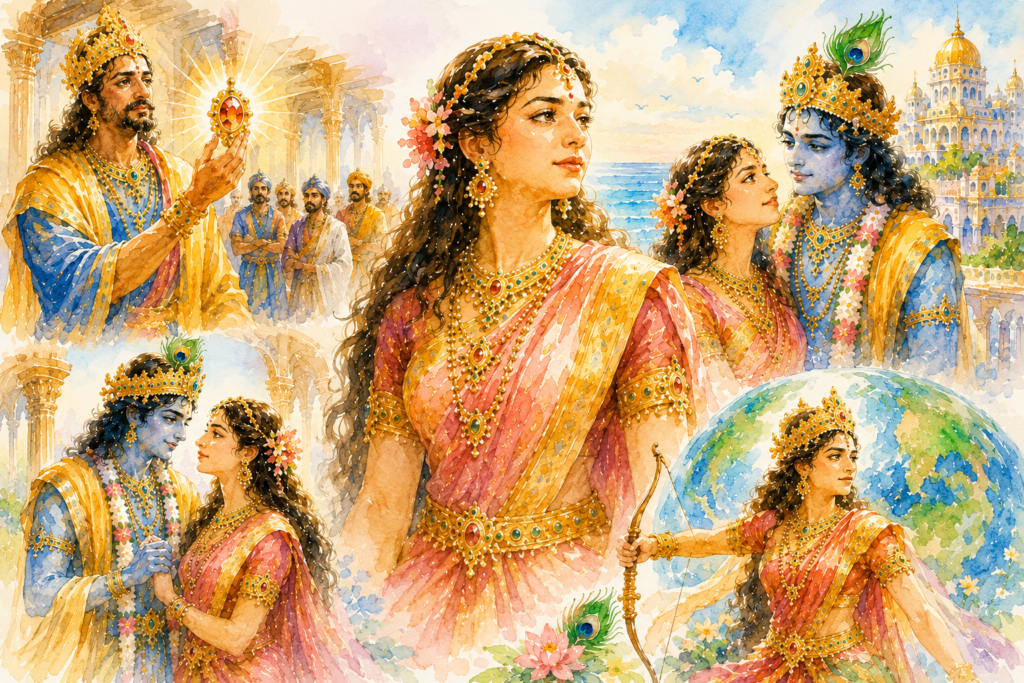
How She Came to Marry Krishna
Honestly, Satyabhama’s marriage story feels less like a traditional romance and more like an epic mythological thriller.
It has everything — a divine jewel, suspicion, political tension, a false accusation against Krishna, a legendary warrior from the Ramayana, and a battle inside a cave that lasted for 28 days.
And somehow, all of it eventually leads to Satyabhama.
The full story is far too fascinating to shorten completely (which is why it deserves its own detailed post, and you can read it here ), but here’s the shorter version.
Satyabhama’s father, Satrajit, possessed the legendary Syamantaka jewel — a divine gem gifted by Surya, the Sun God. The jewel was believed to bring immense prosperity and radiance wherever it remained.
But when Satrajit’s brother disappeared while carrying the jewel, suspicion quickly fell on Krishna. Satrajit openly accused Krishna of murdering his brother to steal the Syamantaka jewel for himself. And for Krishna, clearing his name became deeply important.
So, he followed the trail of the missing jewel into the forest, where the mystery eventually led him to a cave occupied by Jambavan — the great bear king from the Ramayana, the same devoted warrior who had once fought beside Lord Rama.
What followed was not a simple fight, but a legendary duel said to have lasted 28 days.
Eventually, Jambavan realized Krishna was none other than Rama reborn, and surrendered the jewel willingly.
Krishna returned to Dwarka with the Syamantaka jewel and finally proved his innocence.
Satrajit, ashamed of falsely accusing Krishna, sought forgiveness. And as part of that reconciliation, he offered his daughter Satyabhama’s hand in marriage. Krishna accepted Satyabhama.
But interestingly, he refused to keep the jewel. And somehow, that detail says a lot about the story itself. The jewel may have brought them together, but it was never really about wealth or power. It became the thread that tied Satyabhama’s destiny to Krishna’s.
The Battle Against Narakasura
Of all the stories connected to Satyabhama, this is probably the most powerful one.
It’s the story that transforms her from simply being remembered as Krishna’s queen into something much larger — a warrior, a force of justice, and the key figure in one of the most important victories in Krishna mythology.
Narakasura was a ruthless demon king who had become dangerously powerful. The stories say he defeated Indra, stole the divine earrings of Aditi — the mother of the gods — and imprisoned 16,000 women inside his palace.
The world had reached a point where even the gods could no longer tolerate his cruelty.
But there was a problem. Narakasura had a powerful boon: he could only be killed by his mother. And that’s where the story becomes extraordinary.
According to the traditions, Narakasura’s mother was Bhudevi — the Earth Goddess herself. And Satyabhama was believed to be Bhudevi’s earthly avatar.
Which meant that only she could truly bring his end.
So, when Krishna marched to battle Narakasura, Satyabhama did not stay behind in the palace waiting for news.
She went with him.
The image itself feels cinematic even in mythology — Krishna and Satyabhama riding together on Garuda toward the demon’s fortress, preparing for war side by side. And during the battle, one moment changes everything.
Some versions of the story say Krishna was briefly struck unconscious by a powerful weapon. Others describe it more symbolically. But almost every retelling agrees on one thing: it is Satyabhama’s fury and strength that turns the battle.
Enraged and fearless, she lifts her bow and attacks Narakasura herself. And in that moment, the boon is fulfilled.
The mother becomes the one who destroys the son — not out of hatred, but to restore dharma and end suffering.
That’s what makes this story so emotionally powerful to me.
It isn’t just a story about war.
It’s about responsibility.
Justice.
And the idea that compassion and strength can exist together in the same person. And interestingly, this victory is also connected to the origins of Diwali.
Naraka Chaturdashi, celebrated just before Diwali commemorates the defeat of Narakasura and the victory of light over darkness.
The Tulsi Leaf That Outweighed a Kingdom
This is probably one of the most loved and retold stories about Satyabhama — because beneath all the royal grandeur and mythology, it tells something deeply human about love, ego, and devotion.
And honestly, it’s such a simple story on the surface, but the emotion behind it is what makes it unforgettable.
The full version is in our detailed post The Tulsi Leaf That Outweighed a Kingdom, but here’s the shorter version.
The divine sage Narada, who never really missed an opportunity to stir emotions and create drama, noticed Satyabhama’s pride and jealousy toward Rukmini.
Satyabhama deeply loved Krishna, but she also wanted to feel like she was the most important person in his life. Narada cleverly played on those emotions until she made a mistake in a moment of pride — she symbolically “donated” Krishna to Narada.
But there was a condition to get him back. She would have to place Krishna’s equivalent weight in gold and treasure on a scale.
For someone like Satyabhama — a queen surrounded by wealth and luxury — it probably seemed easy at first.
So gold was brought.
Jewels were added.
Treasures piled higher and higher.
But the scale did not move.
No amount of wealth could balance Krishna’s side.
And that’s the moment the story changes from something dramatic to something deeply spiritual.
Rukmini quietly walked forward, placed a single Tulsi leaf on the scale, and offered it with pure devotion and prayer.
And instantly, the scale balanced.
That image has stayed alive in mythology for centuries because of what it symbolizes.
Not that Satyabhama loved Krishna less.
But that devotion without ego carries a different kind of weight altogether.
And I think that’s why this story remains one of the most important turning points in Satyabhama’s journey — not because she was humiliated, but because she learned something profound about love, surrender, and what truly matters.
Her Life After Krishna
After Krishna’s departure from the earth and the destruction of Dwarka, many of his queens are said to have renounced royal life and turned toward spiritual austerity and devotion. Later traditions describe Satyabhama spending her final years in deep remembrance of Krishna, detached from worldly life and immersed in penance and meditation.
Vaishnava traditions believe that Krishna’s consorts ultimately reunited with him in Vaikuntha, the divine realm of Vishnu. While the texts do not always describe Satyabhama’s final years in great detail, devotional retellings often portray her final journey as one of complete surrender to the love that had defined her life.
What I find most fascinating about Satyabhama is how human her love for Krishna feels. She wasn’t calm or detached or endlessly patient all the time. She loved him fiercely — with pride, emotion, protectiveness, even jealousy sometimes. And somehow, that’s what makes her devotion feel so real to me. Not perfect. Not distant. Just deeply honest and wholehearted.
Explore the Full Satyabhama Series
Every story in this series connects back to this post. Read them all:
- The Syamantaka Jewel — How a Diamond Brought Satyabhama to Krishna
- The Tulsi Leaf That Outweighed a Kingdom — Satyabhama, Rukmini and True Devotion
- The Battle Against Narakasura — The Queen Who Fulfilled a Mother’s Boon
- The Parijata Tree — The Day Satyabhama Made Krishna Defeat Indra
- Satyabhama and Draupadi — An Unlikely Friendship in the Forest
- Who Was Bhudevi? — The Goddess of Earth Who Became Satyabhama