

Are you surprised to see this post? Good — because I was surprised when I first came across this story too. Sit tight, because what I am about to tell you is one of the most fascinating and least talked about chapters of the Ramayana. It is about Shanta daughter of King Dasharatha. Let me tell you everything I know.
The first time I learnt about Shanta was in a temple, where a priest mentioned about this temple in Kullu, of Shanta and Rishyasringa. I did know about Sage Rishyasringa, but never heard about the mention of his wife in any books I read. The priest then went on to talk about the story of Shanta, and how he too learnt about it from Sringeri Sharada Peetham.
It was then that I came back and started checking about the facts online. One version which was very much in detail was from the book of my favourite author Devdutt Patnaik sir. After reading through a couple of discussions online, and resources, I was finally able to come up with a draft for this blog.
Everyone knows the story of Rama. Of his birth, his exile, his love for Sita, his battle against Ravana, his triumphant return to Ayodhya. The Ramayana has been told and retold for thousands of years, in every language, in every form.
But very few people know about the child who was born before Rama. The firstborn of Dasharatha. The daughter who was given away before her brothers were even conceived, and whose marriage to a forest sage set in motion the very chain of events that brought Rama into the world.
Her name was Shanta. And this is her story.
| Sources: Valmiki Ramayana (Bala Kanda, references to Rishyasringa); Mahabharata (Adi Parva); Srimad Bhagavatam (9th Skanda); Devdutt Pattanaik’s analysis; Wikipedia entries on Shanta and Rishyasringa; Sringeri Sharada Peetham records. |
The Firstborn of Dasharatha
Shanta was the daughter of King Dasharatha of Ayodhya and his chief queen Kausalya — making her the elder sister of Rama by birth. She was educated in the Vedas, the arts, crafts, and warfare, and was considered exceptionally beautiful and accomplished by every account.
Yet she does not appear in the main narrative of the Valmiki Ramayana as Dasharatha’s daughter. The core text mentions Rishyasringa — the sage who performed the Putrakameshti Yajna — and his wife Shanta, but does not explicitly establish that Shanta is Dasharatha’s biological child. It is in the Mahabharata, the Srimad Bhagavatam, and later regional Ramayana traditions that this connection is made fully explicit.
As the scholar and mythologist Devdutt Pattanaik observes, the Ramayana is like open-source literature — new ideas continuously entered and only that which survived the test of time was celebrated. The story of Shanta is one that survived powerfully in regional traditions, folk memory, and temple worship, even if it was absorbed quietly into the main text.
Why Was She Given Away? The Multiple Versions
Version 1 — The Pact Between Sisters
Dasharatha’s childhood friend was King Romapada of the kingdom of Anga. Romapada’s queen, Varshini, was the elder sister of Kausalya. The two queens, being sisters, made a pact: whichever of them had a child first would give that child to the other.
When Shanta was born to Dasharatha and Kausalya, she became the child who fulfilled this promise. She was given in adoption to Romapada and Varshini, who had no children of their own, and raised as the princess of Anga.
Version 2 — Born in a Difficult Constellation
In the Kigga tradition from Karnataka, Shanta was born in a constellation considered inauspicious, which led to famine in the kingdom. This version adds another layer — that Shanta’s very presence brought both difficulty and, eventually, the power to resolve it.
Version 3 — A Decision About Succession
In one account, since Shanta was a daughter and therefore not eligible to inherit the throne, Dasharatha gave her in adoption to a childless royal couple. This version is the most simply stated but also the one that carries the sharpest edge — a firstborn child set aside because of her gender, whose contribution to the dynasty would ultimately prove irreplaceable.
Rishyasringa — The Sage Who Knew No Women
The man Shanta would marry was one of the most extraordinary figures in all of Indian mythology. Rishyasringa was the son of the great sage Vibhandaka. According to the Mahabharata, Vibhandaka once saw the Apsara Urvashi bathing in a river and was overcome. His seed fell into the water. A doe, who was a cursed Apsara, swallowed it and gave birth to a boy — who was born with a small horns, similar to that of a deer on his forehead. The boy was named Rishyasringa, meaning deer-horn.
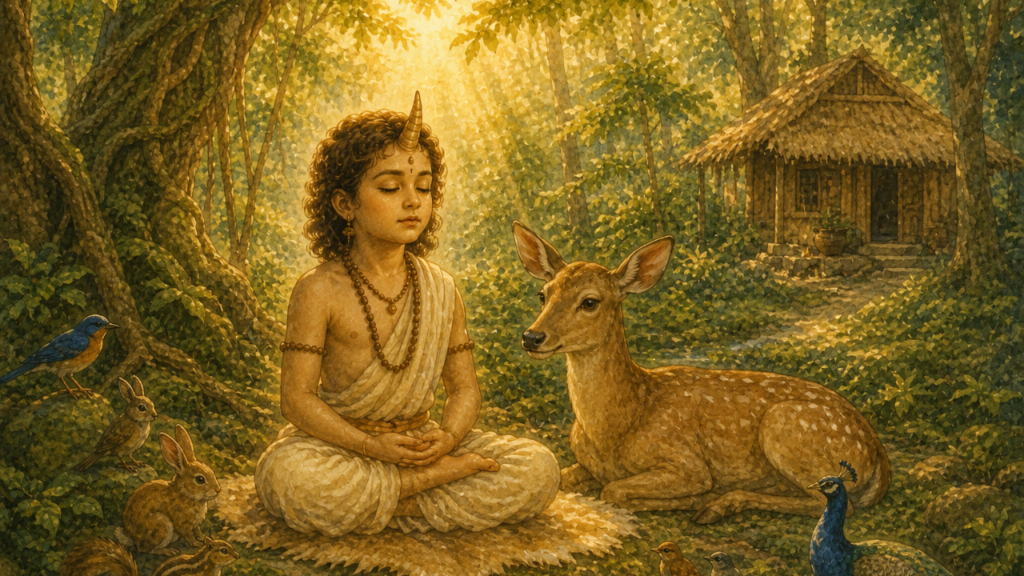
Vibhandaka raised his son in complete isolation in the forest, with no knowledge whatsoever of the existence of women, or of human society beyond their hermitage. Rishyasringa grew up practicing absolute brahmacharya and accumulated extraordinary spiritual powers as a result. Such was the potency of his chastity that wherever his feet touched the earth, rain followed.
The Drought and the Mission
Meanwhile, in the kingdom of Anga, a Brahmin came to King Romapada seeking help during the monsoon season. Romapada, distracted in conversation with his daughter Shanta, failed to attend to the Brahmin’s need. Insulted, the Brahmin left. Indra, unable to bear the affront to his devotee, withheld the rains.
The kingdom fell into severe drought and famine. Romapada was told that the only remedy was to bring a man of perfect chastity to the kingdom, and that such a man was Rishyasringa.
But there was a problem. Rishyasringa had never seen a woman. His father, the formidable Vibhandaka, was fiercely protective and would be furious if anyone approached the ashram. And Rishyasringa himself had no concept of the world beyond the forest.
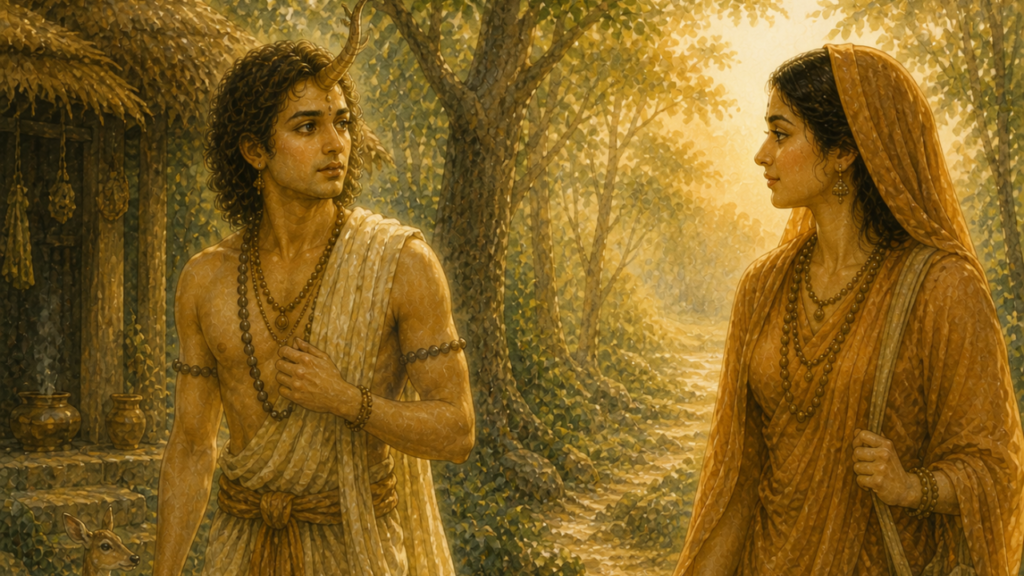
The solution, according to the Sringeri Sharada Peetham’s own account of the story, came from Shanta herself. She led a group of women, dressed as sanyasins, to approach Rishyasringa’s hermitage in his father’s absence. The young sage, who had never encountered a woman in his life, was bewildered by Shanta’s beauty. He then followed them willingly.
Rain at His First Step
The moment Rishyasringa’s foot touched the soil of Anga; the heavens showered their blessings. Rain poured across the drought-stricken kingdom. People came out of their homes in relief and joy. Romapada, waiting at the border of his kingdom to receive the sage, was overwhelmed with gratitude.
According to the Sringeri account, it was Shanta herself who then confided in her father Romapada that she wished to marry Rishyasringa. The king agreed readily — having a sage of such power as a son-in-law would bless the kingdom beyond measure.
Rishyasringa and Shanta were married, and settled in Anga. Even Vibhandaka, Rishyasringa’s fierce father who initially came to Anga in fury, ultimately accepted the marriage as inevitable, recognising that the principle of male and female forces could never be permanently separated, no matter what.
The Yajna That Brought Rama into the World
It was during this period that Dasharatha — Shanta’s biological father — sent word to Rishyasringa. He was without an heir despite having three wives and wished to perform the Putrakameshti Yajna, a sacred fire sacrifice to beget progeny.
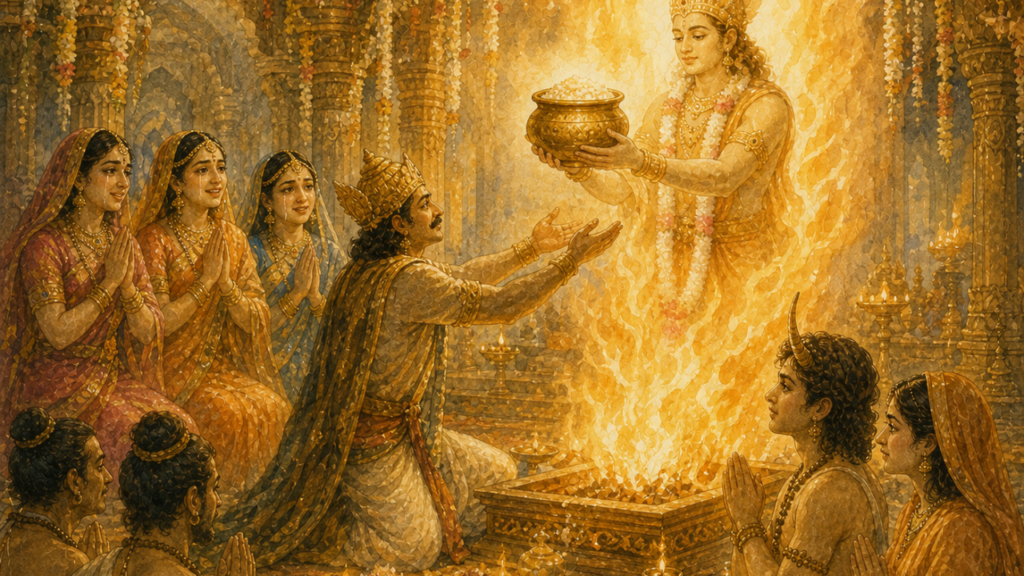
Rishyasringa agreed to come. But what is remarkable — and rarely mentioned — is that he set one condition: his wife Shanta must accompany him and serve as a co-priest in the ceremony.
And so, Shanta returned to Ayodhya. The palace she was born in. The parents who had given her away. When she arrived and prostrated at the feet of Dasharatha and Kausalya, the king did not recognise the woman standing before him — she looked like a rishi. When she revealed herself as Shanta, their long-given-away daughter, the reunion was a moment of profound emotion.
The Putrakameshti Yajna was performed with both Rishyasringa and Shanta presiding it. From the sacred fire emerged a divine being bearing a golden vessel of payasam, a sacred pudding. Dasharatha distributed it among his three queens. And from that payasam were born Rama, Bharata, and the twins Lakshmana and Shatrughna.
Her Character in Regional Traditions
In the main devotional literature, particularly Tulsidas’s Ramcharitmanas, Shanta is largely absent. But in regional traditions she is vivid and fully formed.
In Telugu folk songs, she is described as a fierce elder sister, the kind who speaks her mind and does not hold back. When Rama abandons Sita following street gossip, it is Shanta in these songs who is furious, who challenges her brother, who refuses to remain quietly on the sidelines of her own family’s story.
She is described across traditions as exceptionally educated, versed in the Vedas, skilled in arts and warfare and as deeply beautiful. Unlike Rama, who is always mentioned as stoic and serene, she was said to be sensuous, present and alive.
Why Did She Disappear from the Main Text?
Scholars and mythologists have asked this question for a long time. The most likely answer is that as the Ramayana evolved into an increasingly Rama-centric devotional text, the stories that did not directly advance Rama’s narrative were gradually set aside. Shanta’s story is essential to understanding how Rama came to exist, but it is not essential to the devotional arc of Rama as an avatar of Vishnu.
There is also a more uncomfortable reading. Shanta was given away because she was a daughter, not a son. Her contribution to the dynasty was indirect, through her husband, through the yajna she co-presided over, through the rain that followed Rishyasringa’s feet. In a tradition that sometimes struggled to centre women’s stories, hers quietly receded.
And yet she never disappeared entirely. The temples remain. The folk songs remain. The lineages that trace themselves back to her remain. Memory is stubborn when it is rooted in something true.
Princess Shanta’s story is one that stayed with me long after I first heard it. Her journey — from being given away as a newborn, to being raised as the princess of another kingdom, to becoming the wife of a forest sage who barely knew the world existed — feels both extraordinary and deeply human. But beneath the beauty of her story lies something uncomfortable: she was given away simply because she was a daughter. Not because she was unloved. Not because she was unwanted. Simply because she was a girl. There is something both painful and quietly powerful in that truth.
| Source note: This story draws from multiple authentic sources including the Valmiki Ramayana (Bala Kanda), the Mahabharata (Adi Parva), the Srimad Bhagavatam (9th Skanda), the Sringeri Sharada Peetham’s documented history of Sage Rishyasringa, and regional folk traditions from Andhra Pradesh, Karnataka, and Himachal Pradesh. As with all Ramayana traditions, different recensions carry different details. The reflection and interpretation are the author’s own. |
Read More from the Ramayana
Continue exploring the world of the Ramayana on Fables n Tales, and here are a few more stories you can check on my blog:
- The Temples of Shanta and Rishyasringa — Where This Story Lives in Stone
- The Prince Who Turned into a Wishing Tree — Another forgotten story from Indian mythology
- The Samudra Manthan — How gods and demons together shaped creation
Did this story surprise you? Share it with someone who loves the Ramayana — and who perhaps did not know Rama had an elder sister. Explore more stories from Indian mythology right here on Fables n Tales.