

There is a film coming this Diwali season that is going to be very hard to avoid, and honestly, you would not want to avoid it. Ramayana, Part 1, has been years in the making, carries one of the largest budgets any Indian film has ever had, and brings together a cast most of us never expected to see standing together in the same story. If you grew up with the Ramayana the way most of us did, half remembered episodes, a grandparent’s retelling, the old television series playing on a loop during a festival week, this is going to be worth knowing properly before it arrives.
So let me walk you through what it is, who is playing whom, how much of the actual epic it covers, and a few lovely little details about the casting that made me smile when I found them.
The basics
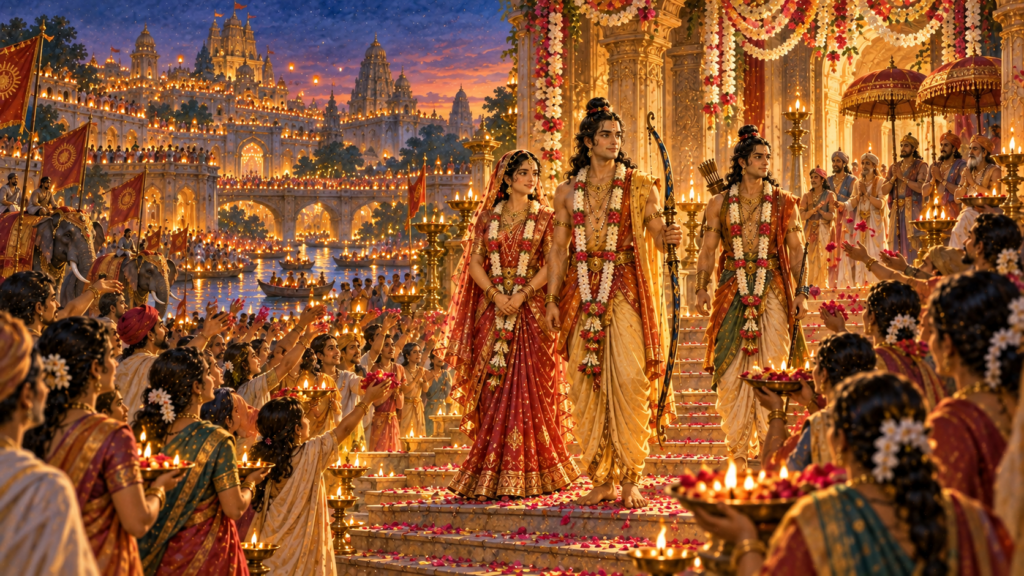
Ramayana, Part 1 is directed by Nitesh Tiwari, the same director behind Dangal and Chhichhore, and it is based directly on the Valmiki Ramayana, the oldest and most foundational telling of the epic. It has been conceived as a two-part film, with this first instalment expected in cinemas around the Diwali season this year, and the second part planned for Diwali the following year. Reports on the precise release date have shifted a little as the date approaches, some naming late October, others early November, so I would treat any single date you see online as provisional until the makers confirm it closer to release. What is certain is that it is timed for Diwali, and there is something rather beautiful in that choice, since Diwali itself marks Rama’s own return home after his long exile, so the film is arriving in cinemas at exactly the moment its own story is about.
The scale of the production is genuinely enormous, filmed for IMAX, built with visual effects from some of the same international teams behind major global blockbusters, and reported among the most expensive films ever made in India. Whatever else it turns out to be, nobody is approaching this one as a small effort.
Who is playing whom
This is the part people ask me about most, so here is the cast mapped out plainly.
| Actor | Character | Who they are |
| Ranbir Kapoor | Rama | The prince of Ayodhya, exiled from his kingdom, whose story the whole epic follows |
| Sai Pallavi | Sita | Rama’s wife, daughter of King Janaka, whose abduction sets the second half of the story in motion |
| Yash | Ravana | The powerful demon king of Lanka, this is his first major Hindi film role |
| Sunny Deol | Hanuman | The devoted vanara whose loyalty becomes central once the story reaches Lanka |
| Ravi Dubey | Lakshmana | Rama’s younger brother, who follows him into exile without hesitation, marking Dubey’s film debut |
| Arun Govil | Dashratha | Rama’s father, the king of Ayodhya, whose promise sets the exile in motion |
| Lara Dutta | Kaikeyi | One of Dashratha’s queens, whose old boon becomes the reason for Rama’s exile |
| Kajal Aggarwal | Mandodari | Ravana’s wife, queen of Lanka |
| Rakul Preet Singh | Shurpanakha | Ravana’s sister, whose encounter with Rama and Lakshmana in the forest sets the abduction in motion |
A few names beyond the main cast are also confirmed, including Anupam Kher, Vivek Oberoi, Kunal Kapoor, and Indira Krishnan as Kaushalya, Rama’s mother, with more of the ensemble expected to be revealed closer to release.
The lovely bit of casting nobody is talking about
Here is a small detail I genuinely loved discovering, and I suspect it was not an accident. Arun Govil has been cast as Dashratha, Rama’s father. If that name feels familiar, it should. Arun Govil is the actor who played Rama himself in the beloved 1987 television Ramayan, the version an entire generation of Indians grew up watching, often as a whole family gathered around one television set. To see him now playing Rama’s father in this new telling feels like a quiet passing of the torch, one generation’s Rama stepping into the role of the man who raised the next one. I do not know if the filmmakers meant for that detail to land the way it does, but it does, and it is worth knowing before you watch.
How much of the story this covers
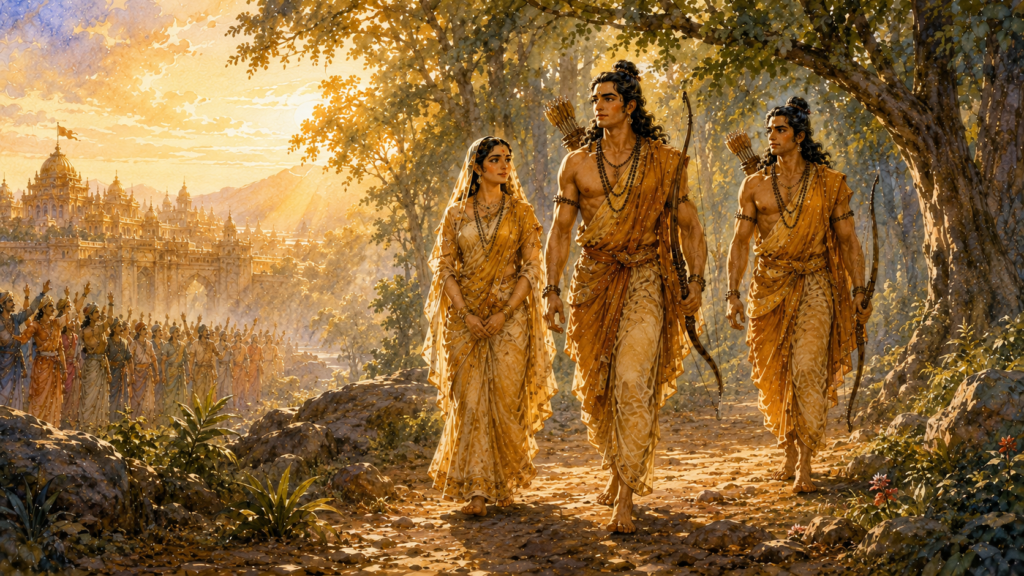
The Ramayana is vast, and no single film could hold all of it, which is exactly why this has been made as two parts. From what has been shared so far, Part 1 follows Rama’s early life in Ayodhya, his marriage to Sita, and the events that lead to his exile into the forest, building toward the growing conflict with Ravana. In the language of the original epic, this maps roughly onto the earlier books, the Bala Kanda and Ayodhya Kanda, moving into the Aranya Kanda, the years in the forest.
What that means in practice is that Part 1 is likely to end somewhere around the abduction of Sita, or the events building directly toward it, the moment the story turns from a tale of exile and family duty into the great rescue and war that most people associate with the Ramayana. The full scale confrontation with Ravana, the building of the bridge to Lanka, and the climactic battle are the natural material for Part 2, arriving the following Diwali.
The music, and one more first
One detail worth knowing simply because it has not happened before. The film’s songs are composed by A. R. Rahman, and its background score by Hans Zimmer, the composer behind the scores for some of the biggest films in the world. This marks Zimmer’s first full length work on an Indian film, and having these two composers on the same project at all is being treated as a genuine landmark in itself, quite apart from the story being told.
Why this one feels different
Indian cinema has told the Ramayana before, in television, in animation, in countless regional films across the decades. What makes this one worth paying attention to is not really the scale of the budget or the size of the cast, though both are considerable. It is the plain fact that this story has never really gone away. It gets told again in every generation because each generation needs to hear it again in its own voice, and this looks to be the version being made for ours.
Whatever the film turns out to be once it actually reaches the screen, and reviews are always their own separate conversation, the story underneath it is the same one that has been carrying people through their own exiles, their own long waits, and their own homecomings for thousands of years. It arrives, fittingly, on the one festival built entirely around the idea that the light does eventually come home. If you want to walk into the cinema this Diwali already knowing who everyone is and where the story is likely to take you, you are, I hope, a little more ready for it now.
MORE FROM MYTHOLOGY TODAY
Nagabandham, Which Parts Are Real Temple Lore, and Which Did the Film Just Make Up
Krishnavataram, Everything You Need to Know About the Mythology Behind the Film