I think this is one of the questions I asked my parents the most when I was a kid. Later when I grew up, I read a lot of stories about how the universe began, but sadly most of them were almost the same. You ask anyone, they often give you the same story. I think I got the answer to my question when I visited a temple and asked the pujari there about the same. And, you will be surprised by reading what I found out.
Believe me when I say, Hindu creation stories become far more interesting than any single tidy myth could ever be. So let me walk you through them, the way I wish someone had walked me through them years ago.
Not one story, but a library of them
Here is the thing to hold onto before we begin. The Hindu tradition is not a single book written by a single hand at a single time. It is a huge, layered library, built up over thousands of years, from the Vedas to the Upanishads to the Puranas. Each of those layers was asking its own questions, in its own mood. So each one answers the creation question a little differently.
One text hands you a glowing golden egg. Another gives you a cosmic being who becomes the world. Another simply shrugs and admits that maybe nobody can really know. They all sit side by side, and the tradition just lets them. It never forces them into one official version. It helps to think of them less as rival theories and more as different windows into the same enormous room.
Let me show you the main ones.
The hymn that admits nobody knows
We may as well start with the boldest, because it is also one of the oldest. The Nasadiya Sukta, tucked into the tenth book of the Rig Veda, is a short hymn about the very beginning. And instead of confidently describing that beginning, it does something almost nobody expects from an ancient sacred text. It asks questions it cannot answer.
It describes a time before there was being or non-being, before death, before even the difference between night and day. It speaks of a single something that breathed, all on its own, without any air. And then, right at the end, it says the most astonishing thing. The gods themselves came after creation, so how could they possibly know how it happened? Perhaps the one who watches over everything from the highest heaven knows. Or perhaps, the hymn quietly adds, even he does not.
Three thousand years ago, somebody wrote a sacred hymn whose final word was a humble I am not sure. I find that breathtaking, and it is a good sign of what this whole tradition is willing to do.
The golden egg
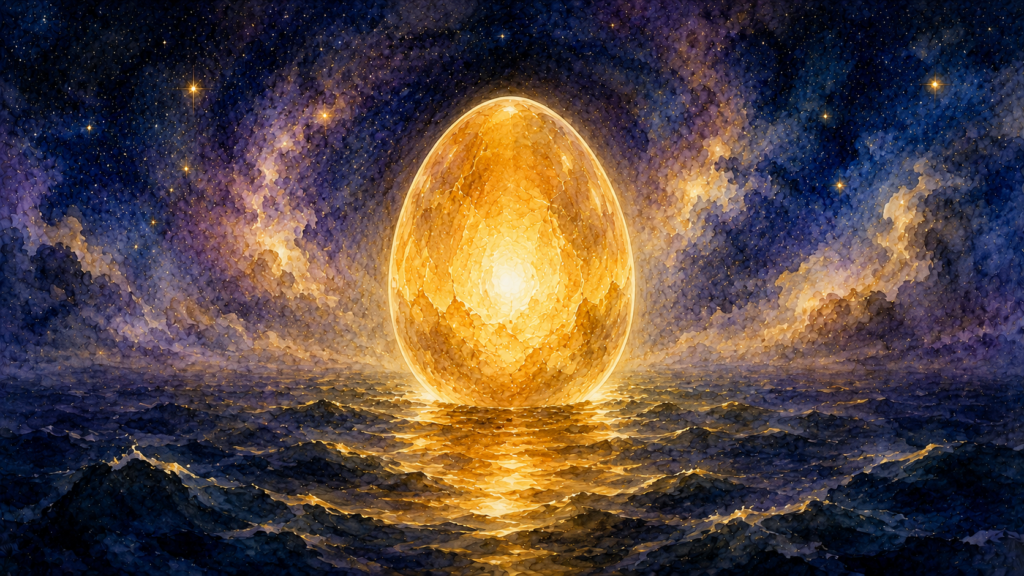
If the Nasadiya Sukta is comfortable sitting with mystery, the Hiranyagarbha hymn hands you a picture you can actually hold. It says that out of the dark primordial waters rose a single golden egg, glowing, floating, holding the seed of everything inside it. For a full cosmic age it drifted. Then it cracked open, and the top of the shell became the sky and the bottom became the earth, and everything we know poured out from within.
It is warm and vivid and impossible to forget, and it became one of the most travelled images in the world. The whole universe as one complete thing that breaks open and becomes the many.
The body that became the world
Then there is the Purusha Sukta, which offers something stranger and grander still. It describes a vast cosmic being, and says the universe was made through a great sacrifice in which this being offered up his own self. The sun came from his eye, the moon from his mind, the wind from his breath, the earth from his feet. In this telling, the universe is not something a god built from the outside. It is something a god became.
It is a beautiful idea, and it is also a text people still debate, because it carries one of the earliest mentions of the old fourfold social order of ancient India. That conversation is a real and serious one, and it is still going on. But at its heart the hymn is making a single sweeping claim, that absolutely everything shares one common source.
Brahma on the lotus
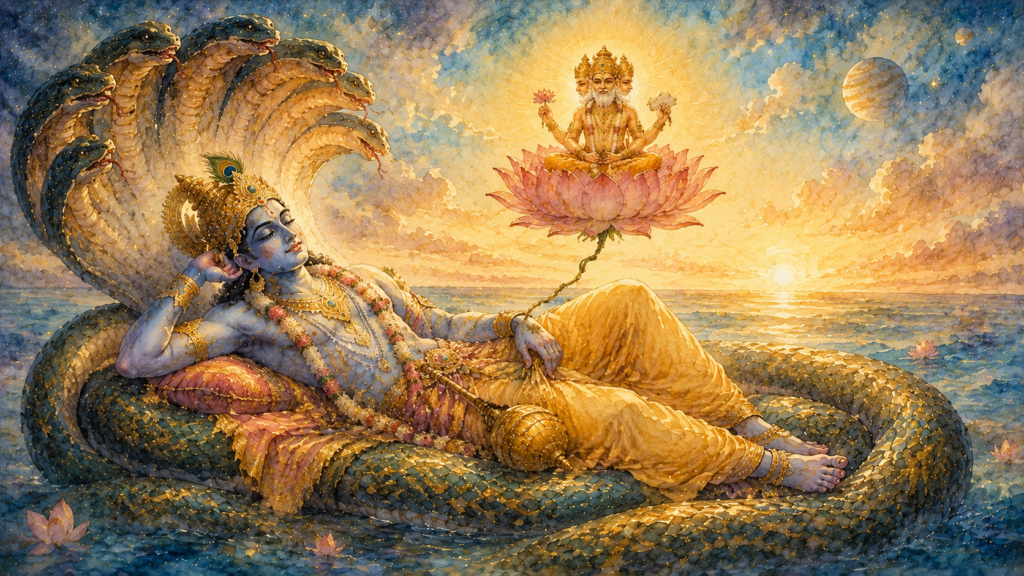
Move forward in time to the Puranas and the picture shifts again. Now you get the image that sits on a thousand calendars and temple walls. Vishnu, asleep on the coils of a great serpent, floating on the cosmic ocean. From his navel grows a lotus. And seated on that lotus is Brahma, who looks around at the endless waters and begins the patient work of shaping the worlds. Creation here feels calmer, almost homely. A god wakes from a long sleep, and gently, the making starts up again.
So which one is true?
By now you might be waiting for me to tell you which of these is the real Hindu creation story. And the honest answer, the one the tradition itself gives, is that this is the wrong question to be asking.
These stories were never really competing to be the single correct report of a physical event. They are more like different answers to different questions. If you ask whether we can ever truly know how it all began, the Nasadiya Sukta answers you. If you ask what it means that everything came from one source, the golden egg answers. If you ask why you should treat the world around you as sacred, the Purusha Sukta answers. Read them that way and they stop contradicting each other and quietly start completing each other.
That is the real gift hiding inside all of it. Not a fact about the distant past, but a way of holding big questions. Curious, unhurried, and comfortable with more than one answer at a time.
So the next time someone asks how Hindus think the universe began, you do not have to pick a single story and defend it to the death. You can smile and say, well, that rather depends on which question you are really asking. There is a golden egg, and a cosmic being, and a god asleep on the sea, and one very old hymn brave enough to say that perhaps nobody knows at all. Somehow, sitting together, they tell you more than any single answer ever could. Pick whichever one pulls at you, and start there. This whole series is really just a slow, happy walk through that library, one story at a time.
Sources & Canonical References
To ensure accuracy, the philosophical concepts highlighted in this guide are drawn directly from traditional Vedic and Puranic literature:
- The Nasadiya Sukta: Rig Veda, Mandala 10, Hymn 129.
- The Hiranyagarbha Hymn: Rig Veda, Mandala 10, Hymn 121.
- The Purusha Sukta: Rig Veda, Mandala 10, Hymn 90.
- The Puranic Narrative: Srimad Bhagavatam (Bhagavata Purana), Canto 3.