

Visit a temple, and you would hear a lot of stories about it. I often loved listening to such temple tales from my grandmother, who travelled a lot between Chennai and the Telugu states. One of the most beloved tales is that of Lord Ganesha and Lord Muruga and a single golden mango.
We hear this story during the Ganesha Chaturthi puja story as well. But, this version is what is being told at the hill temple of Palani in Tamil Nadu. It is the tale behind the hill temple of Palani in Tamil Nadu, and it explains, in the sweetest possible way, why an entire town came to be called after a piece of fruit.
It begins, as so many good stories in this tradition do, with Narada.
A mango that was no ordinary mango
We know how mischievous Narada can be. He is the wandering sage, who travels between the worlds, and carries messages between the gods. He does not miss any chance to stir up any trouble along the way. One day during his travels, he visited Mount Kailasha, which is the home of Shiva and Parvati, and their two sons Ganesha and Muruga.
Narada carried with him a gift, a single mango, which was ripe and golden and glowing as though lit from within. But he was quick to say it was no ordinary fruit. This, he told them, was the fruit of gyana, of wisdom and knowledge itself. Whoever ate it would receive that wisdom entire.
Parvati, being a sensible mother with two children in the room, suggested the obvious thing. Cut it in half. Let each boy have a share, and there would be no fuss at all. But Narada, true to his nature, would not allow anything so simple. The fruit had to be eaten whole, he said, by one person only.
And, he did not leave it at that. He also added that the fruit would be sweeter if it was earned first, through a worthy test.
The race around the world
Shiva liked the idea of a challenge, and he set one that only gods could attempt. Whichever of his two sons could circle the entire world first would win the mango.
Muruga did not wait to hear it twice. He loved a good contest, and he had the perfect vehicle for one, his peacock, swift and eager. He leapt onto its back and shot off at once, delighted at the thought of beating his brother fair and square across the whole wide world.
Ganesha, meanwhile, did not move an inch.
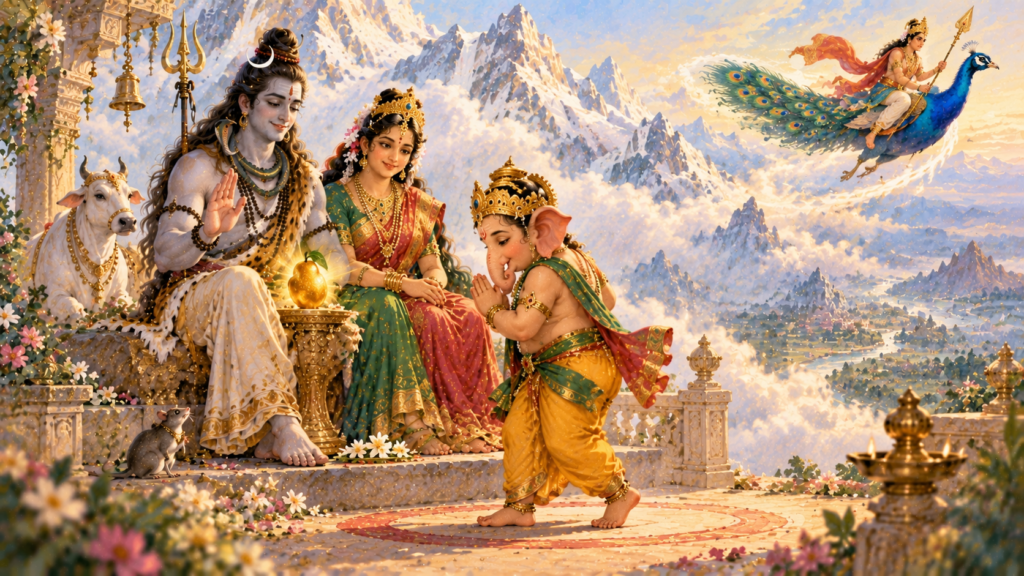
He turned instead to his mother and father, seated together nearby, and simply walked a slow, careful circle around the two of them. Then he bowed low and touched their feet, asking for their blessing, as though that was all the journey required.
Shiva could not help but ask why he was not chasing after his brother like everyone expected.
Ganesha’s answer came without a moment’s hesitation. Because you, he said, are my whole world.
A gift, and a sulk
There was no arguing with that. Parvati and Shiva were utterly won over, and the mango was placed in Ganesha’s hands. It was not really about speed at all, they realised, it was about understanding what the challenge had truly been asking.
Some time later, a thoroughly worn out Muruga finally returned, having genuinely circled the whole world on his peacock, only to learn that his little brother had won the fruit without ever leaving the mountain. He did not take it well. Feeling outsmarted and more than a little humiliated, Muruga stormed off from Kailasha in a temper.
He came down to earth and chose a lonely hilltop to sit upon, and there he shed every trace of his usual finery, his fine silks, his jewels, everything a young god might normally wear. He wrapped himself in nothing but a simple loincloth, took up a plain wooden staff, and sat there like any wandering ascetic, sulking in the stillness of his own pride.
The words that gave the hill its name
Word of this reached Kailasha, and Shiva, Parvati, and Ganesha all came down together to coax him home. But Muruga, arms crossed in every sense, would not be moved. He sat there in silence, refusing to budge.
At last Shiva looked at his sulking son with nothing but love in his eyes, and said something that has been remembered ever since. You are Subrahmanya, he told him, beloved of the wise and the learned. Why let one fruit trouble you so, when you yourself are the very fruit of wisdom.
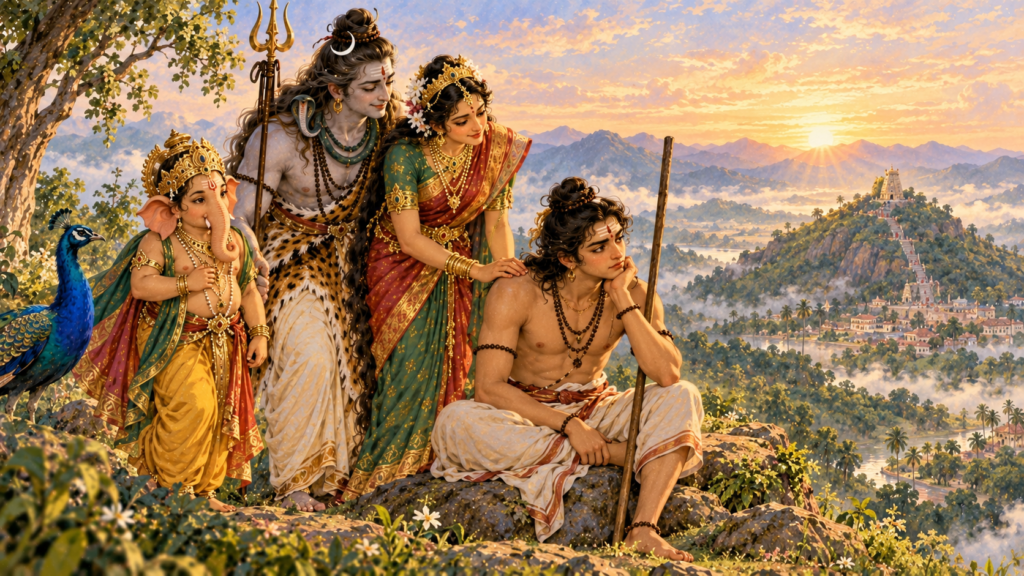
In Tamil, the word for fruit is pazham. And in that single gentle sentence, calling his son the fruit of wisdom himself, pazham nee, the hill on which Muruga sat was given its name. Over time, Pazhani softened into Palani, and the town that grew up around that hill has carried the name ever since, a whole place named quietly after a father’s kind words to his upset son.
Muruga chose to remain there. Even today, in the temple that stands on that same hill, he is worshipped not in his usual radiant, richly dressed form but exactly as he sat that day, plain and humble, holding his staff. He is called Dhandayudhapani there, the one who holds the divine staff, and pilgrims still climb that hill in their thousands to see him just as he chose to be seen, a god who once let his pride get the better of him, and stayed to become something gentler because of it.
What I love most about this story is that nobody in it is entirely wrong. Muruga’s hurt is real, he did try honestly, he did circle the whole world, and it still was not enough. Ganesha’s answer is not really a trick either, it is simply a truer way of seeing what the test was actually asking. And Shiva does not scold his sulking son at all, he just reminds him, gently, of who he already is. Sometimes the wisest response to someone else’s cleverness is not to feel smaller, but to remember your own worth was never really in question. It took a mango, a race around the entire world, and a father’s few kind words to teach that to a god, so I suppose the rest of us can be forgiven for needing reminding now and then too.
| Where this comes from This is a well known Puranic legend associated with the Palani Murugan temple in Tamil Nadu, told and retold across many regional sources. This retelling draws on the traditional story rather than any single published account. |
Read More Temple Tales Here
Sources & Scriptural References
The historical and mythological accounts featured in this temple guide are drawn from canonical text traditions and local regional history:
Puranic Origins: Shiva Purana and Skanda Purana (detailing the divine lineage and conflicts of Mount Kailasha).
Tamil Literary Lore: The Sthala Purana (local temple history) of the Arulmigu Dhandayuthapani Swamy Temple in Palani.
Regional Tradition: Traditional oral retellings of the Pazham Nee milestone celebrated within the ancient Tamil Bhakti literature.