

If you’ve read any Panchatantra story before, you’ve probably noticed it belongs to one of five books — Mitra Bheda, Mitra Labha, Kakolukiyam, Labdhapranasam, or Aparikshitakarakam. Most retellings mention this in passing and move straight on to the story itself.
But here’s something worth sitting with for a moment: the order of these five books isn’t random. Read together, in sequence, they tell a much bigger story — about how power, friendship, and trust actually work, from beginning to end.
Book One — How Friendships Are Lost
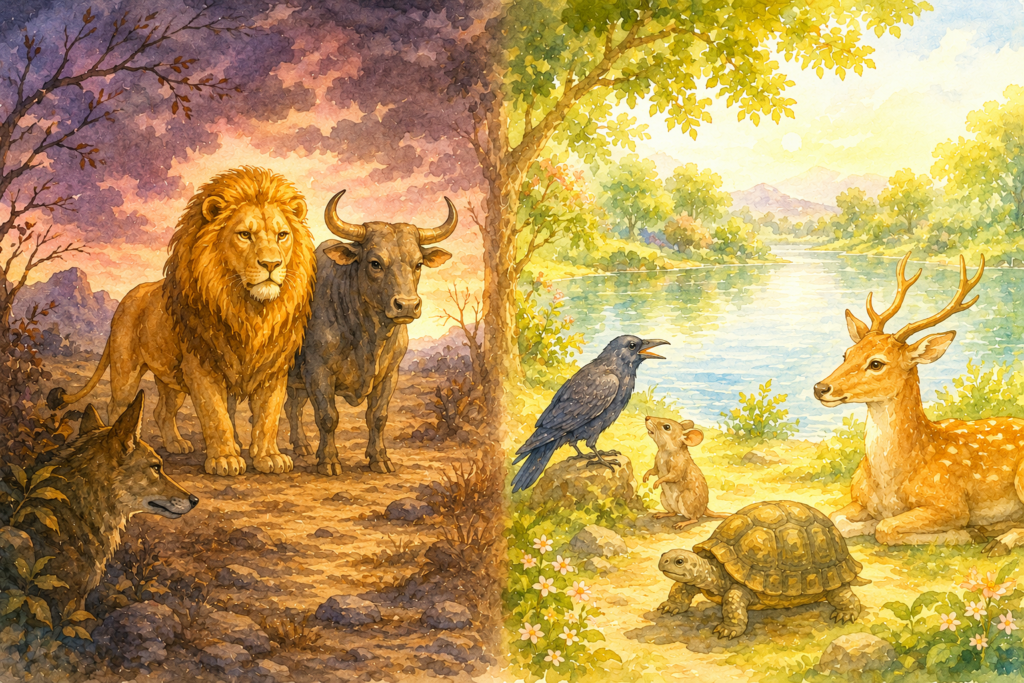
Mitra Bheda opens the whole collection with its darkest material first. A lion king and a bull become close friends — and two scheming jackals, worried about losing their own influence, slowly poison that friendship with manufactured suspicion until it ends in death.
Why start here, with the worst possible outcome? Because the Panchatantra wants its readers — originally three young princes who would one day rule a kingdom — to understand the danger first. Before you learn how to build anything good, you need to understand exactly how easily it can be destroyed.
Book Two — How Friendships Are Actually Built
Mitra Labha is the deliberate opposite. A dove, a crow, a mouse, a tortoise, and a deer become genuine friends — not through convenience, but by saving each other, again and again, from real danger. Each one contributes something only they can offer.
Read right after Book One’s tragedy, this book feels like a quiet exhale. Having shown us the worst version of friendship, the Panchatantra now shows us the best — and the contrast is the whole point.
Book Three — How to Survive a War You Didn’t Start
By the time we reach Kakolukiyam, the Panchatantra assumes its reader already understands friendship — both how fragile and how strong it can be. Now it moves to something harder: what do you do when an enemy simply will not stop attacking you?
The crows and owls of this book are old, bitter enemies. The crows survive not through strength, but through patience, intelligence, and one extraordinary act of strategic deception. This book is preparing a future ruler for the reality that not every conflict can be solved with friendship alone.
Book Four — How to Protect What You’ve Already Won
Labdhapranasam shifts again. The monkey and crocodile have already built something — a real, easy friendship — and this book is about what happens when someone else’s greed threatens to take that away. It’s a book about vigilance. About noticing, just in time, that something you trusted has quietly turned dangerous.
Having taught the reader how to make friends and how to fight enemies, the Panchatantra now teaches something subtler: how to hold on to what you’ve gained, because winning something is never the end of the story.
Book Five — How to Avoid Destroying It All Yourself
And then, right at the end, Aparikshitakarakam — the shortest, bleakest book of the five. No grand wars. No clever escapes. Just story after story of people destroying everything through one rushed, unconsidered action: a loyal mongoose killed on a wrong assumption, a barber who copies a ritual he never understood, a Brahmin so greedy for treasure he curses himself.
Why end here, on such a dark note, after the triumphs of the earlier books? Because this is the Panchatantra’s final and most important warning. You can master friendship, war, and wealth — and still lose everything in a single careless moment. It’s deliberately the last thing a future ruler is left holding onto.
So, What Should You Take From This?
- The five books aren’t a random anthology — they follow the real lifecycle of power: making friends, losing them, fighting enemies, protecting what’s won, and avoiding self-destruction.
- Reading Book One and Book Two as a deliberate pair — tragedy, then its opposite — reveals one of the Panchatantra’s most carefully designed structural choices.
- Ending on the darkest book, rather than a triumphant one, tells us exactly what the original audience was most urgently meant to remember.
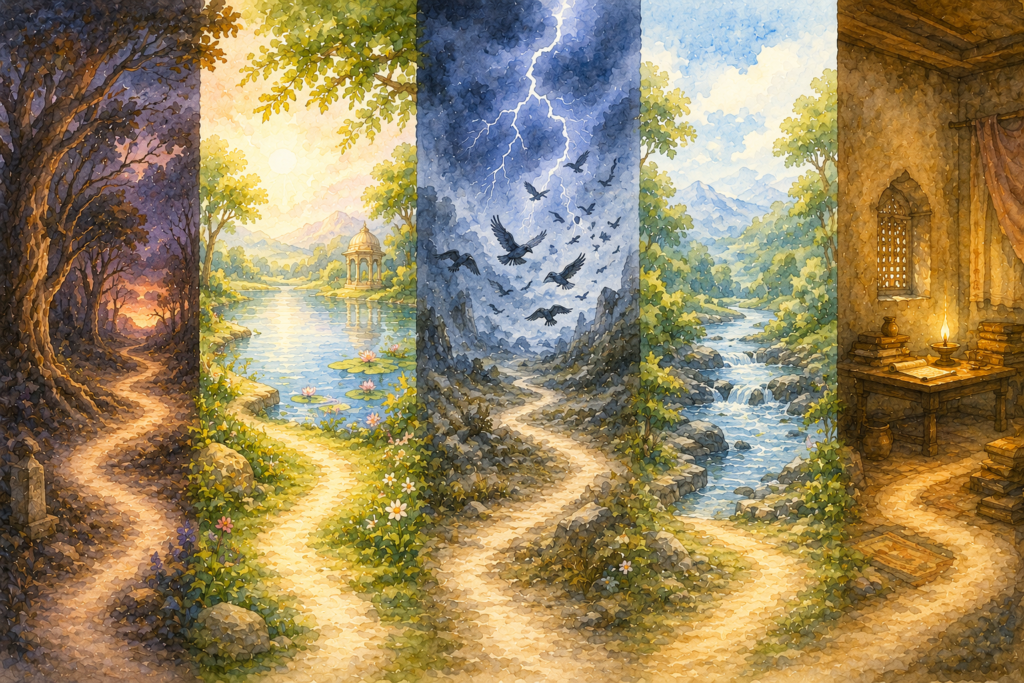
What I find most impressive about this structure is how unsentimental it is. A lesser book might have ended on the crows’ victory in Book Three, or the warm friendship of Book Two, and called it a happy ending. Instead, the Panchatantra deliberately saves its bleakest material for last — because the people it was written for were about to hold real power, and real power is lost far more often through carelessness than through any clever enemy.