Every Panchatantra story we’ll ever tell you traces back to one name — Vishnu Sharma.
And here’s the strange part. We genuinely don’t know if he existed.
What the Text Itself Says
We’ve already told the story of how Vishnu Sharma came to teach three impossible princes — a tale you can read in full elsewhere on the blog. The short version: a worried king, three sons who refused to learn anything, and an old scholar who made an unusual promise to transform them within six months, using nothing but stories.
That story is how the Panchatantra introduces itself. Vishnu Sharma is presented as the narrator — the wise old teacher sitting the princes down and beginning, one story at a time, the long education that becomes the entire book we now read.
It’s a beautiful frame. The only problem is, we have almost no way of confirming any of it actually happened.
A Name, and Almost Nothing Else
Outside the Panchatantra itself, there’s no solid historical record of a scholar named Vishnu Sharma living and teaching in ancient India. No other texts mention him by name in a way scholars can confidently connect to this story. No inscriptions, no other writings confidently attributed to him.
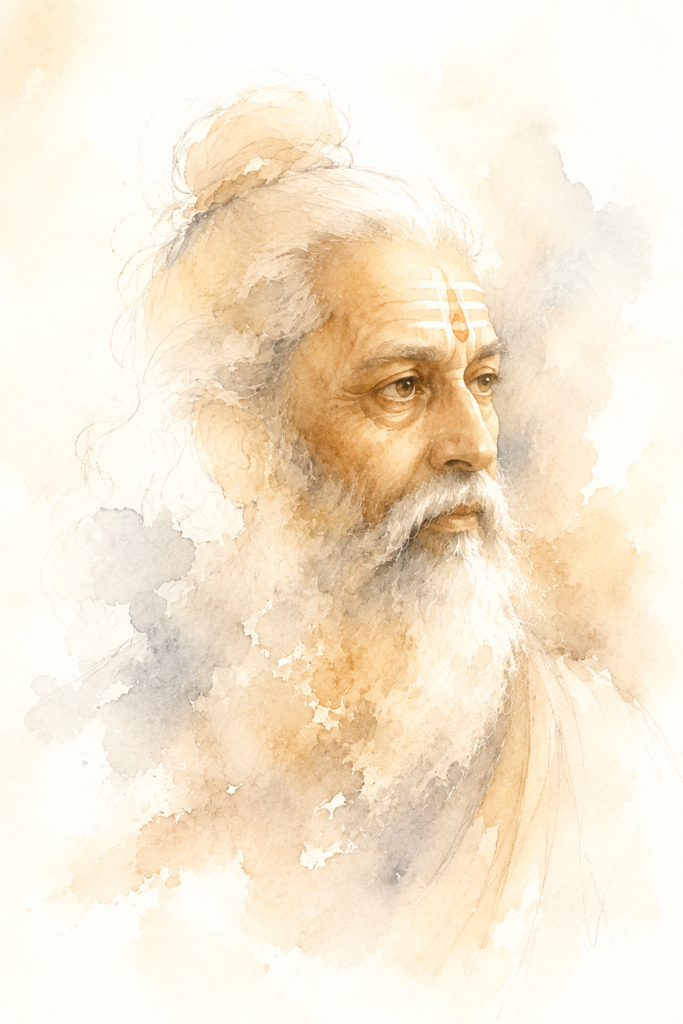
This has led many scholars to a fairly direct conclusion: Vishnu Sharma may never have been a real, individual person at all. He might simply be a literary device — a face and a name given to what was actually centuries of oral storytelling tradition, gathered together and written down by someone (or several someones) who chose not to take credit for it themselves.
Why Give Credit to Someone Who May Not Exist?
This isn’t unusual in ancient Indian literature, actually. Plenty of old texts are credited to a single named sage or teacher, even when scholars suspect many hands and many generations were really involved. There’s something almost humble about it — the individual storytellers disappear, and what’s left behind is simply the wisdom itself, attached to a single dignified name so it can be remembered, taught, and passed on more easily.
In a strange way, it doesn’t really matter whether Vishnu Sharma personally existed. What matters is the role he plays in the story — the patient, clever teacher who knew that three bored princes would never sit through a lecture, but would absolutely lean forward to hear what happened to a foolish monkey who pulled a wedge out of a log.
The Teacher as a Method, Not Just a Man
What’s genuinely radical about the Vishnu Sharma frame, real person or not, is the teaching method itself. He doesn’t sit the princes down and explain the rules of good governance. He tells them about a lion who trusted the wrong advisor. About a crocodile whose jealous wife asked for a friend’s heart. About four foolish scholars who brought a dead lion back to life because they could, without ever asking if they should.
Each story does the work that a hundred warnings never could. The princes don’t have to be told not to trust flattery — they’ve just watched a foolish donkey die because of it.
There’s something I find quietly moving about this. Somewhere, centuries ago, real people sat together telling each other stories about clever crows and foolish donkeys, refining them, passing them on, letting them travel from one mouth to the next for generations — and at some point, all of that collective wisdom was simply folded into one name. Vishnu Sharma became the keeper of stories that, in truth, belonged to everyone who ever told them.
From Me to You
I think about this whenever I wonder who ‘really’ wrote the old stories we grew up with — the ones our grandparents told us, that their grandparents told them. Maybe it doesn’t matter whose name we attach to a story, as long as the story itself keeps doing its quiet work. Vishnu Sharma may or may not have been one specific man. But the patient, clever teacher he represents — the one who knows a story will land where a lecture never could — feels very real to me.