

There are many ways to tell a love story. Some begin with a chance meeting. Some with a glance across a room. Some with years of shared history slowly deepening into something more.
Rukmini’s love story began with a letter. A letter written to a man she had never met, whose reputation had reached her across kingdoms. A letter that said, in plain words: come and take me. Or I will die rather than marry another.
It is one of the most extraordinary acts of courage in all of Indian mythology — and it is told in full detail in the Srimad Bhagavatam.
Who Was Rukmini?
Rukmini was the daughter of King Bhishmaka, the ruler of the prosperous kingdom of Vidarbha — the region that covers present-day Maharashtra and eastern central India. She had five elder brothers, the most prominent of whom was Rukmi, who would become the central obstacle in her love story.
The name Rukmini comes from the Sanskrit word Rukma, meaning radiant, bright, or decorated with gold. She is described in the Bhagavatam and the Vishnu Purana as an incarnation of Goddess Lakshmi — the eternal consort of Vishnu — who had descended to earth to reunite with her beloved in his form as Krishna.
She is considered the first and principal queen of Krishna’s eight principal wives — the Ashtabharya — and is still worshipped today alongside Krishna across India, most particularly in Maharashtra where she is known as Rakhumai and worshipped with Vithoba, the regional form of Krishna, at the great Pandharpur temple.
How Rukmini Fell in Love with a Man She Had Never Met
Rukmini had grown up hearing stories about Krishna. Not just his childhood adventures in Gokul — but his character. His wisdom. His courage. The fact that he had protected the innocent and defeated the arrogant without ever becoming arrogant himself. His grace. His kindness. The depth of his understanding.
These stories, travelling across kingdoms through traders and wandering sages, had reached Vidarbha and settled in Rukmini’s heart with such completeness that by the time she was of marriageable age, she had made her decision. She would marry Krishna or no one at all.
The problem was her brother Rukmi.
The Brother Who Chose the Wrong Side
Rukmi was politically ambitious, militarily powerful, and deeply hostile to Krishna. His reasons were partly ideological — he was an ally of Jarasandha, the powerful king of Magadha who had repeatedly attacked Krishna and the Yadavas, driving them eventually to build the new city of Dwarka — and partly personal. He had decided that his friend Shishupala, the crown prince of Chedi, would marry his sister.
Shishupala was, according to the Bhagavata Purana, not a random villain. He was the latest incarnation in a cosmic karmic chain — having been Hiranyakashipu in one life and Ravana in another — and carried an ancient enmity toward Vishnu across births. He was, in other words, exactly the worst possible match for the incarnation of Lakshmi.
King Bhishmaka, Rukmini’s father, was privately in favour of Krishna and even arranged a palace for him when he visited. But Rukmi’s power within the court and Jarasandha’s military backing left him unable to override his son’s decision. The wedding with Shishupala was set in motion.
The Letter
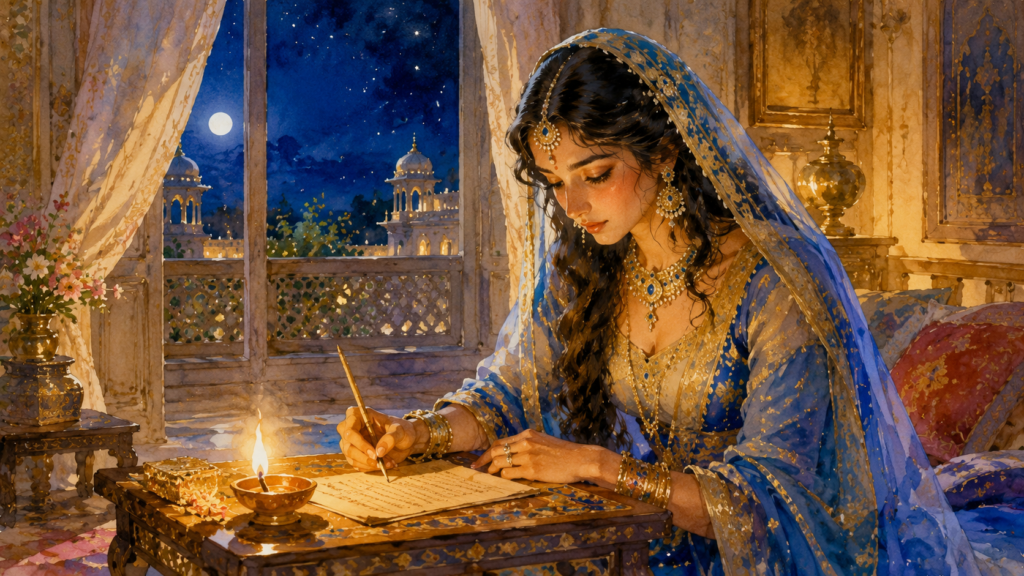
Rukmini heard about this and made a decision. She found a trusted Brahmin priest and gave him a letter. He was to carry it to Krishna in Dwarka, find him, place it in his hands, and return with his answer.
The letter, recorded in detail in the Srimad Bhagavatam (10th Canto, Chapter 52), is one of the most remarkable documents in all of Indian mythology. In it, Rukmini expressed her love for Krishna directly, her determination not to marry Shishupala, and her plan. She asked Krishna to come to Vidarbha before the wedding and abduct her — specifically on the day she would go to the temple of Goddess Ambika to pray before the ceremony.
She told him exactly where she would be and when. She told him she would walk out of the temple alone, briefly unescorted by the main group, and that would be his moment.
And she told him, with absolute clarity: if you do not come, I will fast until death rather than be given to Shishupala.
Then she waited.
Krishna’s Response
The Brahmin reached Dwarka and found Krishna. He read the letter. The Bhagavatam records that as Krishna read Rukmini’s words, he smiled — and then, gripping the Brahmin’s hand, he said: he had been thinking of her too. He had heard of Rukmini. He had already decided he would make her his wife.
That same night, Krishna set out for Vidarbha with Balarama and a military force — not large enough to look like an invasion, but strong enough to fight off whatever resistance Rukmi would mount.
The Abduction — Rakshasa Vivaha
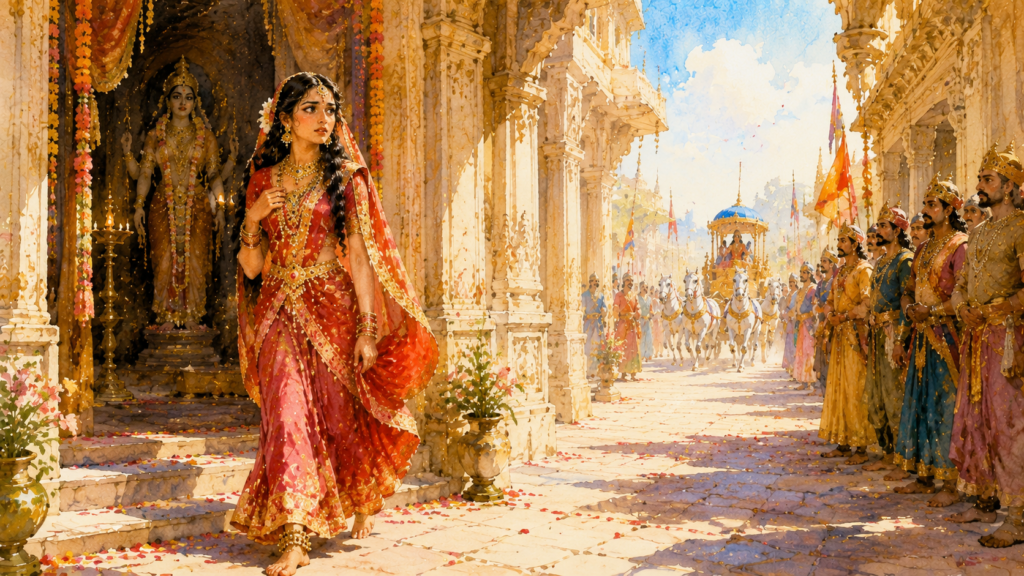
On the morning of her wedding, Rukmini went to the temple of Goddess Ambika with her attendants and the women of the court — exactly as she had described in her letter. She prayed. She emerged. And as the procession moved toward the wedding venue, she stepped slightly apart from the group, as planned.
Krishna was there. He lifted her into his chariot in a single swift movement. The chariot surged forward.
The Bhagavatam describes the assembled kings — Shishupala, Jarasandha and their armies — as initially frozen with shock. Then the chase began.
Balarama and the Yadava forces held them off. Rukmi, furious beyond measure, pursued Krishna himself. He was defeated and overpowered. Krishna, at Rukmini’s tearful request, spared his life — but shaved his head and moustache as a mark of disgrace and sent him back, humiliated, to his father’s court.
King Bhishmaka, who had quietly wished for this outcome all along, gave the marriage his blessing. The wedding of Krishna and Rukmini was celebrated in Dwarka with great joy.
Rukmini as Queen of Dwarka
As queen, Rukmini was everything the texts describe Lakshmi to be — gracious, devoted, calm, generous, and deeply attentive to the needs of everyone around her. She managed the royal household with quiet efficiency and received every guest — including the difficult sage Durvasa, known for his explosive temper — with such perfect hospitality that she earned the epithet Chirayauvana, meaning ‘forever young’, as his blessing.
Her relationship with Krishna was one of deep mutual respect and genuine love. The Bhagavatam records a beautiful scene where Krishna, in a teasing mood, questioned whether she had made the right choice in marrying him — listing all his flaws and all the more powerful kings she could have chosen instead. Rukmini’s response was so eloquent, so complete in its love and its theology, that it has been preserved as one of the great speeches of Indian devotional literature.
Rukmini’s Life — The Loss and the Return
Rukmini’s life as a queen was not without sorrow. Her firstborn son Pradyumna was abducted from the maternity room when he was just ten days old — a story we tell in full in our companion post: Pradyumna — The Son Who Was Lost and Found Again.
But Pradyumna returned. He grew up to be one of the greatest warriors of his generation, married, and gave Rukmini a grandson — Aniruddha — who was the apple of Krishna’s eye.
After Krishna left his mortal body, Rukmini and several of Krishna’s other queens ascended the funeral pyre with him. The woman who had written a letter to a stranger and asked him to save her from an unwanted life ended her story in the same spirit she had begun it — on her own terms, entirely and completely devoted to the one she had chosen.
| Sources and References Sources: Srimad Bhagavatam (10th Canto, Chapters 52-54, 60) — Rukmini’s letter and elopement; Vishnu Purana (Book 5) — Rukmini as Lakshmi; Mahabharata — references to Rukmini as Krishna’s principal queen; Wikipedia — Rukmini; KrishnaBhumi.in — How Krishna Wed Rukmini; Vedicstory.com — Rukmini the First Ashtabharya; Bonobology.com — Krishna and Rukmini. All reflections are the author’s own. |
Continue Exploring Tales of Krishna
Read more from the Tales of Krishna series on Fables n Tales:
- Pradyumna — The Son Who Was Lost to a Demon and Found Again
- Rukmini vs Satyabhama — Two Queens, Two Kinds of Love
- Satyabhama — The Warrior Queen of Krishna
- Krishnavataram — Everything You Need to Know About the Mythology Behind the Film
Did Rukmini’s letter surprise you? Share this story with someone who believes in loving boldly. And explore the full Tales of Krishna series right here on Fables n Tales.