

Whenever we see the idol of Ganesha, there is one question that comes to our mind – why does he have an elephant head. Well, this was very much me when I was younger. Even though every year during Ganesh puja, my father used to read the story on the day of the festival, I always wondered why an elephant head, and if there is more to the story.
I asked many people, a few priests, and heard more than one answer – always. So, I had to verify the same, and asked a pujari in a Ganesh temple. He had to say just one thing; all the stories may be right.
I guess this is a place where our Hindu tradition is very honest, and there is no one fixed account of how Lord Ganesha looks the way he does. Read through the Puranas, and you will find various answers, all of them from different periods. And each of these also disagree from each other when it comes to the details.
I think that is worth explaining properly, rather than picking the one most people already know and presenting it as though it were the only version. So let me walk you through the main ones.
In Short, why does Ganesha have an elephant head?
Like I mentioned earlier, there is more than one answer. As per the Shiva Purana, Shiva beheaded a boy who was guarding the door of Maa Parvati. He does not know that it was her son, and once he knows, he restored him to life with an elephant head.
As per the Brahma Vaivarta Purana, the head of the infant Ganesha was destroyed by the gaze of Shani, and Vishnu was the one who brings back an elephant head to revive him. There are other telling’s that vary further still. None of these is treated as the single official account, all are honored within different parts of the tradition.
The version most of us know, but briefly
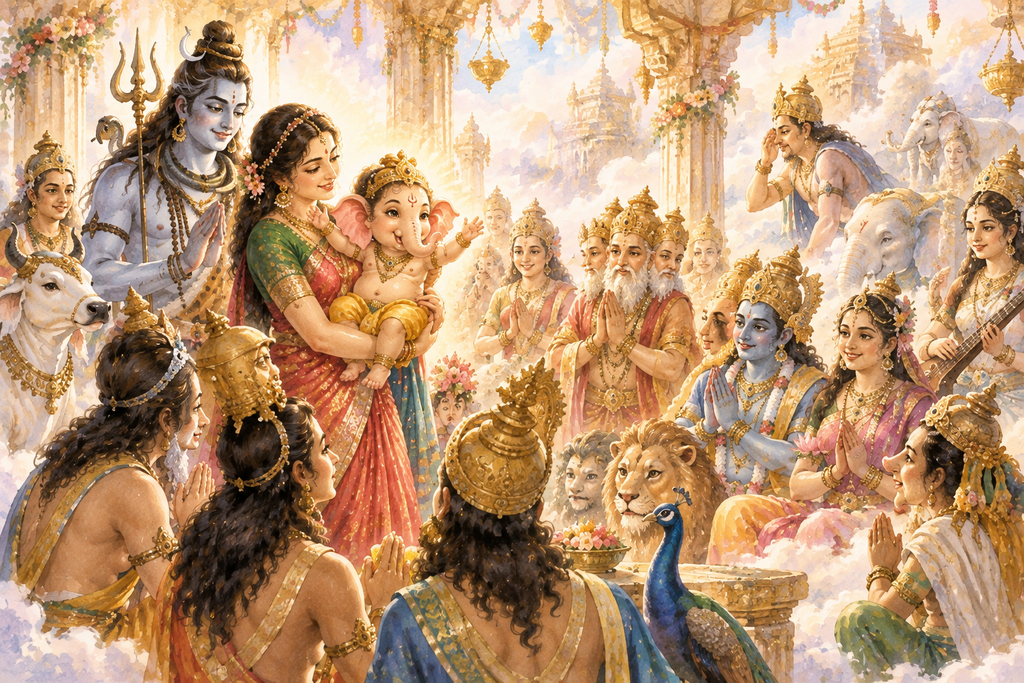
This is the version we often hear and know well. In the Shiva Purana’s telling, Parvati creates Ganesha from turmeric paste, and sets him to guard her door while she bathes. Once Shiva returns home, he is refused entry by a boy he does not recognise as his own son, and beheads him in anger.
Once he knows that he beheaded his son, and to console a grieving Parvati, Shiva has his attendants fetch the head of the first creature they find sleeping with its head turned north, and that creature turns out to be a young elephant.
In some other tellings, the elephant is not just any anonymous animal but a defeated demon named Gajasura, who, before his head was taken, asked for two things in return for his sacrifice, that people remember him by honouring the very head that would now sit atop Ganesha, and that Shiva wear his skin.
The other version, not so well known – Shani’s gaze
You come across this version in the Brahma Vaivarta Purana. This tells a very different story with different characters, and does not talk about being beheaded by Shiva.
In this telling, Parvati longed for a son, and at Shiva’s suggestion she undertook a long and devoted fast to please Vishnu, who granted her wish. A beautiful, radiant baby boy was born to her, and word spread through the heavens, and every god and goddess came to see him and offer their blessings.
In the guests was Shani, the deity associated with the planet Saturn, who carried an old curse of his own, that whatever his gaze fell upon directly would be destroyed. Knowing this, Shani hung back and would not look at the newborn, no matter how much he was pressed to.
But Parvati, who was delighted with her son and wanting every god to admire him properly, insisted that Shani look too. When he finally did, gently and reluctantly, the curse did exactly what it always did. The infant’s head was destroyed in an instant.
Greif and panic followed, but Vishu acted immediately, and mounted his vahana Garuda, and flew north to the banks of the river Pushpabhadra, where he found a young elephant sleeping. He brought back its head and fixed it to the child’s body, and life returned to him, and Ganesha was whole again, though changed.
This is an entirely different version from the first, where the wound happens due to an old curse, and the god who revives Ganesha here is Vishnu and not Shiva.
Two entirely different Puranas, telling two entirely different stories, both ending at the same familiar image, an elephant headed God restored to life and beloved by his mother.
Well, there are more
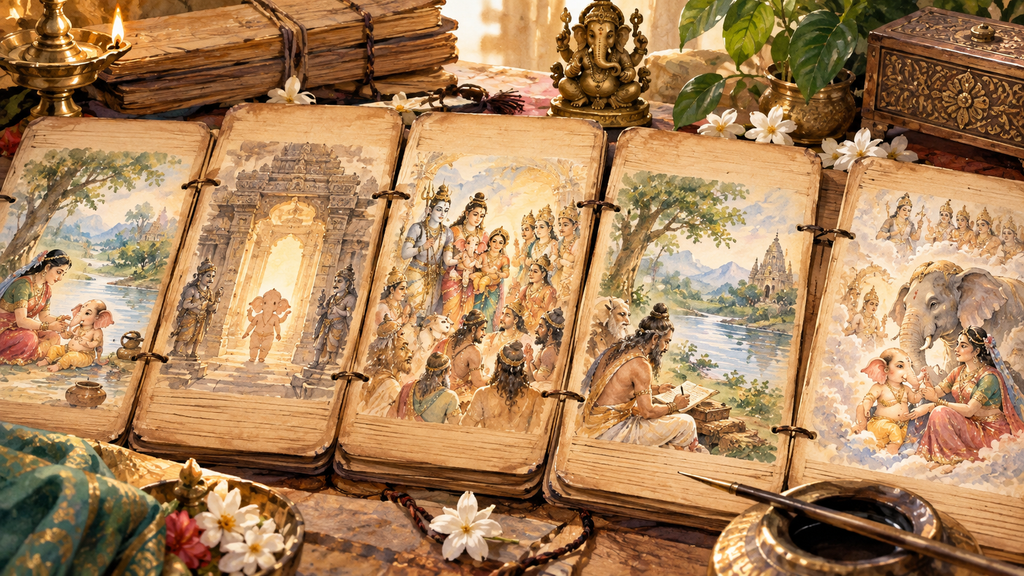
The above mentioned may the ones you come across often, or the ones you already know. But these are not the only ones. There are a few tellings in Padma Purana, which skip the whole idea of beheading of the head and reviving with the elephant head.
In one version, Parvati shapes a little figure that has an elephant’s head out of the fragrant paste, just as a passing whim. She later sets the figure into the waters of Ganga, and that is when it springs into life once it comes in contact with the river. He is then recognized as Ganesha at once, who was born with a elephant head from the start, and there is no violence in the story.
There are even purely symbolic readings that set the historical question aside entirely, treating the elephant head less as an event that happened and more as a meaning to be understood, wisdom and strength and the sacred sound of Om all gathered into a single, unforgettable form.
Do we need to settle on one retelling or version?
A few readers may expect that such an old tradition needs to have one origin story as it belongs to our beloved deity, and his most recognizable feature. But that expectation says more about how we think stories are supposed to work than it does about how they actually have worked, for most of human history, across most cultures.
The Puranas were composed over centuries, in different regions, by different hands, often for different sects who each wanted the story to honour their own preferred deity, Shiva in one telling, Vishnu in another. Of course they do not all agree.
And I think that disagreement is not really a flaw to smooth over. It is closer to what a story looks like when it has genuinely been loved and retold by many different people across a very long time, rather than issued once, from a single source, and left untouched.
Each version still arrives at the same tender centre, a mother’s devastating loss, and a form of healing that leaves her son forever marked, and forever cherished exactly as he now is. Whichever door he is guarding, or whichever curse found him, Ganesha ends every one of these stories held, restored, and loved. Perhaps that is the one part none of the old texts ever disagree on.
Read More Stories
The Fight for Wisdom, and How a Sulking God Gave a Town Its Name
The Churning of the Ocean (Samudra Manthan): How Gods and Demons Made the World Together