

Nagabandham came out swinging this year, a Telugu mythological adventure with the kind of budget usually reserved for a film with three superstars in it, and not one but two double roles, a sealed treasure, a villain who has been waiting in a cave for centuries, and a hero who was a Naga Sadhu in a past life. It released in theatres on the third of July and moved to Amazon Prime Video by the end of the month. Reviews were mixed. Gorgeous to look at, a little tangled in the telling.
But what I actually want to talk about is a question a few of you asked me after watching it. How much of this is real? Is there really a hidden door somewhere guarded by ancient power? Is the Brahma Kamalam an actual thing? Was there ever a Naga Sadhu like the one in the film?
So let us go through it properly. The film’s plot next to what genuinely exists in temple tradition and Indian legend, and see where the line actually falls.
A quick plot refresh for anyone who hasn’t seen it
An American archaeologist uncovers an old manuscript called the Nagabandham, said to hold the key to a treasure hidden somewhere beneath India. He hands it to the head of the Archaeology Department before he is murdered for it, and the manuscript is stolen by a man working for a villain named Bairagi, who has been trapped inside a Himalayan cave for centuries and wants the treasure so he can seize control of the world.
Meanwhile, in the temple town of Srirangam, a young man named Rudra is drawn into an expedition to recover a sacred golden flower, the Brahma Kamalam, believed to be hidden at a place called Bhairavakona. Rudra turns out to be connected to a Naga Sadhu from centuries past, and the story moves back and forth between his present life and the old ascetic’s story, building toward the opening of the Nagabandham itself, a mystical sealed door that can only be opened when the flower and the manuscript are brought together.
What is genuinely real: the Brahma Kamalam
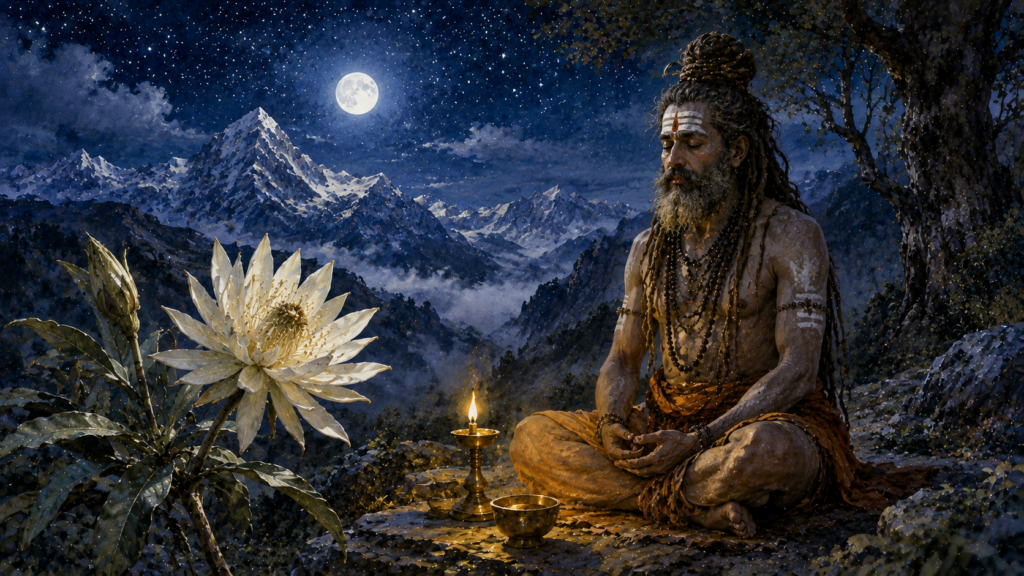
Start with the flower, because this one is real, and rather lovely once you know it. The Brahma Kamalam is an actual flower, rare, pale, and strikingly beautiful, that blooms only at night and only for a few short hours before it closes forever. It grows in the high Himalayas and is treated with real reverence in several parts of India, offered to Lord Vishnu, and considered so sacred and so rare that catching it in bloom is treated as a small blessing in itself.
The film borrows the flower’s real qualities almost exactly, its rarity, its association with Vishnu, the sense that finding one at all is close to a miracle. Where the film invents is in turning it into a literal treasure hunt object, a magical key needed to open a supernatural door. In the real tradition, the Brahma Kamalam’s power is symbolic and devotional, not mechanical. Nobody is unlocking anything with it. Its worth was never meant to be a puzzle piece. It was always meant to be an offering.
What is genuinely real: the Naga Sadhu
The film’s hero has a past life as a Naga Sadhu, and this part of the story, at least, is drawn from something entirely real. Naga Sadhus are a genuine and ancient order of Hindu ascetics, most closely tied to Shaivism, known for extreme renunciation, ash-covered skin, matted hair, and a life stripped of nearly everything ordinary people hold onto. You may have seen photographs of them gathering by the thousands at the Kumbh Mela, one of the largest religious gatherings on earth.
What the film invents is the specific character and his centuries-spanning destiny. There is no known legend of a particular Naga Sadhu tied to a treasure door in Srirangam. The tradition itself is authentic. The plot wrapped around it here is the film’s own invention, built to give its hero a suitably epic backstory.
What is loosely inspired by something real: the sealed vault
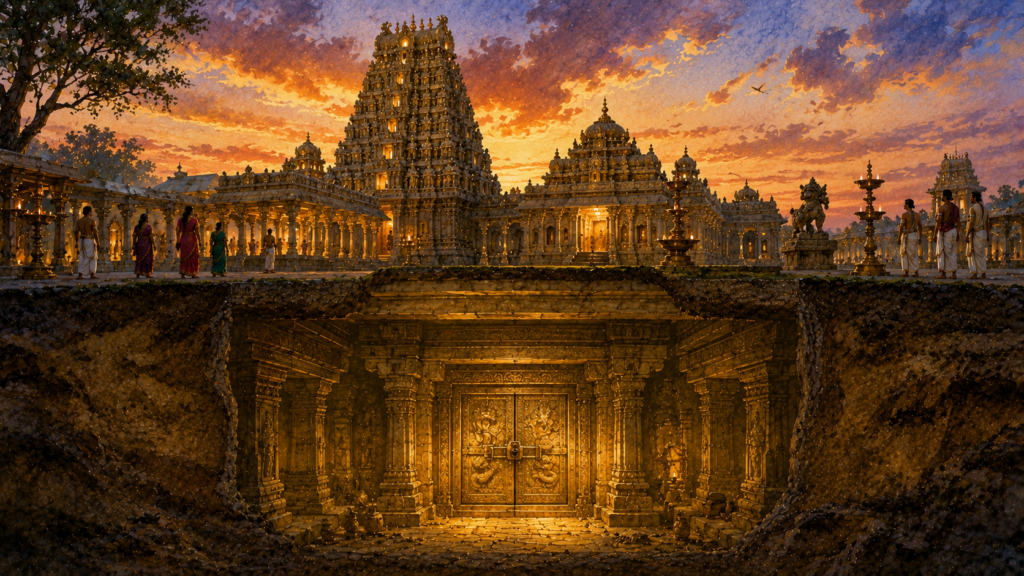
Now here is the part I suspect the writers were quietly thinking of, even if they never say so directly. A grand South Indian Vishnu temple, a sealed chamber nobody dares open, a treasure of almost unimaginable value hidden inside it, guarded by something more than locks and guards. That description does not belong only to this film.
It describes, almost exactly, the real Sree Padmanabhaswamy Temple in Kerala. That temple genuinely has a series of underground vaults, and one of them, known simply as Vault B, has never been opened in living memory. It is said to hold treasure of extraordinary value, and a mix of religious caution and old warnings has kept it sealed even through court cases and public debate about whether it ever should be opened. It is one of the most fascinating real mysteries connected to any Indian temple today, and it is very hard not to see its shadow in Nagabandham’s whole premise of a sealed door nobody should open lightly.
So, the vault itself is not copied from any single legend, but the shape of the idea, the sacred door that guards something too powerful to casually reveal, is not invented from nothing either. It is drawing on a real and ongoing mystery that continues to fascinate the whole country.
| What the film calls the Nagabandham itself This exact term, used the way the film uses it, a mystical sealed door bound shut by ritual power and opened only by bringing together a sacred flower and an old manuscript, does not correspond to any specific traditional legend. It is the film’s own invented central object, built in the spirit of real temple reverence and real stories of hidden vaults, but not drawn from one particular source. |
What is pure invention: Bairagi and the centuries in the cave
The villain’s name is worth a small note of its own. Bairagi is a real and old word in Indian tradition, referring to a wandering ascetic, usually of Vaishnavite background, who has renounced worldly life. It is a title of humility and detachment in its proper use, which makes it an interesting choice for a villain who has spent centuries plotting to seize control of the world from inside a cave. That particular character and his imprisonment are the film’s own invention, using a real word for a very different purpose than its traditional meaning.
The idea of a powerful being sealed away for centuries, waiting to return, does echo a very old and common shape in Indian storytelling, plenty of demons and dark powers across the Puranas are bound, cursed, or imprisoned rather than destroyed outright. But Bairagi himself, as a specific character with this specific backstory, belongs to the film alone.
Why this kind of film is worth a gentle look either way
I do not think a film needs to be scripturally accurate to be worth watching, and Nagabandham never claimed to be a documentary. It is an adventure film first, built for spectacle, and it borrows the texture of real devotion, real temples, real ascetic traditions, and a real ongoing mystery, and weaves them into something new. That is an old and honourable habit, honestly. Storytellers have always taken the sacred things around them and spun fresh adventures out of their edges.
What I do think is worth doing, gently, is knowing where the borrowed thread ends and the invention begins. The Brahma Kamalam really is sacred, and really is rare, and really is offered to Vishnu, long before any film used it as a treasure key. The Naga Sadhu tradition really exists, ash and renunciation and all, quite apart from any hero’s secret past life. And that sealed door nobody should open lightly is not just a plot device dreamed up for the screen. Somewhere in Kerala, a real vault has sat closed for longer than anyone alive can remember, and nobody has yet decided it is wise to open it.
The film borrowed the shiver of that real mystery and built a fantasy around it. Knowing that, I think, makes both the fantasy and the real story underneath it a little more interesting.
𑀫
MORE FROM MYTHOLOGY TODAY
Krishnavataram, Everything You Need to Know About the Mythology Behind the Film