Imagine writing the oldest creation hymn your whole civilization will ever produce, a sacred song that people will still be reciting three thousand years later, and then choosing to end it by admitting that you do not actually know how creation happened. That is exactly what the Nasadiya Sukta does. And it might be the bravest ending of any sacred text I have ever come across.
It sits in the tenth book of the Rig Veda, composed somewhere around three thousand or more years ago. People often call it the Hymn of Creation. But really it is a hymn about the very edge of what can be known.
Where its name comes from
The name itself is a small clue to how this hymn thinks. Nasadiya comes straight from its opening words in Sanskrit, na asat, which mean not non-being. So the hymn is named after its very first breath, the exact moment it begins stripping away the things that were not there. Right from that first syllable, this is less a story than a careful act of thinking out loud. A poem written by people who clearly loved a difficult question more than they loved a neat answer.
Before there was anything to name
The hymn opens by trying to describe the state before the beginning, and it does it in a curious way. It takes things away from you, one by one. There was no non-being, it says, and there was no being either. There was no air, and no sky beyond it. There was no death, and so there was no deathlessness, because you cannot really have one of those without the other. There was no line drawn between night and day. Every tool we use to tell one thing apart from another simply was not there yet.
Try to actually picture that and your mind slides right off it. That is rather the point. The hymn is walking you up to the very edge of what language can hold, and then giving you one gentle nudge past it.
The One that breathed without breathing
In all of that shapeless dark, the hymn says, there was a single something. It does not give it a grand name or a face. It just calls it that One. And this One breathed, but without any air, moving only by its own quiet impulse. Apart from it there was nothing at all. Darkness lay hidden inside darkness. Whatever was there was formless water, with no feature anywhere to catch hold of.
I love how restrained this is. There is no thunder here, no booming command, no god shaping figures out of clay. Just a stillness, breathing softly to itself, with everything that would ever exist still folded up inside it, waiting.
You could almost mistake it for a description of the moment just before you fall asleep, or the hush right before a storyteller opens their mouth. Everything already present, nothing yet begun.
Desire, the first seed
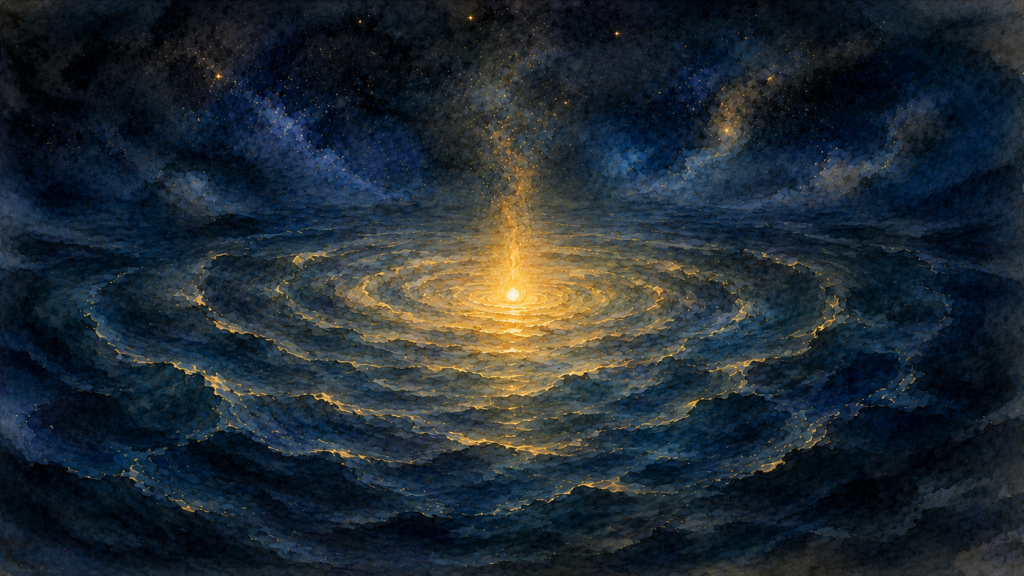
Then comes the turn, and it is a strange and lovely one. What moved first, according to the hymn, was desire. A kind of longing arose in that One, and this longing was the very first seed of mind. The poets who wrote this said that, searching their own hearts, they found in that longing the thread that ties what exists to what does not yet exist.
Sit with that for a second. Before matter, before light, before the gods, the first thing to stir was a wanting. Creation begins not with a bang and not with a word, but with something reaching. Anyone who has ever made anything, a poem, a meal, a whole life, understands that somewhere deep in their bones.
There is a reason this image has stayed with people for so long. It does not treat creation as a machine being switched on. It treats it as something almost alive, something that begins the way a thought begins in you, quietly, out of a want you did not quite plan and cannot quite explain.
And then, the honesty
Here is where the hymn does the thing that almost no other creation story dares to do. Having brought you all this way, it stops handing out answers and starts asking questions instead. Who really knows, it asks. Who can honestly say where all of this came from, and how it came to be? The gods, it points out, arrived after creation, not before it. So how could even they know what happened before they existed?
And then the final verse, which still gives me a small shiver every time. Whoever oversees all of this from the highest heaven, the hymn says, surely he must know how it began. And then, in the very last breath of the whole thing, it adds the doubt anyway. Or perhaps, it says, even he does not know.
Why this matters
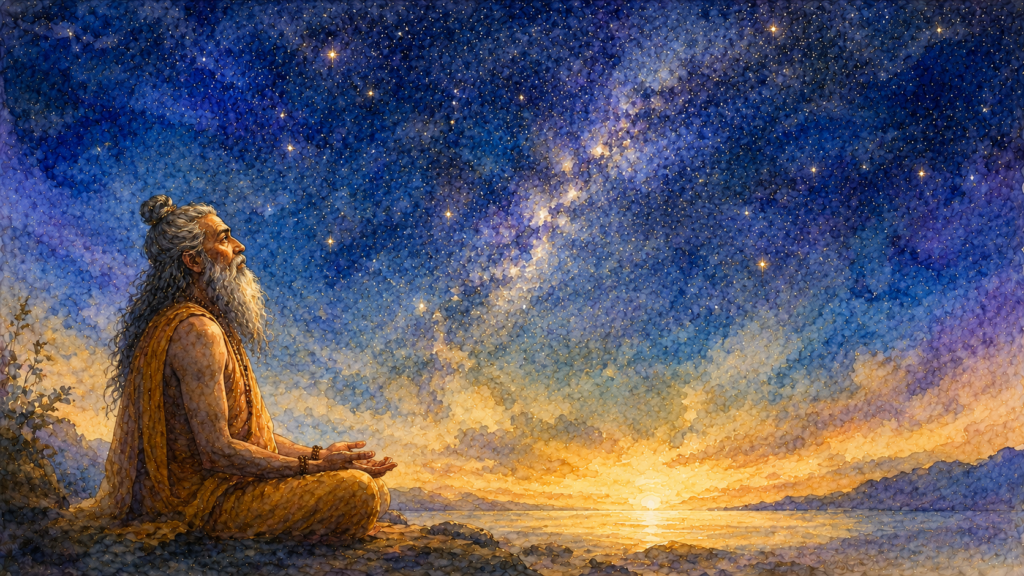
Think about what it took to write that. This was a sacred hymn, meant for ritual, meant to be chanted aloud with authority. And instead of closing on a confident answer, it closes with open hands. It would rather tell you the honest truth about the limits of knowing than pretend to a certainty it has not earned.
That is a very grown up kind of faith. It does not need every answer nailed down and boxed up. It can stand at the edge of the biggest question there is, look straight into it, and simply say, I wonder. In a world that is usually so sure of itself, and so loud about it, there is something deeply calming about a three thousand year old voice that is comfortable saying, I do not know, and neither, perhaps, does anyone.
And notice that it never leaves you feeling small or lost. There is a warmth in its uncertainty, not a coldness. It is the difference between someone snapping I do not know at you and walking off, and someone sitting down beside you in the dark and saying gently, you know, I do not know either, and isn’t that a wonderful thing to sit and wonder about together.
We have a habit of picturing ancient people as simple, as if they reached for gods the way we reach for a light switch, just to explain away anything they could not understand. The Nasadiya Sukta quietly ruins that idea. Here is one of the oldest voices we have, standing under the very same sky you stand under, asking the very same question you ask on a sleepless night, and having the honesty and the sheer nerve to leave it open. Not every mystery needs solving tonight. Sometimes the wisest thing you can do with a great question is to sit with it a while, the way this hymn has been sitting with it, patiently, for three thousand years.
More Stories About Creation
How Did the Universe Begin? A complete guide to Hindu creation stories
The Cosmic Egg (Hiranyagarbha), the golden seed of the universe
Purusha Sukta, when the universe was made from a single cosmic being