

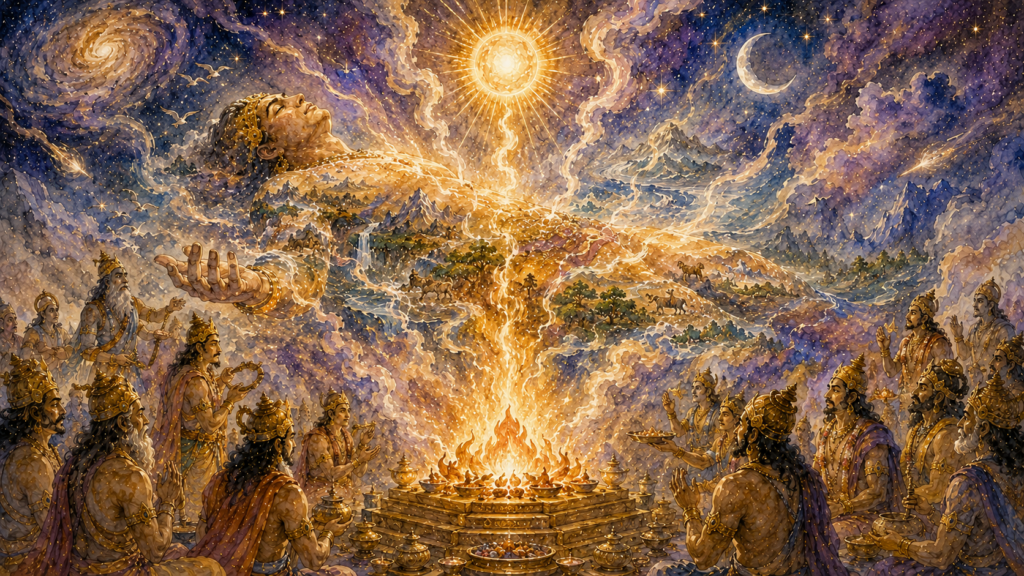
Try to picture this. A being so vast that the moon was born out of his mind and the sun out of his eyes. Fire came from his mouth and the wind from his breath. The mountains are his bones. The rivers are his veins. The sky is the crown of his head. And here is the strange part. The whole universe, everything that has ever been or will ever be, is not something this being made. It is something this being became.
That is the vision at the centre of the Purusha Sukta, one of the oldest and boldest hymns human beings have ever composed. It sits in the tenth book of the Rig Veda, and it has been sung for three thousand years.
Come and look at it with me.
Who is the Purusha?
Purusha means something like the cosmic being, or the universal person. Not a man, and not quite a god sitting somewhere up above. The Purusha is the first consciousness, the awareness that lies underneath everything that exists. The hymn describes this being as having a thousand heads, a thousand eyes, a thousand feet. It does not mean go and count them. It means there is no end to him. He reaches in every direction at once, past every edge you could imagine, holding everything that is and even the things that are not yet.
If a thousand heads sounds like a lot, that is rather the point. The number is not a headcount. It is a way of throwing up your hands and saying there is simply no measuring this. Whatever you can picture, he is already bigger than that. Whatever edge you try to draw around him, he is already standing on the far side of it.
The hymn puts it plainly. Everything was spread out from him, the one who became the past and the future both. He is not a maker standing outside his work. He is the world itself, only wearing a different form.
A sacrifice like no other
Here is where the Purusha Sukta does something that still stops me. In this hymn, the universe is not spoken into being or shaped out of clay. It is created through a sacrifice, a yajna. The gods themselves perform it. And the offering, the thing given up on the altar, is the Purusha. The cosmic being offers his own self, and out of that offering, everything is born.
Sit with how bold that is. The universe did not come from nothing. It was not carved by a god out of some material lying around. It was made out of the body of consciousness itself, given freely. Creation, in this telling, is an act of complete giving.
Think about what that picture is really saying. In most creation stories the maker stands back at the end, pleased with himself, and admires the thing he has built. Here there is no standing back. The maker pours himself into the making until there is no line left between the two of them. He does not build the world and then step away from it. He becomes it, and gives himself up completely to do so. For a hymn this ancient to reach for an idea that tender is quite something.
What came from where
The hymn then maps the whole cosmos onto the body of the Purusha, piece by piece, and it is oddly beautiful to follow. From his mind came the moon. From his eyes came the sun. From his mouth came Indra, the king of the gods, and Agni, the god of fire. From his breath came Vayu, the wind. From his navel came the space of the sky. From his head came the heavens. From his feet came the earth. From his ears came the four directions.
Every single part of the world you can name has its origin somewhere in this one body. The universe is not a thing standing apart from its source. The universe is its source, simply wearing another shape.
The sound of it
If you have ever stood at a ceremony and heard the Purusha Sukta chanted, you will know that it does not really land as an argument or a lesson. It lands as sound. Long, rolling Sanskrit lines, carried by voices that have passed them along for a hundred generations without a break. You do not need to follow every word to feel what it is doing. It is trying to hold the whole cosmos inside a handful of verses, and somehow, for a few minutes, it makes that feel like a perfectly reasonable thing to attempt.
A hymn that shaped a civilization
The Purusha Sukta is one of the most recited texts in all of Indian tradition. It is chanted at temple rituals, at weddings and ceremonies, at the start of important undertakings. For three thousand years its verses have been part of the living fabric of daily worship.
It also carries one of the earliest mentions of the four varnas, the old social divisions of ancient India, and because of that these particular verses have been read, praised, questioned, and argued over for centuries. Scholars still debate what they originally meant and how they were meant to be understood, and that conversation is a real and serious one that is far from settled.
But underneath all of that sits the hymn’s deepest claim, and it is a quiet, sweeping one. Everything in creation shares the same source. The same body. The same origin. Whatever seems to separate us is, at the deepest level, a kind of surface appearance. Below it, everything is one.
Still asking the same thing
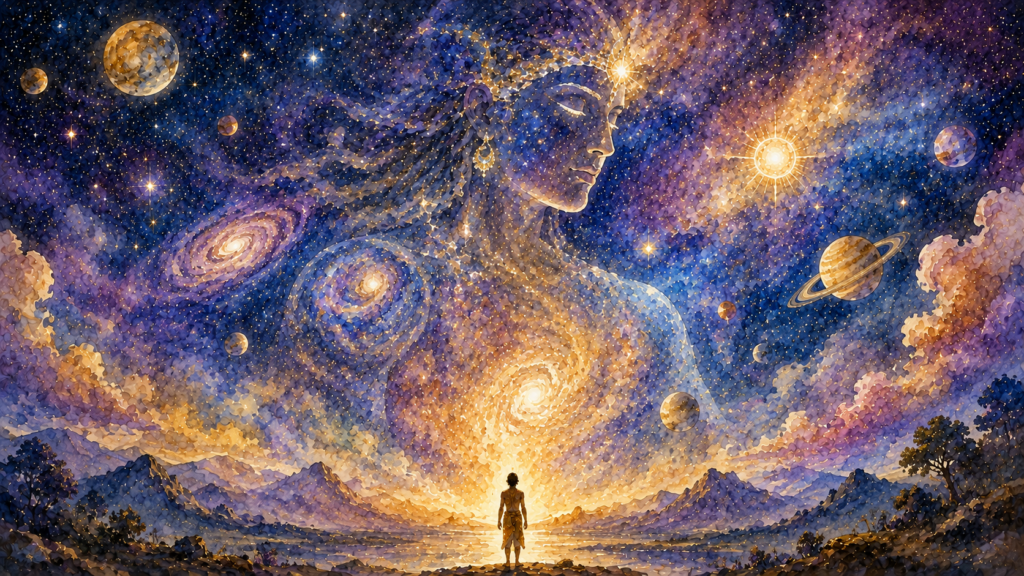
There is an idea that modern physics and philosophy keep circling back to, the possibility that matter and awareness are not two separate things but somehow share a single root. People still argue about it in labs and lecture halls today. The Purusha Sukta arrived at its own version of that thought three thousand years ago, not with instruments, but by sitting still and looking inward for a very long time.
You can read this hymn however you like. As literal cosmology, as poetry, as philosophy dressed up in story. But the thing it leaves you holding is hard to shake. You are not standing inside the universe like a guest in a room. You are made of the very same stuff the universe is made of. The line between you and everything else is not nearly as solid as it feels. Three thousand years ago somebody understood that, and put it into a song, and here we are, still humming it.
More Stories About Creation
How Brahma Created the World, the anchor of the series
The Cosmic Egg (Hiranyagarbha), the golden seed of the universe
The Churning of the Ocean (Samudra Manthan), gods, demons, and a very reluctant partnership