

Tenali Raman is known all over India, and globally too, mostly for his wit. Before being a part of the king’s court, Tenali Raman was a clever and naughty village boy. Though poor, it was hard to persuade him to do a day’s honest work without any mischief.
The story of how such a boy became a legend is known to many. We hear about how he laughed out loud in the face of a goddess who had come to bless or destroy him. Most people who met that goddess in the dark of night were struck dumb with terror. Raman took one look at her and burst out laughing.
That laugh is the reason we still tell his stories five hundred years later. Let me tell you how it happened.
A Naughty Boy in a Thirsty Village
Raman was born in a little village called Garlapadu, in the Krishna district of what is now Andhra Pradesh. His father died when he was very young, and his mother took him to the town of Tenali, which is how, ever after, he came to be known as Tenali Raman, the Raman from Tenali.
He was a bright boy. Everyone could see that. But he was also idle and mischievous to a fault. He would not work. He lived half in poverty and half in hunger, and instead of doing anything to improve his lot, he spent his days poking fun at his neighbours and playing tricks on his friends. He had a sharp tongue and a sharper mind, and not the slightest inclination to use either for anything useful.
Now during this time, a terrible drought fell upon the region. The ponds dried up. The wells went empty. The crops withered in the fields and hunger crept into every house. Some families packed up and left for other villages in search of water.
One day, a wandering monk came to this suffering village, and things changed for better after that.
The Boy Who Would Not Pretend
The village was blessed with rain the moment the monk set foot on the village soil. Now, of course, it was simply that the monk had arrived at the tail end of the dry season, and the rains were due anyway. But the villagers did not see it that way. They saw a holy man arrive and the heavens open, and they fell at his feet in gratitude, certain that his arrival had broken the drought.
Everyone bowed. Everyone, that is, except Raman.
Because Raman, for all his laziness, had a mind that simply refused to believe a thing just because everyone around him believed it. It would have rained anyway, he thought. The monk had nothing to do with it. And rather than keep this sensible thought to himself, Raman being Raman, he went right up to the holy man to say so.
“Tell me, Swami,” he said, all innocence. “Have you ever seen a crow land on a palm tree at the very moment a ripe nut happened to fall? People will swear the crow knocked the nut down. But the nut was going to fall anyway, wasn’t it? Isn’t this the same? You arrived, and the rain came but the rain was coming regardless. It’s a lovely coincidence, Swami. But it isn’t a miracle.”
The villagers were horrified. You do not say such things to a holy man! But the monk was not offended. He looked at this bold, clever, irreverent boy for a long moment and he saw something in him.
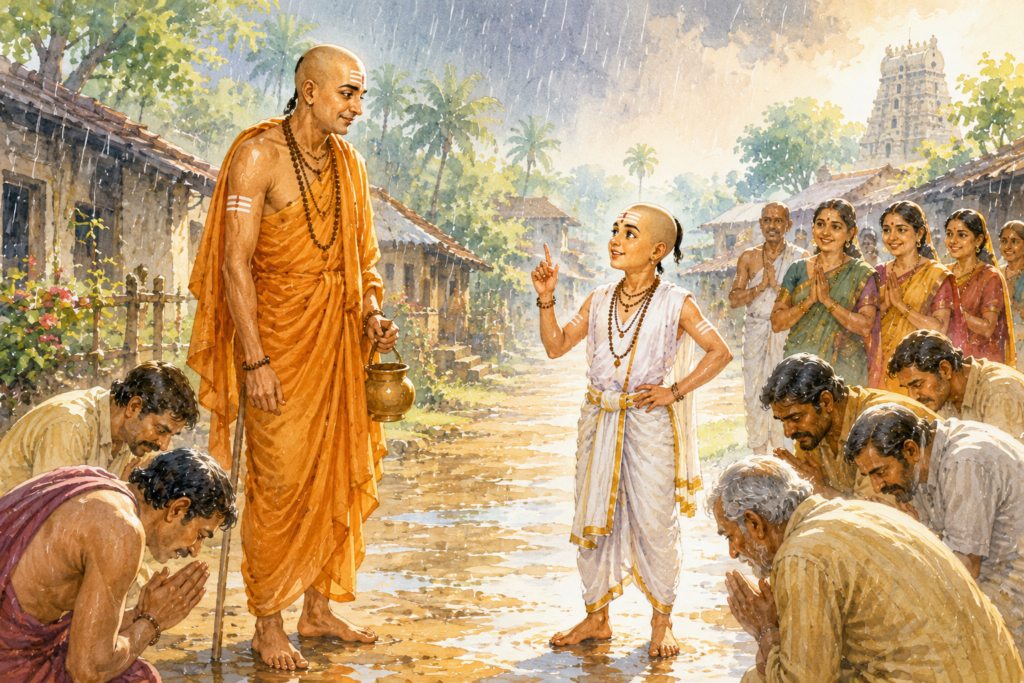
“You are a very intelligent boy,” the monk told him quietly, when the others had drifted away. “That mind of yours is wasted here. Let me give you something.”
And the monk taught Raman a sacred chant, a mantra in praise of the goddess Kali. “Recite this with devotion in the Kali temple,” he said, “and the goddess herself will appear to you. She will bless you, and coming generations will remember your name for your wit and your glory.”
The monk, it seems, expected the boy to ask the goddess for good sense, or good fortune, or an end to his poverty. He could not have guessed what Raman would actually do when he stood face to face with the Divine Mother of the universe.
The Thousand Noses
Raman learned the mantra quickly as he was very clever and he learned everything quickly. After learning the mantra, one night he went to the Kali temple, sat before the idol in the flickering lamplight, closed his eyes, and began to chant.
It was midnight. The temple was empty and silent. And such was the force of the boy’s chanting that, suddenly, with a sound like thunder, the goddess Kali appeared before him.
She was a terrifying sight. She had a thousand faces, and every one of the thousand mouths was open, long teeth bared. Fire blazed from a thousand eyes. Any ordinary person would have fainted dead away on the spot.
Raman opened his eyes, looked up at this awesome, world-ending figure and started to laugh. He couldn’t help it. He laughed and laughed and could not stop.
The goddess was, understandably, taken aback. No one laughs at Kali.
“Why are you laughing?” she asked.
Raman, still chuckling, folded his hands and begged her pardon. “Forgive me, Mother,” he said. “It’s only a thought struck me, and I couldn’t hold it in. You see, I have just one nose, and even I struggle terribly when I catch a cold and I’m forever wiping it, all day long, and I only have the two hands to do it with. And I was looking at you, with your thousand noses, and I thought, great goddess, what on earth do you do when YOU catch a cold? A thousand noses running at once, and still only two hands! I’m so sorry, Mother, but the picture of it was too much for me.”
And Kali, the fierce, the terrible, the destroyer of evil caught the joke, and burst out laughing herself. She liked this boy. She liked his fearlessness, and his innocence, and the fact that he could stand before her at his most terrified and still find something to laugh about.
Both Bowls
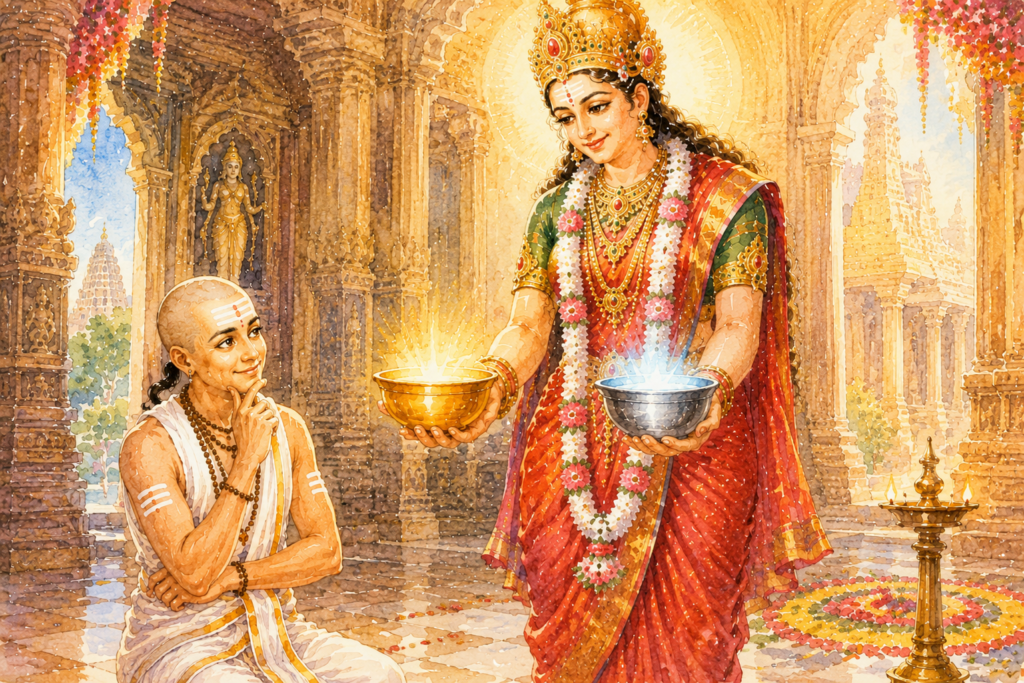
“I came to bless you,” the goddess said, still smiling. “So here is my gift. I hold two bowls. One holds the milk of wisdom, drink it, and you will have knowledge and intelligence beyond any man alive. The other holds the milk of wealth and when you drink it, and you will be rich all your days. But you may choose only one. Choose carefully.”
Raman looked at the two bowls. And his quick mind went to work at once.
“Mother,” he said, “how can I possibly choose without knowing what I’m choosing? Surely you’ll let me taste each one first, just a sip, before I decide?”
The goddess, seeing no harm in it, held out both bowls.
And Raman took them both and in one swift motion, before Kali could stop him, he drank them both down to the bottom. Wisdom and wealth, both, gone in a matter of seconds.
The goddess was astonished, and a little annoyed. “What have you done? I told you to choose ONE!”
Raman bowed low. “Forgive me, Mother. But truly what use is wisdom to a man with no wealth? And what use is wealth to a man with no wisdom? A wise man who is starving cannot help anyone, and a rich fool only ruins himself. The two are worth nothing apart. I had to take both. And besides —” here he could not resist “— you were holding both bowls out to me at the very same time, in the very same way. Even you, Mother, must think them equal.”
✦ ✦ ✦
Kali could not help but smile again. The boy had out-argued a goddess.
“You are clever indeed,” she said. “Too clever. As a small punishment for your cheek, I will make you a jester, a maker of jokes. But because your wit is real, you will also be a great poet. You will have both. Only know this, that the coming generations will remember you not for your poetry, but for your laughter.”
And in that, the goddess was exactly right. Tenali Raman did become a genuine poet, a real scholar whose serious works survive to this day. But it is not his poetry that made him immortal. It is the wit. It is the jokes, the tricks, the impossible cleverness. It is the boy who laughed at Kali and drank both her bowls.
She named him a Vikatakavi, a jester-poet, blessed him, and vanished. And Raman walked out of that temple carrying wisdom and wealth and a gift for laughter, on his way to becoming the most famous court jester India has ever known.
MORE TENALI RAMAN STORIES
This is where it all begins. Follow Tenali Raman’s story from the beginning on Fables n Tales — next, the long and bitter road that finally brought him to the king’s court.