

Parijatapaharanam, a snippet from our history that is so close to my heart. And, let me tell you the reason why. I was about 10 years old, when I saw the movie Parijatapaharanam in Telugu. I was so spellbound by the way the story was shown in the movie that I wanted a Parijata tree myself, in my garden. Later, as I grew up, I read a lot and came to know the story of the Parijata tree, and how Krishna got it to Earth for Satyabhama from Heaven.
Many know the story of the celestial Parijata tree — the divine tree of heaven that Krishna brought to Dwaraka for Satyabhama.
But few know that the story did not begin with a tree.
It began with a single flower.
A flower brought from the heavens by Narada, fragrant beyond compare, carrying with it not merely beauty — but longing, pride, love, devotion and the subtle complexity of Krishna’s leela.
The story of Parijatapaharanam is not merely about a celestial tree taken from Indra’s paradise. It is a story about the hearts of those closest to Krishna, and the strange, tender and sometimes painful ways divine love reveals itself.
Narada Brings the Celestial Flower
One day, the wandering sage Narada arrived in Dwaraka carrying a single Parijata flower from Svarga — the heavenly gardens of Indra.
The flower was unlike anything found on Earth.
Its fragrance lingered endlessly. Its beauty seemed untouched by time itself. It was said that the Parijata bloomed only in the celestial realms and was treasured even among the devas.
Narada offered the flower to Krishna.
And Krishna, with effortless affection, placed it in the hands of Rukmini.
In many retellings, this moment appears small.
But in the quiet spaces of Krishna’s stories, even small moments carry consequences.
Why Was Satyabhama Hurt?
When Satyabhama learned that Krishna had gifted the heavenly flower to Rukmini, she was deeply affected.
Modern retellings often reduce this to jealousy alone, but the older traditions portray Satyabhama with far more depth.
She was proud, passionate and intensely devoted to Krishna. Unlike the serene and inward devotion of Rukmini, Satyabhama’s love burned openly — fierce, possessive and unafraid.
The Parijata flower became symbolic of something larger.
Not merely:
“Why her and not me?”
But:
“Am I loved less?”
Krishna, who understood the hearts of all around him, said little.
As always, his answers would come not through explanation — but through leela.
The Fall of Narakasura
Some time later came the great battle against Narakasura, the asura king who had spread terror across the worlds and imprisoned thousands within his kingdom of Pragjyotishpura.
Krishna rode into battle with Satyabhama beside him upon Garuda.
Many traditions hold that it was Satyabhama herself who ultimately struck down Narakasura, fulfilling the destiny that only his mother’s aspect could end his life.
We have explored the story of Narakasura Vadha in detail separately, for it deserves a tale of its own.
But after the battle ended, another story quietly began.
Read our detailed retelling of the battle against Narakasura here.
Krishna and Satyabhama Visit Aditi
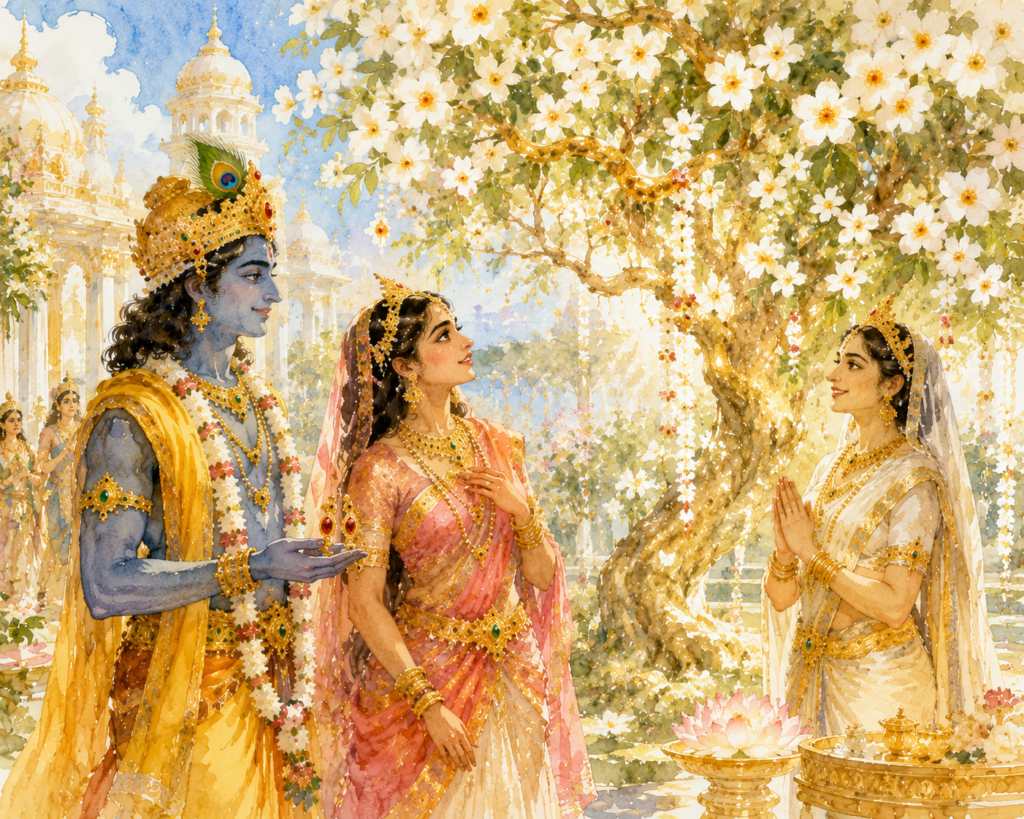
After Narakasura’s defeat, Krishna and Satyabhama traveled to the celestial realms to return the stolen earrings of Aditi, mother of the devas.
Aditi welcomed them with gratitude.
And it was there, within the gardens of Svarga, that Satyabhama saw it.
The Parijata tree.
Its blossoms glowed like moonlight touched by dawn. Its fragrance filled the heavens themselves. No earthly tree carried such beauty.
And seeing it there awakened the memory of the flower once given to Rukmini.
This time, Satyabhama did not desire a single blossom.
She desired the tree itself.
Krishna Uproots the Parijata Tree
Krishna smiled — as though he had known this moment would come all along.
Without hesitation, he uprooted the celestial Parijata tree to bring it back to Dwaraka for Satyabhama.
But the Parijata was no ordinary tree.
It belonged to Svarga — the realm of Indra.
And Indra was not willing to let it go.
Indra Confronts Krishna
When Krishna attempted to carry the Parijata away, Indra opposed him.
What followed was not merely a battle over a tree, but a moment rich with symbolism.
The king of the devas stood against Krishna himself — the very source from whom all divine power flowed.
Different traditions narrate the confrontation differently, but the ending remains the same.
Indra could not truly deny Krishna.
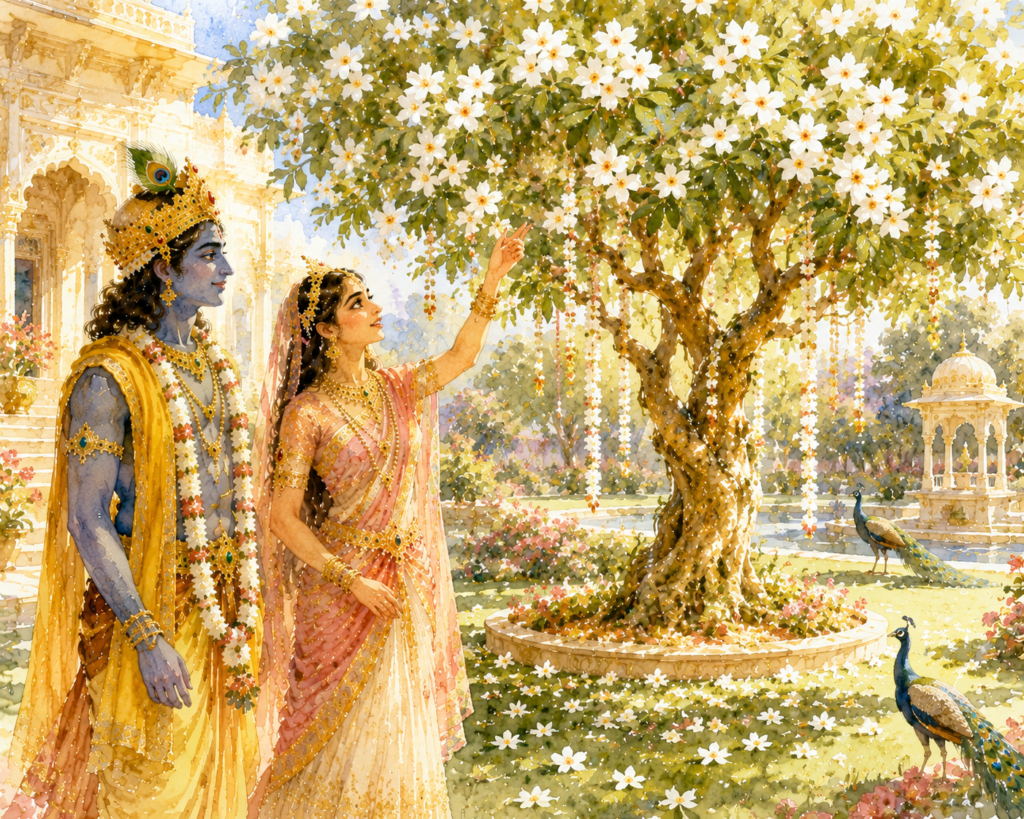
The Parijata tree was brought to Dwaraka and planted within Satyabhama’s gardens.
And yet, the story does not end there.
The Symbolism of the Parijata
In later folklore and devotional traditions, the Parijata became more than a celestial tree.
It became a symbol.
Some traditions say the tree could not fully remain upon Earth. Others say it bloomed in ways that reminded Satyabhama that divine love could never truly be possessed.
Even today, the earthly Parijata flower carries echoes of those meanings.
The flower blooms at night and falls before sunrise, as though surrendering itself before the coming of the sun.
And unlike most fallen flowers, Parijata blossoms may still be offered to the gods.
Because they are believed not to have fallen in rejection — but in surrender.
Perhaps that is why the story of Parijatapaharanam has endured for centuries.
Because it was never truly about a tree.
It was about:
love and longing,
pride and devotion,
possession and surrender,
and the mysterious ways Krishna answered the hearts of those who loved him.
Continue Exploring — Tales of Krishna
- Satyabhama — The Warrior Queen of Krishna
- The Syamantaka Jewel — How a Diamond Brought Satyabhama to Krishna
- Krishnavataram — Everything You Need to Know About the Mythology Behind the Film
- The Tulsi Leaf That Outweighed a Kingdom — what happened next in Satyabhama’s story
Was the Parijata truly about a tree — or about the hearts that loved Krishna? Share this story with someone who cherishes Krishna mythology.