

Here is a strange and wonderful idea to sit with. What if the most precious thing in all of existence, the nectar that makes you immortal, could only be won by your worst enemies and you pulling on the same rope, side by side? That is the heart of the Samudra Manthan, the churning of the cosmic ocean, and it is one of the most dramatic stories India ever told.
It has gods in it, and demons, and a mountain used as a stick and a giant snake used as a rope. It also has a very simple truth hiding inside all that drama. Some things are so precious that nobody, not even the gods, can get them alone.
Let me take you through it.
How the trouble started
Like a lot of big stories, this one begins with bad manners. There was a sage named Durvasa, and Durvasa had a temper you did not want to test. One day he offered a garland of sacred flowers to Indra, the king of the gods, as a mark of respect. Indra, feeling rather pleased with himself that day, took the garland and casually draped it over his elephant, Airavata. The elephant, being an elephant, promptly shook it off and trampled it into the mud.
Durvasa was not the forgiving sort. In a fury, he cursed Indra and all the Devas, the gods, to lose their strength, their luck, and their shine. And the curse did exactly what it promised. The gods grew weak. And the Asuras, the demons, who had been waiting a long time for a moment like this, rose up and pushed the gods clean out of heaven.
Beaten and desperate, the Devas went to Vishnu. And Vishnu, who is always thinking three moves ahead, had a plan.
A partnership nobody wanted
The only way to get their power back, Vishnu told them, was to churn the great ocean of milk, the Kshira Sagara, until it gave up Amrita, the nectar of immortality. But here was the catch. In their weakened state, the gods could not churn an entire ocean by themselves. They needed help. They needed, of all people, the demons.
You can imagine how that went down. Ask our enemies? For help? But Vishnu stayed calm. Promise them a share of the nectar, he said. Get them to pull. Then leave the rest to me.
And so the oddest partnership in the history of the universe was formed. Gods on one side, demons on the other, both heaving on the same task, each keeping one very suspicious eye on the other.
The mountain and the snake
For a churning stick they pulled up an entire mountain, Mount Mandara, and stood it upright in the middle of the ocean. For a rope they used Vasuki, the great king of serpents, wrapping him around the mountain. The gods took hold of his tail. The demons, wanting what looked like the place of honour, grabbed the head end.
That turned out to be a poor choice for the demons. Every time the churning heaved back and forth, Vasuki, understandably unhappy about being used as a rope, breathed out fire and fumes straight into the faces of whoever was holding his head. So the gods pulled from the cool end while the demons pulled from the scorching one. Vishnu, one suspects, had thought about that too.
There was one more problem. As they churned, the mountain began to sink into the soft ocean floor. So Vishnu did what Vishnu does. He took the form of an enormous tortoise, Kurma, dived beneath the waves, and let the whole mountain rest and spin on his back. And with that, the real churning began. Back and forth, back and forth, the mountain turning, the ocean roaring and foaming white.
What the ocean gave up
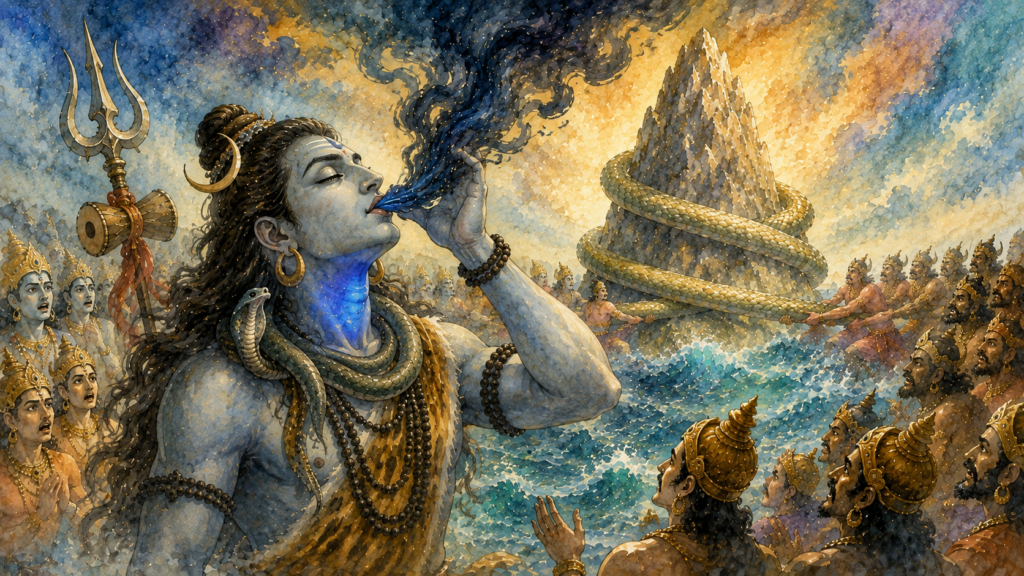
The ocean did not hand over its treasures easily, and it did not hand them over in the order you might hope. The very first thing to rise out of all that churning was not a gift at all. It was Halahala, a poison so terrible that it began to choke the life out of creation itself. Everything stopped. Gods and demons alike stood frozen in horror.
Only one being could deal with it. Shiva stepped forward and swallowed the poison whole. He held it in his throat and would not let it spread, and the poison stained his throat a deep blue that never faded. That is why, to this day, Shiva is called Neelakantha, the blue-throated one. He took the worst thing the ocean produced into his own body so that the world could keep going.
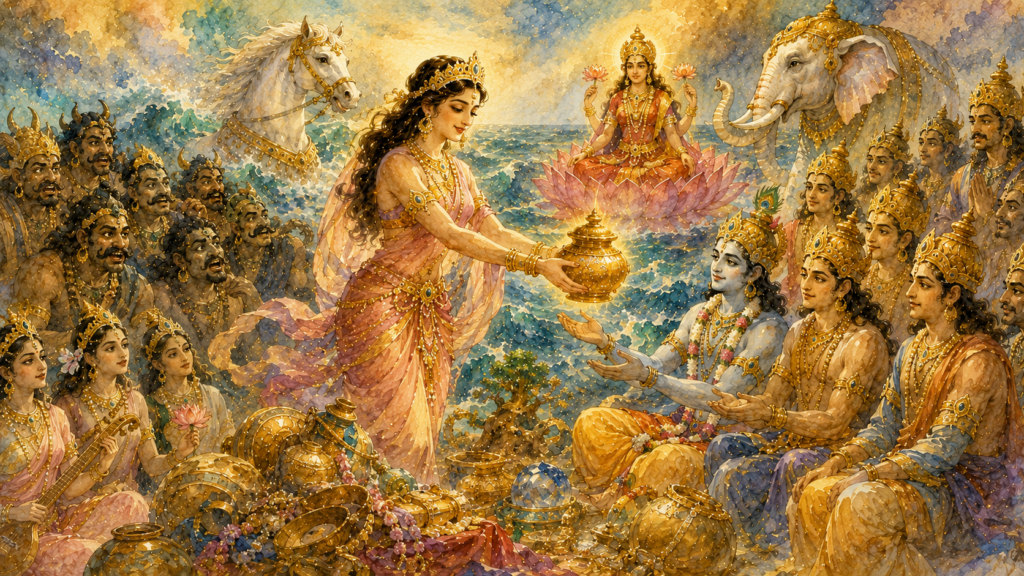
After the poison came the wonders. One by one they rose out of the water. Kamadhenu, the cow who could grant any wish. Ucchaishravas, the perfect white horse. Airavata, the great white elephant. Kalpavriksha, the tree that gives you whatever you ask of it. The apsaras, dancers of impossible beauty. And then Lakshmi herself, the goddess of fortune and abundance, rising up on a lotus, who looked across everyone gathered there and chose Vishnu as her own.
And at last, walking up out of the sea, came Dhanvantari, the physician of the gods, holding in his hands a pot of Amrita, the nectar of immortality. The very thing they had all been churning for.
The trick at the end
You can probably guess what happened next. The moment that pot appeared, the demons snatched it and ran, with no intention of sharing anything with anyone. A brawl broke out. And this is where Vishnu played his last card. He transformed into Mohini, an enchantress so lovely that the demons quite forgot about the nectar and could only stare. While they were dazzled, Mohini quietly served the Amrita to the gods.
Almost all of it, anyway. One sharp demon named Svarbhanu slipped into the line of gods in disguise and managed to swallow a mouthful before anyone noticed. But the Sun and the Moon saw him and called out. Vishnu turned at once and cut off the demon’s head with his discus. It was too late to undo the nectar, though. The demon had already drunk immortality, so both his head and his body lived on, as Rahu and Ketu. To this day, the old stories say, they chase the Sun and the Moon across the sky in revenge, and when they catch and swallow them for a moment, we look up and call it an eclipse.
I love that this story never pretends the good things come easily. The first thing the ocean gives up is poison, not treasure. The gods cannot manage it without their enemies. Somebody has to become a tortoise and hold up a mountain, and somebody has to swallow the poison and carry it in his own throat. Wise people down the centuries have read the whole thing as a picture of our own lives. The ocean is the mind, the churning is the effort, and the sweetness only turns up after you have faced the bitter part first. I do not know if it was ever meant that way. But the next time something worth having asks more of you than you thought you had in you, you might picture a mountain spinning in a milky sea, and a very long pull before the nectar.
More Stories About Creation
How Brahma Created the World, where the whole series begins
The Cosmic Egg (Hiranyagarbha), the golden seed of the universe
Purusha Sukta, when the universe was made from a single cosmic being
1 Comment