

Before Vishnu had a temple. Before the ocean of milk was churned. Before the Puranas were written down at all.
There was a text called the Shatapatha Brahmana.
It is a difficult, technical, extraordinary book — a manual of Vedic ritual, mostly, embedded in the Yajurveda, concerned with the exact construction of fire altars and the precise chanting of syllables. It is not the kind of book you curl up with. It is centuries older than the Puranas we usually quote.
And buried in it, in the eleventh Kanda, is the oldest story about Lakshmi that survives anywhere in the world.
It is not the story you have heard. It is stranger, and darker, and I think it is the most important thing I have read about her.
✦ ✦ ✦
A God, Making Things, Getting Tired
The story begins with Prajapati — the Lord of Creatures, the primordial creator, older than Vishnu and Shiva as we know them.
He is making living beings.
That is all. Not a battle, not a war, no demons. He is simply doing the work of creation, one creature at a time, and it is hard. The text says he grew heated with tapas — that fervid, austere, burning devotion that is the engine of everything in Vedic thought.
He was worn out. He was hot with the effort of it.
And out of that exhaustion, something came.
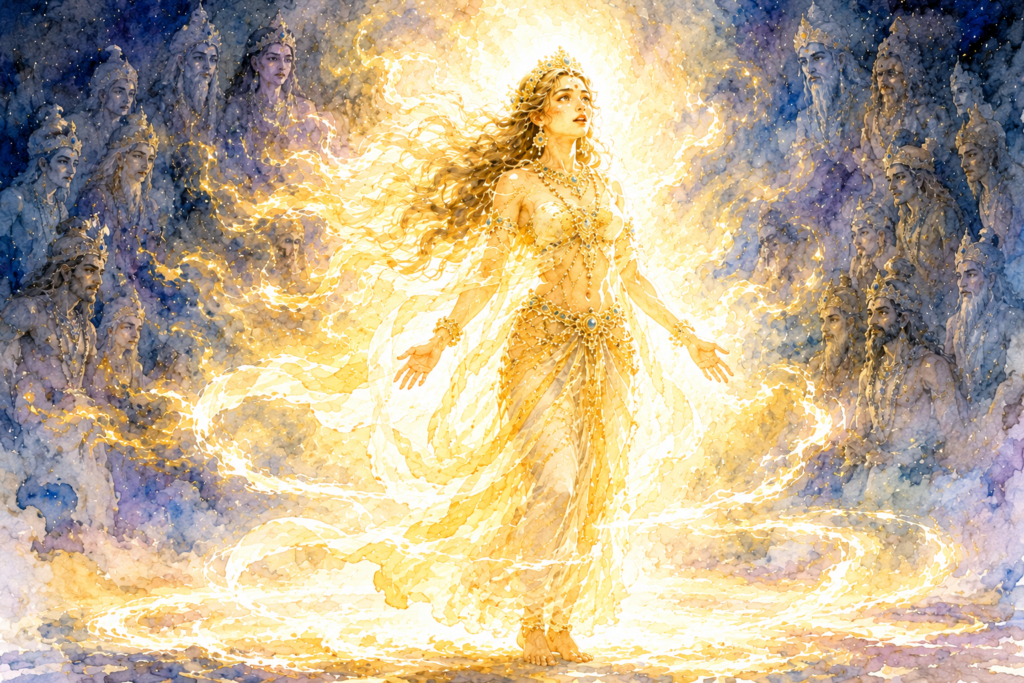
Prajapati was becoming heated by fervid devotion, whilst creating living beings. From him, worn out and heated, Shri came forth.
— Shatapatha Brahmana, Kanda XI, Adhyaya 4, Brahmana 3 (Eggeling translation, 1900)
Shri. Fortune. Beauty. Prosperity. The goddess we now call Lakshmi.
She was not churned from an ocean. She was not born to parents. She came out of a tired god who had been making the world, the way heat comes off a fire, the way light comes off something burning.
And then the text does something no other version does.
It tells us what she looked like when she arrived.
She stood there resplendent, shining, and trembling.
Trembling.
Read that again. Every image of Lakshmi you have ever seen shows her serene — seated on her lotus, calm, half-smiling, in complete possession of herself. But in the oldest account we have, the very first moment of her existence, she is shaking.
She is brand new. She is blazing with power. And she is trembling.
✦ ✦ ✦
What the Gods Wanted to Do
The gods saw her.
They saw this shining, trembling, newly-made woman standing in front of them, holding within herself every good thing that exists — food, authority, splendour, strength, nourishment, form — and their minds fixed on her, and they went to Prajapati.
And they said: let us kill her, and take all of it.
I want to sit here for a second, because I do not think most people know this is in the text.
The gods — Indra, Agni, Varuna, Soma, Brihaspati, the whole shining assembly — looked at the goddess of fortune in the first minute of her life and their immediate, unanimous instinct was to murder her and divide her belongings.
Prajapati refused.
His answer is preserved, and it is simple, and it is not particularly heroic. He said: Shri is a woman. One does not kill a woman. You may take from her — but you take from her while she lives.
It is not a rousing defence. He does not say she is sacred, or that she is his daughter, or that they have no right. He says: she is a woman, and you don’t kill women, and you can have what you want anyway.
So the gods went to her, and one by one they took.
Agni took food. Soma took kingly authority. Varuna took imperial authority. Mitra took martial energy. Indra took force. Brihaspati took priestly authority. Savitri took dominion. Pushan took splendour. Saraswati took nourishment. Tvashtri took forms.
Ten gods. Ten gifts. Everything she had.
And here is the line that reorganised my whole understanding of Hindu mythology.
Every single power those gods are famous for — Agni and his fire that cooks the world’s food, Indra and his overwhelming force, Varuna and his cosmic authority, Saraswati and her nourishment — they did not have any of it before that afternoon.
They took it from her.
Everything the gods possess, they possess because a trembling woman stood in front of them on the first day of her life and they helped themselves.
✦ ✦ ✦
The Other Ancient Image — The Lotus on the Water
There is one more old account, quieter than the Shatapatha’s, and worth setting beside it.
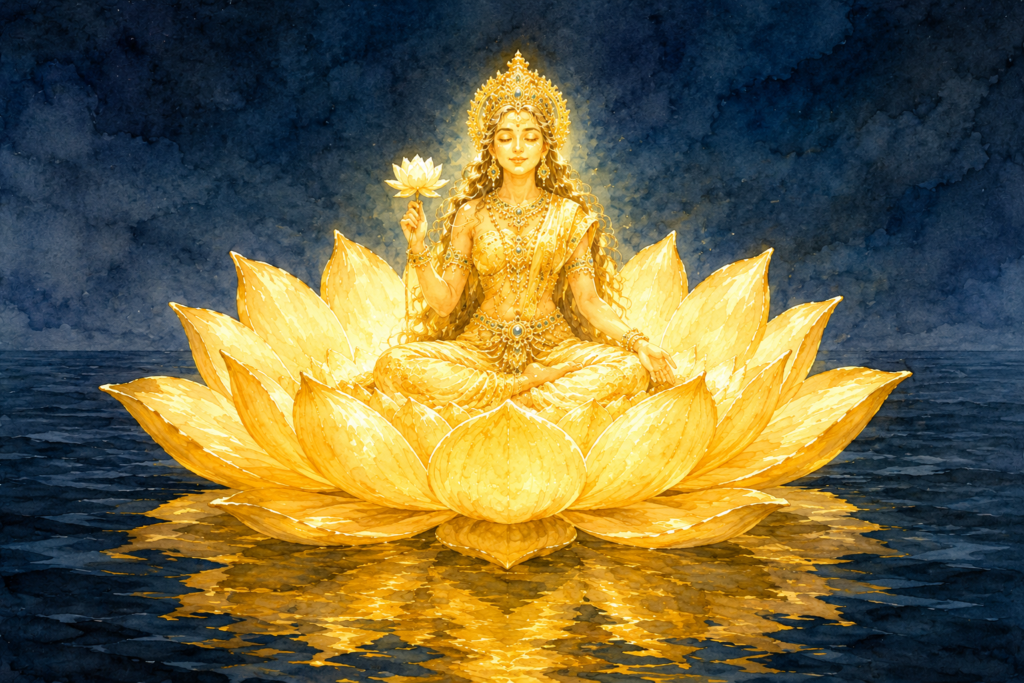
Some traditions hold that Lakshmi appeared at the very moment of creation — not born of anyone, not made by anyone. Simply present. Floating over the primordial waters, seated on the open petals of a lotus, before there was an earth beneath her or a sky above.
No parents. No churning. No ocean of milk. Just water, and darkness, and a flower, and her.
The Sri Suktam — that ancient hymn appended to the Rig Veda, perhaps the oldest sustained praise of her that exists — describes her exactly this way. Golden. Lotus-seated. Adorned. Attended by elephants. It does not tell us where she came from, because it does not seem to think she came from anywhere.
She was simply there, the way fortune is simply there, before anyone thinks to ask for it.
| WHERE THIS STORY COMES FROM Shatapatha Brahmana, Kanda XI, Adhyaya 4, Brahmana 3 — the story of Shri emerging from Prajapati’s tapas, the gods’ request to kill her, and the ten gifts they took. Eggeling’s 1900 English translation is in the public domain. Sri Suktam, appended to the Rig Veda — the oldest sustained hymn to Shri, describing her as golden and lotus-seated. Monier-Williams records a separate tradition of Lakshmi appearing at creation, floating on the expanded petals of a lotus over the waters. Note: In the Shatapatha the goddess is called Shri, not Lakshmi. The two names merge only later. Some scholars argue they began as two different goddesses. |
So, What Can We Take From This?
- The oldest Lakshmi is not serene. She is trembling. Power and terror arrive in the same instant.
- The gods did not give her anything. She gave them everything, and they took it while she stood there.
- Prajapati’s refusal to let them kill her is not noble. It is the bare minimum. And it was enough to save her. Sometimes the bare minimum is what stands between someone and the worst thing.
- And notice who took from her: Agni, Soma, Varuna, Mitra, Indra, Brihaspati, Savitri, Pushan, Saraswati, Tvashtri. If you have been reading our Nakshatra series, you will recognise nine of those ten names. They are the ruling deities of nine of the twenty-seven stars. The gods who own the sky owe it all to Shri.
From Me to You
I came to this story looking for something else entirely, and I found a line I have not been able to put down. She stood there resplendent, shining, and trembling. I keep thinking about how honest that is. We are so used to goddesses arriving in glory, composed and certain, that we have forgotten someone once wrote down what it might actually feel like to come into existence holding every good thing in the world, in a room full of people who want to take it from you. She is shaking. And she gives it all away anyway, and remains the goddess of abundance, and never stops giving. I do not think I will ever look at a Lakshmi picture the same way again.
Had you ever heard this version? Share it with someone who loves the oldest layer of a story — and explore more Stories About Creation on Fables n Tales.