

You know how Lakshmi was born. Everyone does.
The gods and the demons churned the ocean of milk. Mount Mandara was the churning rod, the great serpent Vasuki was the rope, and Vishnu himself took the form of a tortoise to hold the mountain steady. Out came the wish-fulfilling cow, the moon, the poison, the divine physician with the pot of nectar. And out came Lakshmi, seated on a full-blown lotus, holding a water-lily, radiant beyond description.
Except.
Except that when the Vishnu Purana tells this story, it uses a strange word. It doesn’t say she was born. It says she was produced from the sea at a subsequent period.
Subsequent to what?
The answer is sitting right there in the same chapter, in a sentence most of us have read past a hundred times without stopping.
Her first birth was as the daughter of Bhrigu by Khyati; it was at a subsequent period that she was produced from the sea.
— Vishnu Purana, Amsha 1, Chapter 9 (Wilson translation)
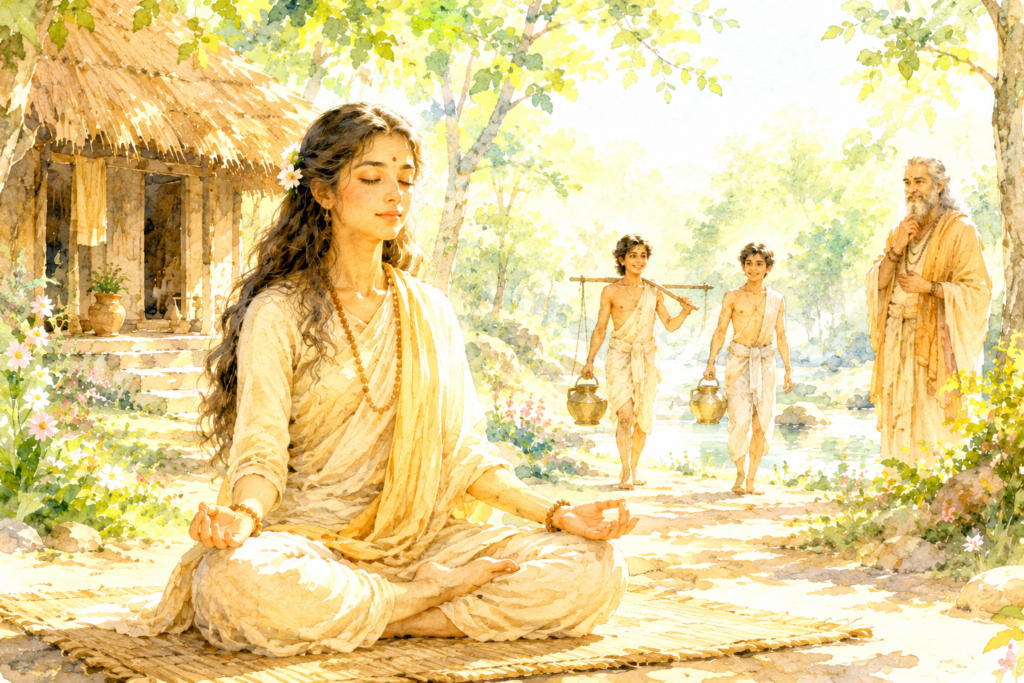
She was born before. To a father and a mother. In a hermitage in a forest, to a sage and his wife, like an ordinary child.
Almost nobody tells this story. Let me tell it to you.
✦ ✦ ✦
Who Was Bhrigu?
Bhrigu was not a minor figure. He was one of the Saptarishi — the seven great sages — and a mind-born son of Brahma himself. Which means the goddess of fortune, in this telling, was Brahma’s granddaughter.
He was also, and this matters, the man who compiled the Bhrigu Samhita — the great astrological text, the collection of birth charts and life-predictions that people still consult today. Bhrigu was the sage who wanted to know something very specific: whether wisdom could satisfy hunger.
It’s a good question. His six brothers had gone and invoked Saraswati and received enlightenment, and Bhrigu looked at all that enlightenment and thought — yes, but can you eat it?
So he set out to understand the other thing. The thing that feeds people. The thing that keeps a household running and a kingdom standing and a child from going to bed hungry.
And the story that comes down to us says he got a daughter.
There is something quietly perfect about that. The sage who asked whether wisdom fills the belly ends up as the father of prosperity itself.
Khyati, and the Two Brothers
Bhrigu’s wife was Khyati — one of the nine daughters of Kardama Prajapati, according to the Bhagavata Purana. She was, by every account, as devoted and as disciplined as her husband.
Together they had two sons, Dhata and Vidhata. And a daughter.
The daughter was Lakshmi.
Because of this she carries a name most people have never connected to her: Bhargavi. It simply means the daughter of Bhrigu. A patronymic. The same way we might say someone’s surname.
Think about that for a moment. The goddess of wealth, of fortune, of everything that flourishes — has a surname. She belongs to a family. She has parents who fed her and brothers who presumably annoyed her.
So How Did She End Up in the Ocean?
This is where the whole picture snaps into focus.
Bhargavi grew up and married Vishnu, exactly as she was always going to. She took her place at his side, and prosperity settled over the three worlds, and everything was as it should be.
Then Indra insulted a sage.
You may know this part. The sage Durvasa — who had a temper of legendary proportions — gave Indra a garland of divine flowers. Indra, riding his elephant, casually draped the garland over the elephant’s head. The elephant, unimpressed, threw it down and trampled it.
Durvasa saw. Durvasa cursed. And the curse was this: let prosperity abandon the heavens entirely.
So Lakshmi left. She withdrew from Swarga, from the gods, from Indra and all his careless glory, and she went down into the ocean of milk and stayed there.
Which means that when the gods, now weakened and desperate, went to churn that ocean — they were not creating her.
They were begging her to come back.
She didn’t rise from the ocean because the ocean made her. She rose from the ocean because she had been sitting in it, waiting, ever since a god was rude to a sage about a garland.
✦ ✦ ✦
The Part of This Story That Stopped Me
Now. There is one more thread, and when I found it, I sat back in my chair.
You know the story of Bhrigu testing the Trimurti. The sages gathered on the banks of the Saraswati and could not agree which of the three great gods deserved the offering. They sent Bhrigu to find out.
He went to Brahma and was deliberately rude. Brahma got angry. He went to Shiva, who rose joyfully to embrace him — and Bhrigu insulted him, and Shiva’s anger rose too.
Then he went to Vaikuntha, where Vishnu was resting.
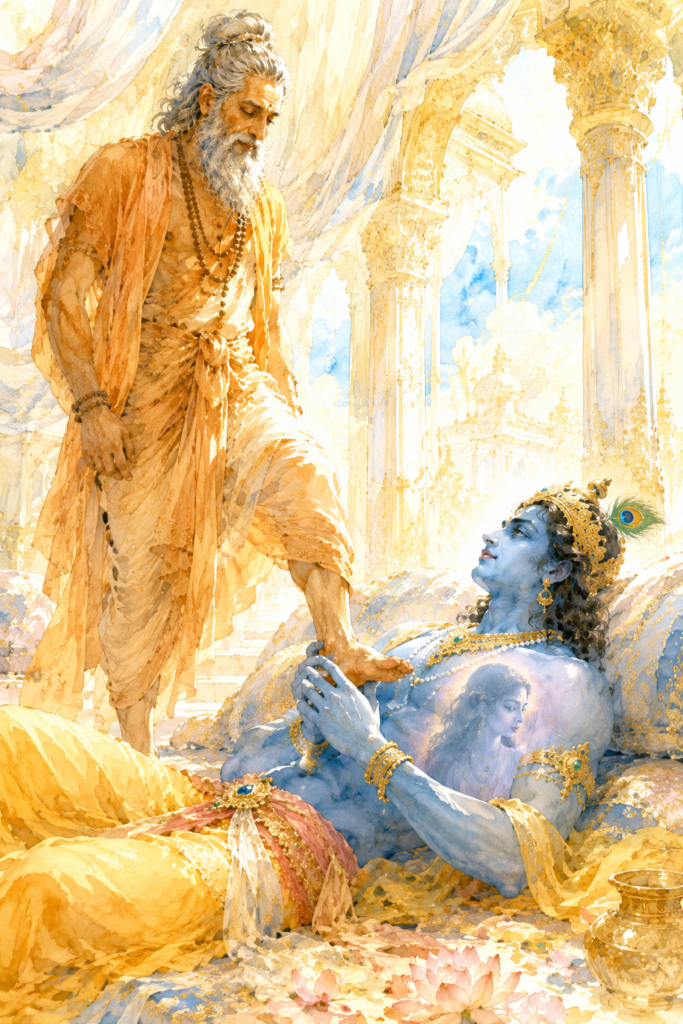
And Bhrigu walked up and kicked him in the chest.
Vishnu woke, and did not get angry. He took the sage’s foot in his hands and began to massage it, asking whether Bhrigu had hurt himself against his hard chest. Bhrigu had his answer, and the offering went to Vishnu.
It’s a famous story. It’s told as a story about humility.
But here is what nobody says out loud.
The chest of Vishnu — the vakshasthala — is where Lakshmi lives. It is her seat. It is her place. It has been her place since before the world was made.
So the sage kicked the exact spot where his own daughter dwelled.
And her husband apologised to him for it.
Lakshmi was furious. In the traditions that follow this thread, she does not accept the apology her husband made on her behalf. She leaves Vaikuntha. She comes down to the earth, and is born there, and grows up, and is eventually found and married again — as Padmavati, at Tirupati.
Some tellings tangle this together and say she was found on a lotus as an infant and raised by Bhrigu and Khyati, which is where the names Bhargavi and Padmavati both come from. Other tellings keep the births separate.
The Puranas do not agree with each other. They never have. That is not a flaw in them — it is what they are. Different communities, different centuries, different storytellers, each reaching for the same goddess and coming back with a slightly different shape in their hands.
What holds across all of them is the strangeness. That she had a father. That her father was the one who struck her husband. That the two men in her life sorted it out between themselves, and she walked away.
| WHERE THIS STORY COMES FROM Vishnu Purana, Amsha 1, Chapter 9 — names Bhrigu and Khyati as her first parents, and describes the ocean-churning as a later reappearance. Bhagavata Purana — names Khyati as a daughter of Kardama, and Dhata and Vidhata as her sons. Skanda Purana — also records Lakshmi as Bhrigu’s daughter, called Bhargavi. Bhagavata Purana — the story of Bhrigu testing the Trimurti and striking Vishnu’s chest. Note: The traditions differ on how these episodes fit together. Some merge Bhargavi and Padmavati into one birth; others keep them separate. Both readings are old. |
So, What Can We Take From This?
- The most famous origin story of a god is often not the oldest one. It is just the one that got told the most.
- Lakshmi did not appear at the churning of the ocean. She returned to it. There is a whole life before that moment.
- And the sages who studied the Bhrigu Samhita believed that fortune was the daughter of a sage — that prosperity is born from wisdom and discipline, not from luck. That is a very different idea about wealth than the one most of us carry around.
From Me to You
I have read the Samudra Manthan a hundred times and I never once stopped at the word subsequent. It sat there in the Vishnu Purana the entire time, quietly telling me there was an earlier story, and I read straight past it because I already knew what I was going to find. That is the thing about the stories we think we know. They keep the door open for years, and we walk by, and one day we finally look in. What I found behind this one was a goddess with a father, a mother, two brothers, and a very complicated family situation. She is more real to me now than she has ever been.
Did you know Lakshmi had a father? Share this with someone who wants to know more about the story of churning of the ocean.