

Before there was light, before there was sound, before there was even time itself — there was only water. Vast, dark, infinite, and utterly still. And sleeping on those waters, coiled on the great serpent Shesha, was Vishnu — the preserver of all things.
This is where the story of our world begins. Not with a bang, not with a void, but with a dream.
The Story: How Brahma Created the World
In the beginning, before time had found its rhythm and before the worlds had taken shape, there was only Vishnu — eternal, silent, and vast beyond understanding.
He rested upon the endless cosmic ocean, suspended between creation and dissolution, in the deep sleep known as Yoga Nidra. Around him stretched only darkness and the still waters of existence, untouched by land, sky, or life.
And then, from Vishnu’s navel, a lotus began to grow. Slowly it rose through the silent waters, its stem stretching across the emptiness of the universe until at last the flower bloomed — radiant and perfect against the void.
Within that lotus sat Brahma.
The creator opened his eyes into a universe that did not yet exist. There was no earth beneath him. No heavens above. No sun, moon, or stars. No sound except the endless silence surrounding the cosmic waters.
Only the lotus. The darkness. And himself.
Confused and alone, Brahma looked around him in every direction seeking answers. As he turned, new faces emerged so that he could gaze east, west, north and south all at once — which is one of the reasons he is depicted with four faces in Hindu mythology.
Yet everywhere he looked, there was only emptiness. No path. No beginning. No end.
And so, seated upon the lotus born from Vishnu himself, Brahma entered deep meditation. From that stillness, creation would begin.
The First Act of Creation
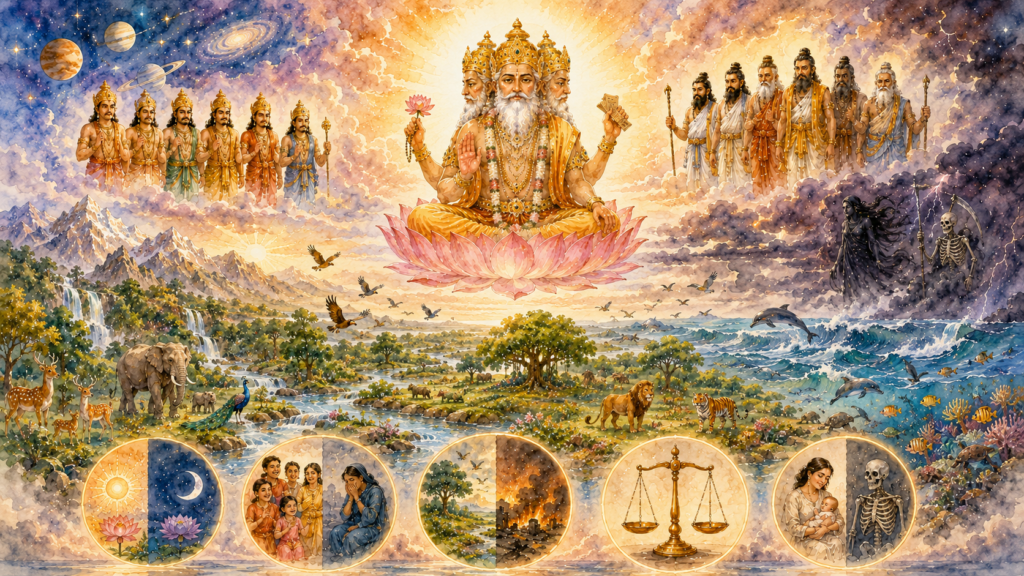
Brahma began with the mind. From the stillness of deep meditation emerged the Prajapatis — the great progenitors entrusted with continuing creation and bringing forth living beings across the worlds.
Then came the Saptarishis, the seven eternal sages. Different Puranas describe them as arising from different parts of Brahma’s own being — from his mind, his breath, his sight, his very consciousness itself. They were not merely wise men, but carriers of sacred knowledge, destined to guide humanity through the ages.
And creation continued to unfold.
First came the heavens above, vast and luminous. Then the earth below, still raw and waiting. Between them stretched the waters of existence — the cosmic space from which life would emerge.
Mountains rose from the land like the bones of the world. Rivers carved their silver paths through forests not yet touched by human feet. Trees, flowers, and grasses spread across the Earth, followed by the creatures of sky, sea, and soil.
- Birds filled the air with movement.
- Fish stirred within the waters.
- Animals wandered the newborn forests.
- But creation was not made only of gentle things.
From Brahma’s own shadow came darkness, fear, and death itself — because in Hindu thought, creation cannot exist without its opposite. A universe without endings could never truly hold beginnings.
And so each thing Brahma brought forth entered the world with its counterpart beside it.
- Light and shadow.
- Joy and sorrow.
- Creation and destruction.
- Life and death.
The universe was not created as a place of perfection alone. It was created as a place of balance.
The First Humans
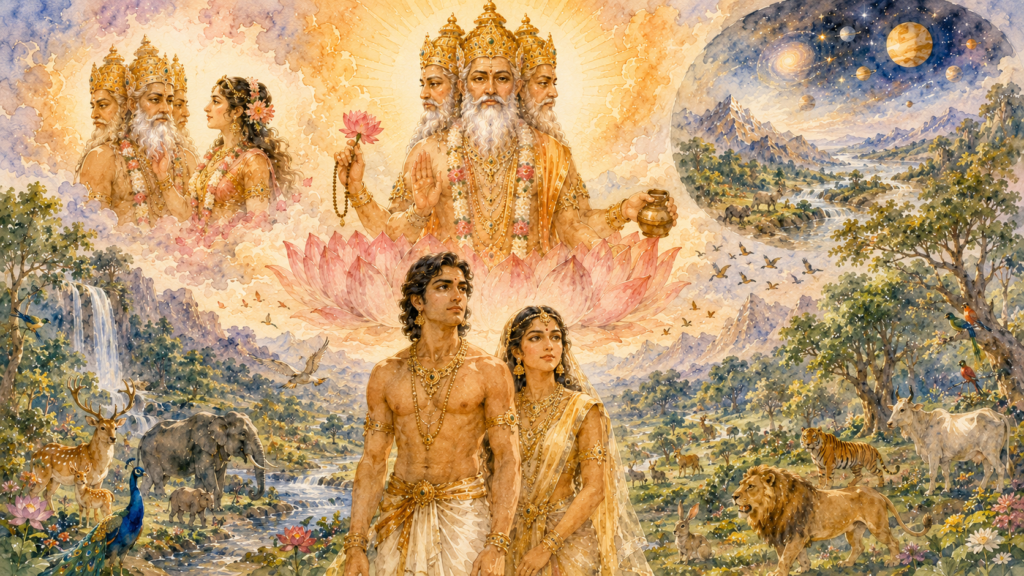
When it came to the creation of humankind, the Puranas tell us that Brahma brought forth Manu — the first man, the ancestor from whom humanity would descend. In many traditions, he was accompanied by Shatarupa, the first woman, created as the living counterpart to Manu so that life upon the newly formed Earth could continue.
Some stories say that when Shatarupa emerged, Brahma himself was struck by the beauty and perfection of his creation. Each time she turned away to avoid his gaze, Brahma grew another face to continue looking upon her — one looking east, one west, one north and one south. This is one of the mythological explanations for why Brahma is depicted with four faces.
Yet the story is often understood symbolically rather than literally. Brahma’s four faces also came to represent the four Vedas, the four directions, and the all-seeing nature of creation itself.
Manu and Shatarupa were then entrusted with the Earth — a young and untamed world still finding its rhythm. Forests stretched endlessly, rivers carved their paths through fresh land, and life had only just begun to awaken.
To them was given the task of continuing creation:
- Populate the World: To expand human life across the newly formed Earth.
- Establish Dharma: To introduce moral grounding, duty, and cosmic order to early civilization.
- Begin the Human Story: To spark the ancestral lineages that would unfold across the cosmic ages.
What This Story Teaches Us
Hindu creation mythology does not describe a single, finished act of creation. It describes a cycle — Brahma creates, Vishnu preserves, Shiva destroys, and then creation begins again. The universe is not a fixed thing. It is a living, breathing, endlessly renewing process.
- Creation requires both light and darkness — one cannot exist without the other.
- The creator himself is part of a larger cycle — no single being holds absolute, permanent power.
- Balance, not perfection, is the underlying principle of the universe.
- Every living thing is connected — born from the same cosmic lotus, the same dream.
The Bigger Picture — The Trinity of Creation
This story is the entry point into understanding the Hindu concept of the Trimurti — Brahma, Vishnu, and Shiva. Together, they represent the three fundamental forces of the universe: creation, preservation, and dissolution.
No force is more important than the other. The universe needs all three, in endless rotation, to continue. This is not mythology for mythology’s sake — it is one of the most sophisticated cosmological frameworks any ancient civilisation ever produced.
The Cosmological Scale
A Day of Brahma in Vedic chronology, this act of creation is not a permanent event, but a recurring dawn. A single day of Brahma is known as a *Kalpa*, lasting precisely 4.32 billion human years. When Brahma awakens, the universe manifest; when he sleeps at night (a period of equal duration), the universe undergoes a partial dissolution (*Pralaya*). This staggering cosmic scale shows that ancient Indian thinkers viewed time not linearly, but as an infinite, breathing cycle.
A Personal Reflection — From Me to You
What fascinates me about Hindu creation stories is that creation does not emerge from emptiness alone, but from consciousness, meditation, and balance. Even before humans appear, the stories remind us that light and shadow, life and death, must exist together. The universe is not created perfect — it is created whole.
About This Series
This post is the first in our Stories About Creation series, where we explore how ancient India understood the origins of the universe, life, death, and everything in between. Each story in this series connects to the others — so the more you read, the richer the picture becomes.
Sources & Puranic References
The cosmological details in this article are synthesized from traditional Vedic literature and canonical Mahapuranas:
The Cosmic Lotus Narrative: Srimad Bhagavatam (Bhagavata Purana), Canto 3, Chapters 8–10.
The Lineage of Manu & Shatarupa: Vishnu Purana, Book 1, Chapter 7, and Matsya Purana.
The Concept of Cyclic Creation: Brahma Purana and the Manu Smriti (Chapter 1, detailing the Yugas and Kalpas).
Continue the Series — Stories About Creation
Next in this series:
- The Cosmic Egg (Hiranyagarbha) — The Golden Womb of the Universe
- The Churning of the Ocean (Samudra Manthan) — How the Gods and Demons Created the World Together
- Purusha Sukta — When the Universe Was Made from a Giant Being
Loved this story? Share it with someone who has ever looked up at the night sky and wondered how it all began. Explore the full series right here on Fables n Tales!