

This is a well-known folk tale from Maharashtra, one that I first heard during my stay in Pune. It was shared with me not from a book, but through conversation—told gently by a friend’s mother one quiet evening. Like many folk stories, it came without an author’s name, yet carried the weight of generations. The story stayed with me long after, not just for its cleverness, but for the quiet wisdom it holds about duty, creation, and rightful action.
The Story Begins
Long ago, in a small town in the heart of India, there lived five close friends. Though they shared deep affection for one another, each followed a very different path in life. One was a skilled carpenter, another a weaver known for his fine silks. The third was a delicate-handed goldsmith, the fourth a cheerful bangle-seller, and the fifth a learned brahmin, well-versed in sacred scriptures and ancient wisdom.
Times were hard in their town. Work had grown scarce, hunger lingered at their doors, and hope seemed to fade with each passing day. After much discussion, the five friends decided to leave their homeland and travel to another region in search of fortune and livelihood.
One early morning, they gathered the tools of their respective trades, took leave of their families, and set out together. The road was long, but their companionship made the journey bearable. By evening, however, they found themselves deep within a thick forest. Darkness fell swiftly, and with no clear path ahead, they decided it would be safest to rest there for the night.
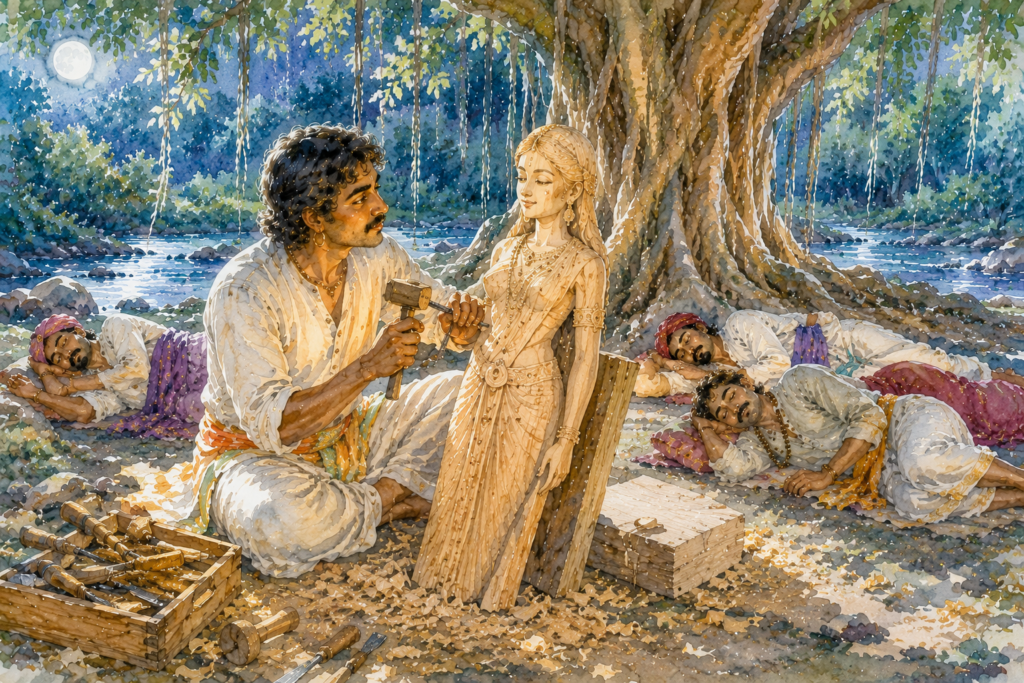
They chose a peaceful spot beneath a vast banyan tree, beside a gently flowing stream. A cool breeze moved through the leaves, and the full moon slowly rose, casting silver light across the water. Though the place was enchanting, weariness weighed heavily on them.
As they prepared to sleep, one of the friends voiced a concern.
“What if a wild beast—perhaps a tiger—comes upon us while we sleep?”
The brahmin reflected for a moment and then said calmly, “Let us take turns keeping watch. Each man shall guard while the others rest.”
The plan was welcomed. The brahmin decided the order: first the carpenter, followed by the weaver, the goldsmith, the bangle-seller, and finally himself.
Soon, all except the carpenter lay asleep.
The Carpenter’s Creation
Left alone under the moonlight, the carpenter felt wide awake. The murmuring stream, the whispering breeze, and the quiet beauty of the forest stirred his thoughts.
“How shall I keep myself occupied?” he wondered.
Suddenly, an idea struck him. Taking up his tools, he selected a fine piece of wood and began to carve. His hands moved with practiced ease, guided by inspiration. Before long, he had sculpted a statue of a young woman—so graceful and beautiful that even he stood amazed at his work.
Satisfied, he placed the statue gently against the banyan tree, woke the weaver for his watch, and lay down to sleep.
The Weaver’s Touch
The weaver, still heavy with sleep, soon noticed the statue. He gazed at it in awe.
“What beauty!” he exclaimed softly. “But she is unclothed. Such beauty deserves modest covering.”
Drawing out his silk threads and loom tools, he wove a delicate sari and blouse, light as a dream. With great care, he dressed the statue, making her appear even more lifelike. Pleased, he woke the goldsmith and rested.
The Goldsmith’s Ornaments
The goldsmith, upon seeing the adorned statue, felt both wonder and dissatisfaction.
“How can such beauty remain without ornaments?” he thought.
At once, he fashioned fine jewellery—earrings, necklaces, and anklets—each crafted with exquisite detail. When he adorned the statue, she shone with elegance. He then woke the bangle-seller.
The Bangle-Seller’s Mark
By now, the moon stood high. The bangle-seller stared at the statue, overwhelmed.
“She lacks the marks of a married woman,” he said. “Without bangles, mangalsutra, and vermilion, she is incomplete.”
He crafted bright bangles, placed a mangalsutra around her neck, and, lacking vermilion, cut his own finger and marked her forehead with his blood. Thus adorned, the statue bore all signs of marriage. He then woke the brahmin.
The Brahmin’s Mantras
The night was nearly over. The brahmin bathed in the stream, chanting sacred hymns, and returned to keep watch. When he saw the statue, his breath caught.
“What sorrow,” he murmured, “that such beauty should remain lifeless.”
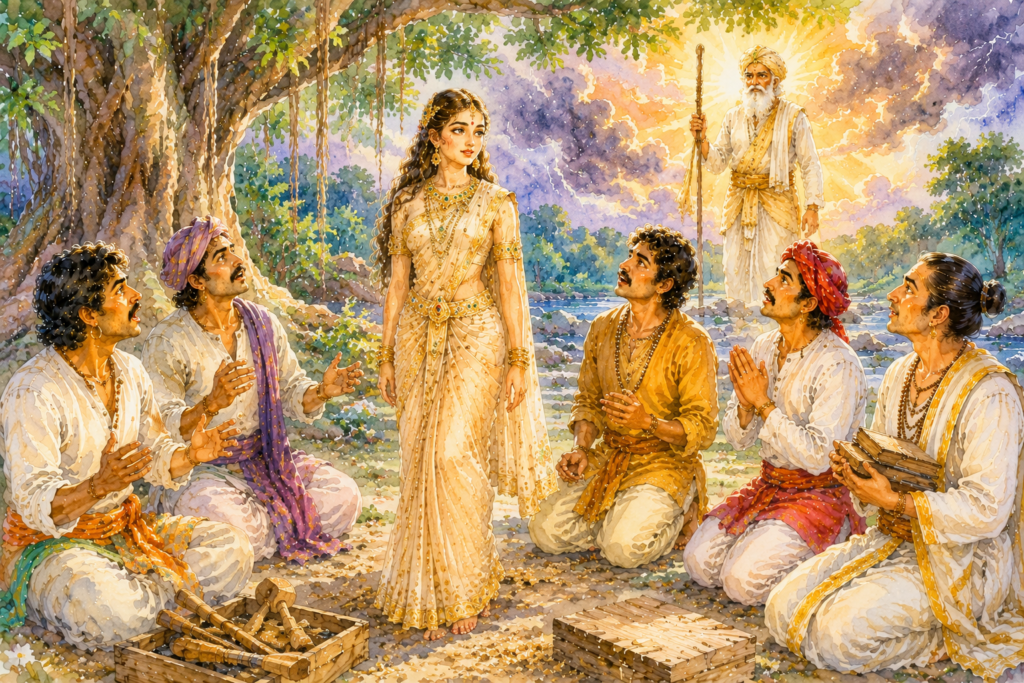
Placing the statue upon a rock, he began chanting powerful mantras, sprinkling holy water as dawn approached. Suddenly, the air stirred—and before his astonished eyes, the statue came alive.
She stood as a radiant maiden, her eyes bright with awareness.
The Dispute
By then, the other four friends had awakened. Seeing the living maiden, each felt desire rise in his heart, and each believed he had the rightful claim to marry her.
The carpenter spoke first.
“I created her. Without me, she would not exist.”
The weaver countered, “I clothed her and protected her modesty.”
The goldsmith declared, “I adorned her as only a husband’s kin would.”
The bangle-seller said firmly, “I gave her the signs of marriage.”
The brahmin, angered, exclaimed, “I gave her life itself!”
The argument grew fierce. At last, they agreed to seek judgment from Lord Brahma.
The Divine Judgment
As if summoned, a great storm arose. Amid lightning and thunder, an old farmer appeared, staff in hand, glowing with divine presence. They knew at once it was Brahma in disguise.
After hearing their claims, the farmer questioned each man. One by one, he revealed their true relationships to the maiden—father, brother, uncle, and teacher.
“Finally, the farmer turned to the bangle-seller. ‘You gave her the marks of a married woman,’ he said. ‘The bangles, the mangalsutra, the vermilion on her forehead — in our tradition, these are not mere adornments. They are the very signs of marriage itself. A woman becomes a wife not when she is created, clothed or adorned with jewels — but when she receives these sacred symbols. You gave her those. She is yours.'”
“Thus, the bangle-seller was chosen.”
Ashamed yet enlightened, the friends accepted the verdict. When they bowed again, the farmer had vanished.
“Each act has its place, but wisdom lies in understanding the true meaning of one’s actions. To create is not the same as to claim. To adorn is not the same as to belong. It is the one who understood the sacred meaning of what he gave — not merely its beauty — who was recognised as the rightful partner.”
Source note: Retold from a traditional Maharashtrian folk tale, as heard during my time in Pune.