


How a Diamond, a Bear King and a False Accusation Brought Satyabhama to Krishna
The story of Syamantaka Mani is very special and close to my heart. To this day, I still look forward to Ganesh Chaturthi to listen to this story from my dad during the morning puja.
This is the story of how a priceless divine jewel, a hunting accident, a false murder accusation and a 28-day battle in a bear king’s cave led to one of the most significant marriages in Krishna’s life.
It is also a story about something timeless — what a person does when they are falsely accused of something terrible, and the quiet power of clearing your name through action rather than argument.
This post is part of the Satyabhama series on Fables n Tales. You can read the first post Satyabhama: The Warrior Queen of Krishna here.
The Jewel That Came from the Sun
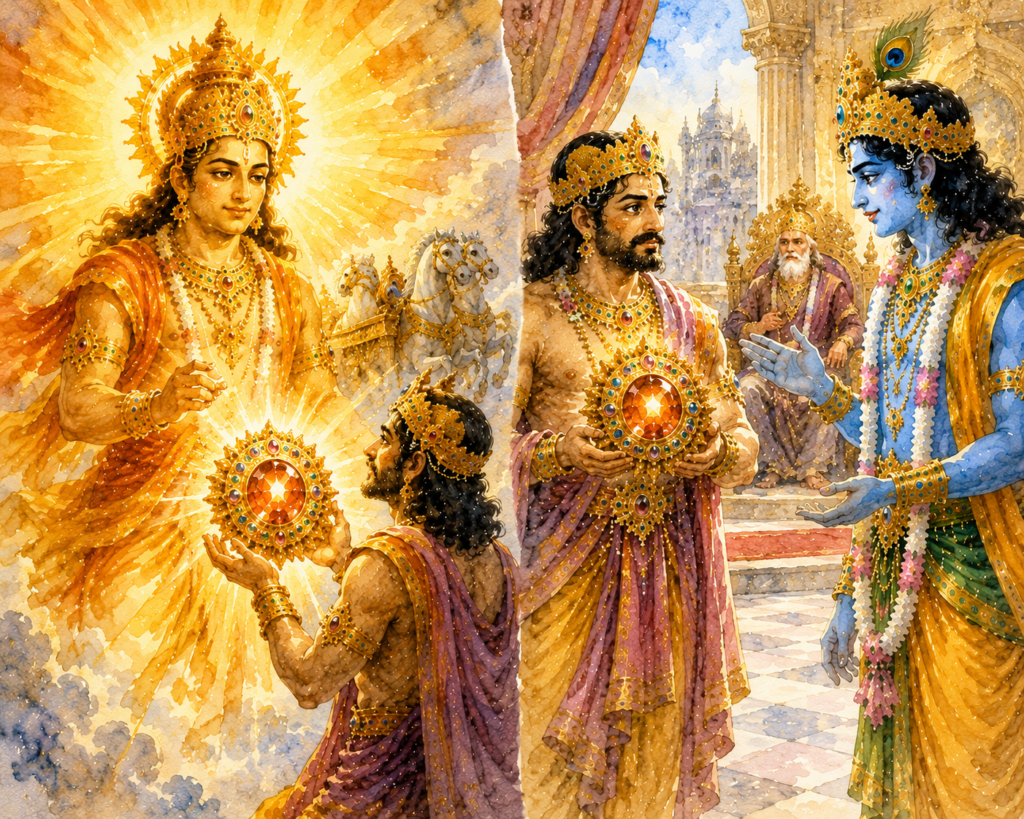
Satrajit was a devoted Yadava nobleman and the royal treasurer of Dwarka. His devotion to Surya, the Sun God, was so profound that Surya appeared before him one day and gifted him the Syamantaka mani — a gem of extraordinary power. It produced eight measures of gold every day for its keeper, protected them from calamity, and blazed with a very fierce light.
Krishna, the king of Dwarka, asked Satrajit to send the jewel to the elder Ugrasena for the benefit of the whole kingdom. Satrajit refused. He wanted it for himself. That refusal set in motion a chain of events that would change everything.
The Hunting Trip That Started It All
One day, Satrajit’s brother Prasena wore the Syamantaka mani and went out hunting in the forest. He never came back. A lion found him, killed him, and took the jewel. The lion was then killed by Jambavan (Jambavanta) — the divine bear king who had served Lord Rama in the Ramayana. Jambavan then took the gem to his cave and gave it to his young daughter as a toy to play with.
When Prasena did not return, Satrajit came to a quick to a conclusion. He thought that Krishna had coveted the jewel and must have killed Prasena to get it. He began to say so publicly, loudly, and repeatedly.
The accusation spread through Dwarka. Krishna, without a word of protest, simply went into the forest to find the truth.
Twenty-Eight Days in the Dark
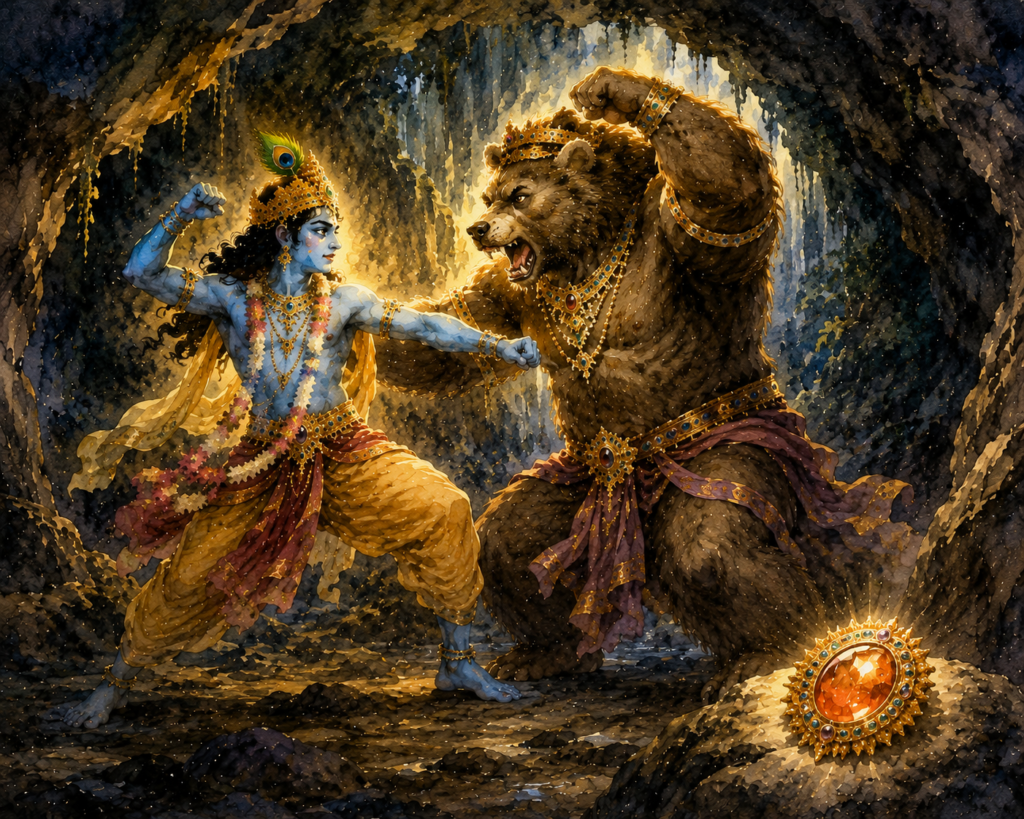
Krishna tracked the trail carefully — Prasena’s body, then the lion’s body, then the tracks leading to Jambavan’s cave. He entered the cave and found the jewel. But Jambavan, the great bear king who had once moved mountains for Rama, was not going to give it up without a fight.
What followed was one of the longest duels in all of Krishna’s stories. For twenty-eight days — without pause, without rest — Krishna and Jambavan fought in the darkness of that cave. Outside, Dwarka began to fear for the safety of Krishna.
Then, gradually, Jambavan began to feel something he had not felt since the Ramayana. This opponent was no ordinary being. The strength, the presence, the inexhaustible energy — it could only be one thing. He stopped fighting. He fell to his knees. Before him stood Vishnu himself, in a different form than the Rama he had loved and served, but unmistakably the same divine presence.
Overcome with joy and devotion, Jambavan surrendered the jewel — and offered Krishna his daughter Jambavati in marriage as well, as a mark of his devotion.
The Return and the Apology
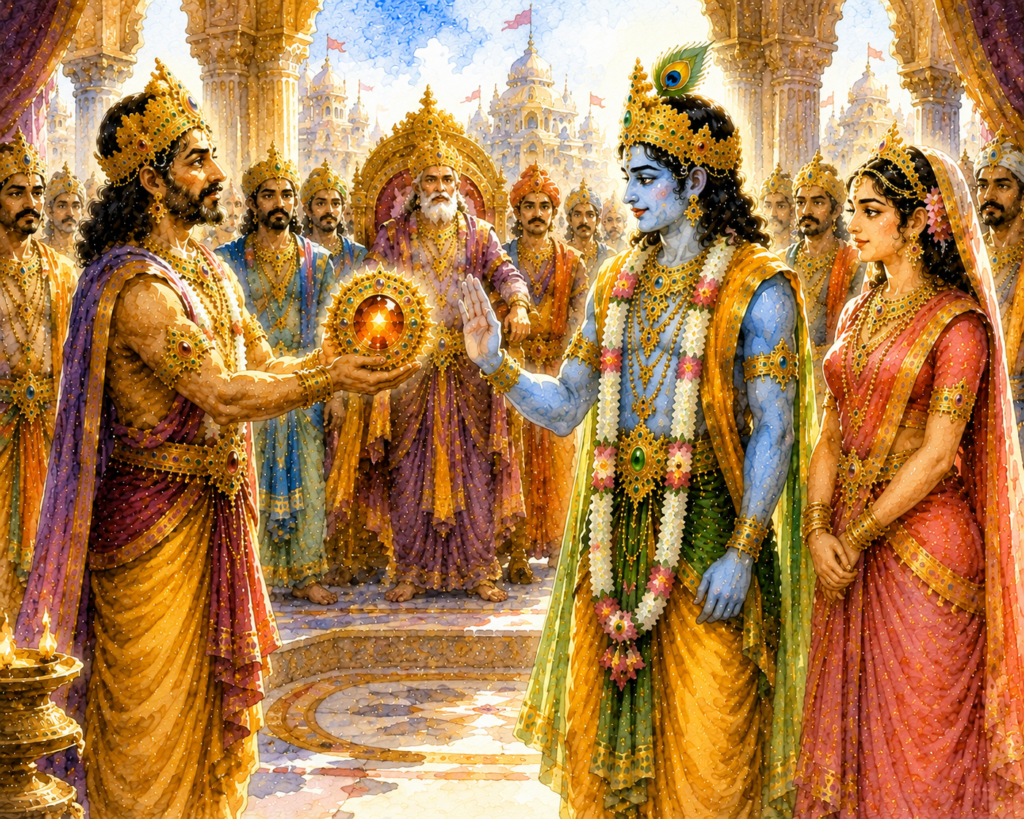
After 28 days inside the cave, Krishna finally returned to Dwarka carrying the Syamantaka Mani. By then, the entire kingdom had begun to fear the worst. Some believed Krishna had died. Others still believed the accusations against him. And then suddenly, he returned — alive, victorious, and carrying the very jewel he had supposedly stolen. The truth became impossible to deny.
Satrajit, who had publicly accused Krishna of murdering his own brother out of greed, now stood exposed before the whole kingdom. The shame of it was complete. But what I find interesting is that Krishna did not return angry or seeking revenge. He simply returned the jewel and cleared his name.
Realising the gravity of what he had done, Satrajit apologised to Krishna and offered him the Syamantaka Mani as restitution. But Krishna refused it. He had never wanted the jewel in the first place.
That moment says so much about Krishna’s character in this story. The entire kingdom had fought, suspected, and suffered over a jewel that Krishna himself had no desire to possess.
And then came the second offer. As a gesture of reconciliation and respect, Satrajit offered Krishna the hand of his daughter, Satyabhama. This time, Krishna accepted.
And that is how one of the most important relationships in Krishna mythology began — through a story filled with suspicion, destiny, pride, forgiveness, and truth finally revealing itself.
What This Story Tells Us
What stays with me most in this story is how Krishna reacted when he was falsely accused.
He didn’t get angry.
He didn’t stand there trying to prove himself to everyone.
He didn’t give long explanations.
He simply went and found the truth.
I don’t know why, but that part always feels incredibly powerful to me. Sometimes the strongest response is not arguing endlessly — it is quietly doing what needs to be done and letting truth speak for itself.
And then there’s the moment with Jambavan inside the cave.
Imagine fighting someone for 28 days in complete darkness, only to slowly realise you are standing before the same divine soul you once served as Rama in another lifetime. That moment of recognition feels so beautiful and emotional to me. It’s one of those moments in mythology that reminds you how deeply connected these stories are across generations and yugas.
Honestly, the story of Syamantaka mani has everything — mystery, pride, devotion, destiny, and redemption. But beneath all the drama, it also feels like a story about truth eventually revealing itself, no matter how deeply buried it becomes.
Continue the Satyabhama Series
Read more from this series:
- Satyabhama — The Warrior Queen of Krishna
- The Tulsi Leaf That Outweighed a Kingdom — what happened next in Satyabhama’s story
- The Battle Against Narakasura — Satyabhama’s greatest moment
Did the 28-day duel in the dark surprise you? Share this story with someone who loves Krishna mythology — and explore the full Satyabhama series on Fables n Tales.